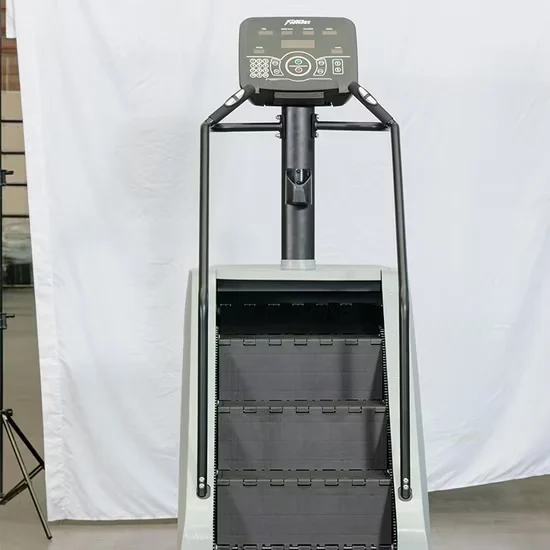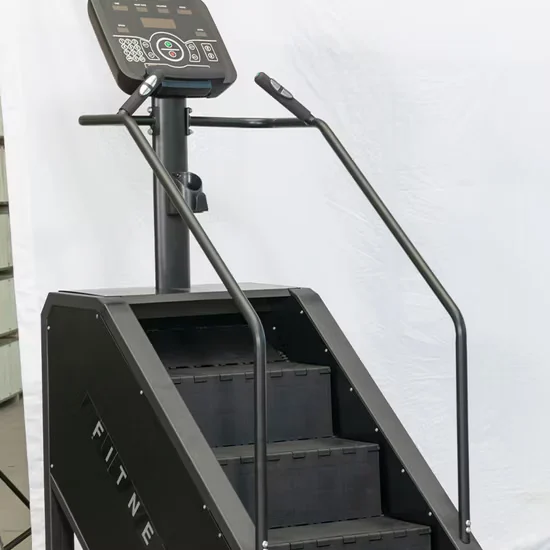
Sub-35dB Operation — sealed bearings and magnetic damping keep motor-drive stair climber noise below conversation level on hotel guest floors.
Technical Specifications
| Parameter | Value |
|---|---|
| Designation | SQ1017 |
| Product Type | Stair Climber |
| Drive Type | Motor Drive |
| Running Velocity | 15 – 164 steps/min |
| Step Area | 560 × 235 × 220 mm |
| Console Display (OSD) | Time, Climb, Calories, Steps, Heart Rate |
| Connectivity | IoT-enabled |
| Heart Rate | Contact sensors |
| Noise Level | Sub-35 dB |
| Mains Input | AC 220 V ±10 % / AC 110 V ±10 % |
| Product Dimensions | 1450 × 820 × 2080 mm |
| Net Weight | 148 kg |
| Foldable | No |
| Certification | CE |
Application Suitability
| Deployment Scenario | Typical Use |
|---|---|
| Hotel fitness center on guest room floors | 24-hour access with whisper-quiet motor operation so rooms above and beside stay undisturbed |
| Chain gym cardio zone | High-frequency uptime and IoT console analytics feeding facility management dashboards |
| Corporate wellness room | Low-maintenance motor-drive system running multiple short sessions per hour without thermal buildup |
| High-end residential home gym | Compact footprint with acoustic isolation for shared-wall apartments and multi-story villas |
| Sports performance training center | Heart-rate-accurate interval programming for athletic conditioning across variable step-rate zones |
What Peak Horsepower Hides About Continuous Duty in a Commercial Stair Climber Motor Drive Electric
Continuous output, not peak rating, determines whether the motor survives the third shift.
Facility managers learn the hard way: a motor rated for short bursts quits under continuous public facility run-times, and the replacement cycle begins before the first year closes. Light-duty motors pushed into twenty-hour gym schedules accumulate thermal stress that degrades windings and shortens bearing life. Noise complaints reach the front desk before maintenance ever opens a ticket, because guests hear the grinding before the motor finally trips its thermal cutoff [NEED_CITE: motor duty cycle classification for continuous commercial operation]. When the motor in a commercial stair climber motor drive electric unit is sized only for peak output, the entire cardio zone loses uptime and member confidence erodes with every out-of-order sign.
Positioning the Stair Climber in a Mixed-Cardio Floor Plan
The SQ1017 fills the vertical-loading slot in a cardio zone, pairing with treadmills for horizontal work and ellipticals for low-impact cross-training. Step-rate ranges from 15 to 164 steps per minute cover steady-state climbing through high-intensity interval blocks. The 560 mm step width accommodates users from light to heavy builds within the 180 kg commercial range. The IoT-enabled console logs climb count, heart rate, calories and session time, feeding usage data to facility management software for occupancy and retention analysis. Deploying this commercial stair climber motor drive electric unit beside rowing machines creates a push-pull conditioning circuit without duplicating movement patterns.
Continuous-Run Requirements and Deployment Environment
A hotel fitness center running twenty-two hours daily demands a motor duty cycle that never drops below rated output during back-to-back sessions. Sub-35 dB operation matters most on floors where guest rooms share ceiling plenums with the cardio zone; low-frequency vibration travels farther than airborne sound. The 2080 mm unit height requires clearance for overhead HVAC supply registers so motor cooling air is not starved during summer peaks. Dual-voltage input (AC 220 V / AC 110 V) eliminates plug-adapter failures, but the dedicated circuit must match the inrush current of the motor-drive system at startup. Data cabling from the IoT console to the facility network should be mapped before the unit is positioned, since moving a 148 kg machine after commissioning risks connector damage [NEED_CITE: EN 957 requirements for commercial cardio equipment].
Motor, Drive and Console Engineering Readouts
Motor-drive stair climbers use a variable-speed electric motor turning a sprocket or belt that pulls the step chain; the motor must sustain torque at low step rates without cogging. Continuous output rating matters more than peak because peak figures apply only to short sprints. Sealed bearings prevent sweat and cleaning chemicals from reaching the races, extending service intervals. The contact heart-rate sensors on the handlebars deliver readings stable enough for interval programming, though chest straps remain the reference for clinical accuracy. The OSD console surfaces five real-time metrics and passes session data through the IoT interface, avoiding the stranded-data problem that blinds operators to peak-hour usage. Steel-pipe frame construction dampens resonance that lighter tube sections amplify at mid-range step rates.
The Hidden Cost of Spec Compromise
Operators who accept a residential-grade motor in a commercial stair climber motor drive electric unit often face winding burnout within months of high-traffic deployment. Noise complaints cascade into guest compensation, and the capital saved at purchase is erased by replacement labor and reputation damage. Consoles lacking data interfaces leave usage patterns invisible, so underperforming time slots go unnoticed until membership churn shows up in quarterly reports. Voltage mismatches discovered after the container arrives force transformer retrofits that void warranty terms and delay opening [NEED_CITE: international voltage compatibility in commercial fitness equipment]. Skipping the 3D layout phase means the unit ends up against a load-bearing wall where vibration transmits to adjacent quiet zones.
Why This Product Line Earns the Floor Space
Sub-35 dB acoustic verification is run on every SQ1017 before crating, so hotel deployments start quiet and stay quiet. The 10,000-hour durability test covers motor windings, step chain tension and bearing seals under continuous load. The IoT console accepts custom UI skins through full OEM scoping, matching brand guidelines without third-party middleware. Six cardio series in one product family let a facility source every discipline from a single engineering platform, simplifying spare-parts stocking. Free 3D cardio-zone planning accounts for the SQ1017 footprint and sightline clearance so the unit faces entry sightlines rather than hiding in dead corners. Round-the-clock technical support responds to fault codes before a machine sits idle through a morning rush.
Documentation & Test Records
- CE declaration of conformity for SQ1017 motor-drive stair climber
- EN 957 safety and performance test report
- ISO 9001 manufacturing system certificate
- Noise level test record confirming sub-35 dB operation
- Motor and bearing durability log covering 10,000-hour run
- Console technical documentation with IoT data-interface spec sheet
Installation, Commissioning & Maintenance
- Allow 600 mm rear clearance for step-chain access and 900 mm side clearance for user entry
- Level the 1450 × 820 mm footprint with adjustable feet before anchoring to reduce frame resonance
- Connect to a dedicated circuit matching the AC 220 V or AC 110 V mains rating on the nameplate
- Run the console IoT setup wizard and verify data packets reach the facility management server
- Inspect step-chain tension and motor-belt alignment every three months under continuous commercial use
- Wipe handlebar heart-rate sensors daily with non-alcoholic cleaner to maintain contact conductivity
Equipment Selection and Inquiry Guidance
Share the cardio zone square footage and planned unit count to receive a 3D layout with airflow and sightline recommendations for the SQ1017. State the expected daily run-hours so the motor duty cycle can be matched to your traffic profile. Confirm the deployment floor and adjacent room types to validate sub-35 dB suitability. Specify target-market voltage and plug type before the proforma invoice stage. Indicate whether the IoT console must push data to an existing member app or facility dashboard.
Frequently Asked Questions
Q: What is the difference between motor continuous output and peak power in this commercial stair climber motor drive electric unit?
A: Continuous output is the power the motor can deliver indefinitely without thermal shutdown, measured under sustained load at rated step speed. Peak power applies only to short acceleration bursts. Commercial facilities running eighteen or more hours daily must match continuous output to expected member weight and step rate, because relying on peak figures leads to premature winding failure and unplanned downtime.
Q: How does motor-drive stair climber noise compare to other cardio equipment in hotel deployments?
A: Motor-drive stair climbers generate low-frequency vibration through the step chain and frame, which travels through floor slabs more readily than airborne noise from treadmills or fans. The SQ1017 sealed-bearing and reinforced-frame design keeps measured output below 35 dB, but deployment on guest-room floors still requires isolation pads and structural decoupling to prevent structure-borne transmission to occupied rooms below.
Q: Can the console sync with our facility management software or member apps?
A: The IoT-enabled console transmits session data through a documented interface that facility management platforms can ingest. Integration requires the console technical documentation package, which lists the data fields, packet structure and network requirements. Custom UI branding and metric selection are available through OEM scoping, letting operators match the member-app experience without modifying the hardware.
Q: What maintenance is required for motor-drive stair climbers in twenty-four-seven commercial use?
A: High-frequency deployment demands periodic step-chain tension checks, motor-belt alignment verification, and sealed-bearing inspection for contamination. Handlebar heart-rate sensors need daily cleaning to maintain signal accuracy. The console firmware should be updated when facility management software revisions change data-parsing rules. Scheduling these tasks quarterly prevents the unplanned outages that erode member trust.
Q: How do I plan the cardio zone layout to optimize airflow and sightlines for stair climbers?
A: The SQ1017 stands 2080 mm tall, so overhead HVAC supply must not discharge directly onto the user path. Positioning the unit on entry sightlines increases spontaneous usage. Side clearances of at least 900 mm allow safe mounting and dismounting. A 3D layout plan accounts for these dimensions alongside adjacent equipment spacing, ensuring air exchange rates meet the thermal output of the full cardio cluster.
![Commercial Stair Climber Machine for Home Gym Fitness [WARN] draft identifier mismatch](https://bicksport.com/wp-content/uploads/2026/08/commercial-stair-climber-machine-for-home-gym-fitness-warn-draft-identifier-mismatch-7b0cb3.webp)
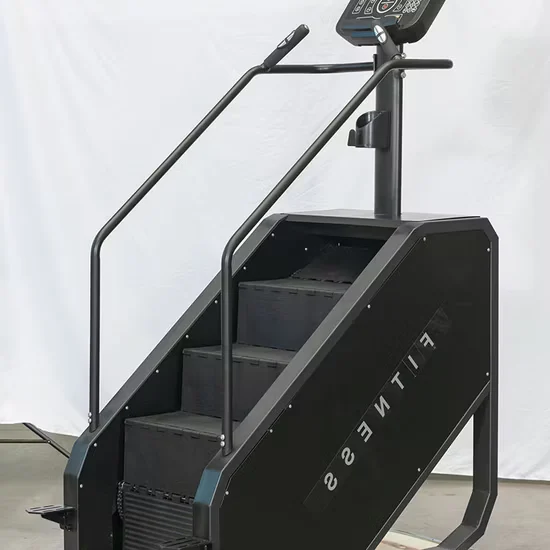
![Commercial Stair Machine for Fitness Clubs SQ1017 [WARN] draft identifier mismatch](https://bicksport.com/wp-content/uploads/2026/08/commercial-stair-machine-for-fitness-clubs-sq1017-warn-draft-identifier-mismatch-351157.webp)