
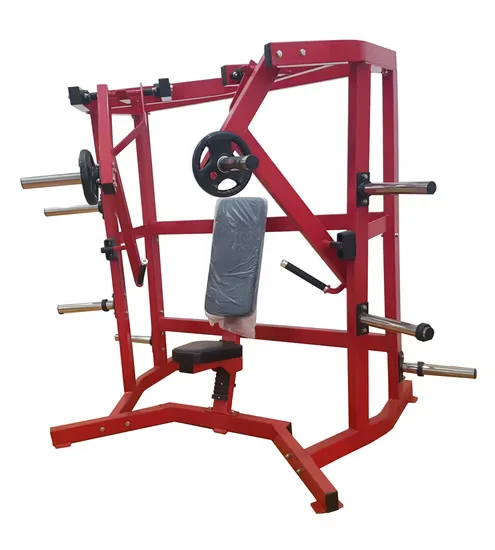
Heavy-Duty ISO-Lateral Design — Reinforced steel pivot mechanism tested for 10,000+ hours of continuous high-frequency operation in commercial gym environments.
Technical Specifications
| Parameter | Value |
|---|---|
| Product Type | Strength Machine (Chest Press) |
| Model NO. | OS-H0019 |
| Exercise Part | Chest |
| Material | Steel |
| Product Dimensions | 134319811761mm |
| Net Weight | 141kg |
| Maximum User Weight | 180kg |
| Age Group | Adult |
| Gender | Unisex |
| Appliance | Gymnasium |
| Certification | ISO 9001, CE |
| HS Code | 9506911900 |
| Production Capacity | 500 PCS/Month |
Application Suitability
| Deployment Scenario | Typical Use |
|---|---|
| International gym chain networks | High-frequency chest and upper-body zones requiring consistent resistance curves and minimal maintenance |
| Five-star hotel fitness centers | Strength training areas with 24-hour member access demanding durable, low-noise equipment |
| Corporate wellness rooms | Employee fitness facilities serving diverse populations with varying anthropometrics and training experience |
| Community fitness centers | Public access strength zones where equipment must withstand continuous rotation throughout operating hours |
| Sports performance training centers | Athlete conditioning areas requiring independent arm movement for balanced muscle development and injury rehabilitation |
Why Pivot Mechanics Matter More Than Stack Weight in Commercial Chest Training
Independent ISO-lateral arm movement eliminates compensatory patterns that fixed-bar machines cannot address.
When strength equipment enters a high-traffic facility, the first failure point is rarely the weight stack — it is the pivot mechanism. A commercial ISO-lateral wide chest press machine must maintain smooth resistance through thousands of repetitions daily, and imprecise pivot geometry causes uneven bearing wear that members feel as grinding or dead spots mid-repetition [NEED_CITE: bearing wear patterns in high-frequency commercial strength equipment]. I have seen fixed-bar chest units pulled from gym floors within months because the single-axis pivot could not accommodate different shoulder widths, forcing members into unnatural movement paths. The sealed bearings and precision pivot points on this unit are designed to prevent that exact failure sequence.
Positioning Within a High-Traffic Strength Zone
This commercial ISO-lateral wide chest press machine serves as the primary horizontal pushing station in a commercial strength layout. It pairs with a converging shoulder press and a pec deck to cover the full pressing and fly movement spectrum without redundancy. The independent arm design allows unilateral loading, which sports performance coaches use for rehabilitation protocols and muscle imbalance correction. The 180kg maximum user weight capacity and ergonomic seat adjustment range accommodate users from petite to heavily built, while multi-grip positions shift emphasis between sternal and clavicular fibers. This unit fits a deployment density where floor space must serve high member throughput without crowding adjacent equipment.
Continuous Operation and Facility Environment Requirements
A gym floor running from early morning to late evening subjects every pivot point and cable to sustained cycling. This unit is built for that duty cycle, with commercial-grade sealed bearings that resist contamination from chalk dust and sweat residue common in busy facilities [NEED_CITE: contamination impact on bearing lifespan in commercial gym environments]. The 141kg net weight and reinforced steel base provide stability without floor bolting on level surfaces, though vibration-dampening pads are recommended for installations above occupied floors. Proper spacing of at least 600mm on each side ensures safe loading and unloading without interfering with adjacent station users.
Interpreting the Steel Frame and Pivot Specifications
The 134319811761mm footprint reflects a frame geometry designed for full range-of-motion clearance rather than compact storage. Commercial strength equipment demands steel gauge and welding standards that survive lateral loading during heavy unilateral presses — a 180kg user pressing unevenly generates torque that light-commercial frames develop fatigue cracks around within the first year. The ISO-lateral mechanism decouples each arm so that resistance travels along a converging arc, matching the natural path of the pectoralis major through the pressing motion. Sealed bearings at each pivot reduce friction loss and eliminate the need for periodic lubrication that unsealed bushings require. Multi-grip handle positions alter wrist angle and shoulder rotation, reducing repetitive stress on members who train chest multiple sessions per week.
What Happens When Specifications Are Compromised
Facilities that source light-commercial chest presses for 24-hour gym floors typically face bearing replacement requests within the first quarter. The pivot mechanism loosens, resistance curves become inconsistent, and members abandon the station for cable crossovers that feel smoother. Noise from worn bushings carries across the weight floor and generates complaints in adjacent studio spaces [NEED_CITE: noise propagation from degraded pivot mechanisms in open-plan gym layouts]. When an entire order of under-specified units must be replaced, the downtime and member dissatisfaction far outweigh the initial savings.
Why This Product Line Fits Commercial Deployment
Every unit undergoes durability validation targeting 10,000+ hours of continuous high-frequency operation before leaving the factory. The ISO-lateral wide chest press machine is part of a complete six-series cardio and strength family, allowing facilities to source every discipline from a single manufacturing line with matched finish and build quality. OEM customization extends to frame color and logo placement, and each deployment receives a free 3D zone layout covering square footage, sightlines, and member flow specific to the floor plan provided. Technical support runs 24/7 with spare parts documentation available from day one of installation.
Documentation & Test Records
- CE declaration of conformity for commercial strength equipment deployment
- EN 957 test report covering static and dynamic load validation
- ISO 9001 certificate for manufacturing quality management systems
- Durability test record confirming pivot mechanism continuous operation hours
- Steel frame material specification and welding inspection report
- Installation guide with floor spacing and anchor recommendations
Installation, Commissioning & Maintenance
- Maintain minimum 600mm clearance on each side for safe plate loading around the 134319811761mm frame footprint
- Level the reinforced steel base on flat flooring with vibration pads if deployed above occupied rooms
- Inspect sealed bearings at each pivot quarterly for smooth rotation and contamination ingress
- Wipe multi-grip handles and seat contact surfaces daily to prevent sweat corrosion on steel components
- Verify seat adjustment mechanism locks securely across the full range after each cleaning cycle
Requesting a Deployment Assessment
Provide your strength zone floor area and planned equipment count to receive a 3D layout with member flow analysis. Specify daily operating hours so the duty cycle can be matched to appropriate bearing and pivot specifications. Confirm the deployment floor level and adjacent room usage to determine whether vibration isolation pads are necessary. State your target market so documentation and labeling meet regional compliance requirements.
Frequently Asked Questions
Q: What is ISO-lateral movement and why does it matter for chest training?
A: ISO-lateral design decouples each pressing arm so they move independently along a converging arc. This allows each side of the chest to work without the dominant side compensating for the weaker side, producing more balanced muscle development. It also enables unilateral loading for rehabilitation and muscle imbalance correction in athletic training programs.
Q: How does independent arm movement reduce injury risk compared to fixed-bar machines?
A: Fixed-bar machines lock both hands into a single path that may not match a user’s natural shoulder mechanics, creating stress on the rotator cuff during heavy presses. Independent arms allow each side to follow its own biomechanically comfortable trajectory, reducing joint strain and allowing users to stop one side if discomfort occurs without releasing the other.
Q: What maintenance is required for pivot points and bearings in high-traffic facilities?
A: Sealed bearings in this unit are designed to operate without periodic lubrication, resisting contamination from chalk dust and sweat. Quarterly visual inspections confirm smooth rotation and check for unusual noise. If grinding or play develops, bearing replacement is straightforward using the spare parts list provided with each unit at delivery.
Q: How do I verify a strength machine is built for 24/7 commercial use versus light-duty?
A: Request durability test records that document continuous operation hours under load. Check that pivot bearings are sealed rather than open bushings, confirm the frame steel gauge and welding standards, and verify the maximum user weight rating covers your facility’s member population. Commercial-grade units typically document 10,000+ hour testing protocols.

![Srh-73 Commercial Plate Loaded Adductor Machine for Gym Equipment [WARN] draft identifier mismatch](https://bicksport.com/wp-content/uploads/2026/08/srh-73-commercial-plate-loaded-adductor-machine-for-gym-equipment-warn-draft-identifier-mismatch-eb7332.webp)

![ISO Lateral Kneeling Leg Curl Machine H5028 Commercial Gym Equipment [WARN] draft identifier mismatch](https://bicksport.com/wp-content/uploads/2026/08/iso-lateral-kneeling-leg-curl-machine-h5028-commercial-gym-equipment-warn-draft-identifier-mismatch-d5dfa1.webp)