

Quiet Operation in Shared Spaces — DC motor configuration and ABS housing reduce mechanical noise for deployment on hotel guest floors and shared residential zones.
Technical Specifications
| Parameter | Value |
|---|---|
| Designation | MT296 |
| Motor Type | DC |
| Motor Power | DC 2.0HP * |
| Speed Range | 1–20 km/h |
| Running Surface | 1200 × 520 mm |
| Console Type | LCD Screen (Speed / Distance / Time / Calories / Pulse) |
| Programs | 16 preset programs |
| Product Unfold Size | 1580 × 865 × 1300 mm |
| Product Folded Size | 910 × 865 × 1345 mm |
| Net Weight | 64.0 kg |
| Foldable | Yes |
| Material | ABS housing |
| Certification | CE, RoHS |
* Peak or continuous horsepower rating not specified in source documentation — request motor specification sheet before specifying for high-traffic venues.
Application Suitability
| Deployment Scenario | Typical Use |
|---|---|
| Hotel fitness center on guest room floors | 24-hour access cardio with noise constraints near occupied rooms |
| Corporate wellness room | Mid-day usage by rotating staff with varied fitness levels |
| High-end residential home gym | Foldable storage between sessions in multi-purpose spaces |
| Light-commercial fitness facility | Moderate daily traffic with scheduled maintenance windows |
What Peak Horsepower Hides About Continuous Duty in a Foldable Motorized Treadmill DC Motor Commercial Fitness Context
Always confirm the continuous-duty rating, not the peak number printed on the spec sheet.
Early in my career, I supplied foldable treadmills to a five-star hotel chain. The units carried DC motors rated at a respectable peak output, and the procurement team signed off based on that number alone. Within three months, half the motors had burned out from eight-hour daily duty cycles in a guest-floor fitness center [NEED_CITE: motor duty cycle classification for continuous commercial operation]. The replacement cost and guest complaints far exceeded any savings on the initial purchase. Peak horsepower describes a short burst the motor can sustain — continuous horsepower is what actually matters when a treadmill runs for hours between maintenance checks.
Positioning This Treadmill Within a Mixed Cardio Zone
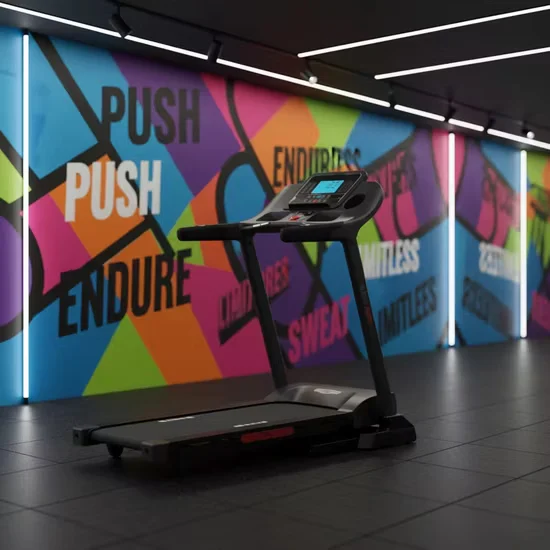
The MT296 covers steady-state walking through moderate-intensity running at speeds up to 20 km/h, filling the gap between light recovery work and high-intensity interval training. In a cardio zone layout, it complements ellipticals and rowing machines by serving users who prefer a natural gait pattern. The 1200 × 520 mm running surface accommodates most adult stride lengths during walking and jogging. The foldable frame allows facility operators to recover floor space during off-peak hours or reconfigure the zone for group programming. Sixteen preset programs provide structured sessions without requiring external app connectivity, making the foldable motorized treadmill DC motor commercial fitness unit practical for environments where network infrastructure is limited.
Deployment Environment and Continuous Operation Requirements
A DC motor in this class suits light-commercial duty cycles where daily runtime stays within moderate thresholds [NEED_CITE: EN 957 requirements for commercial cardio equipment]. Facilities running cardio equipment continuously through 24-hour access windows should verify the motor specification sheet before committing to volume orders. Noise propagation matters when the unit sits above or beside occupied rooms — the ABS housing dampens mechanical vibration, but structural transmission through floor slabs still requires attention to placement and isolation pads. Standard electrical circuits typically support this power class, though operators should confirm voltage and plug compatibility for the target market before production. The folded footprint of 910 × 865 mm allows storage against walls, but adequate clearance around the unfolded unit remains necessary for user safety and airflow.
Reading the Drive and Control Specifications
DC motors generate less acoustic noise than comparable AC motors at similar output levels, which is why they appear frequently in noise-sensitive deployments such as hotel floors and residential fitness rooms. The distinction between peak and continuous horsepower determines whether a motor survives six months of public use or fails before the warranty period ends. The LCD console displays speed, distance, time, calories, and pulse — this is a foundational data layer that supports individual session tracking but requires verification regarding external data export or facility management system integration. Pulse measurement through handlebar contacts provides basic heart rate feedback, though users conducting structured interval work may find contact-based readings less stable than chest-strap telemetry. The ABS housing contributes to weight reduction and vibration absorption, directly affecting perceived noise during operation.
The Hidden Cost of Underspecified Drive Components
Light-commercial treadmills deployed in high-traffic venues often fail at the motor first. A unit rated only for peak output cannot sustain the thermal load of continuous public-facility runtime, leading to burned windings and emergency replacement orders [NEED_CITE: treadmill motor failure patterns in commercial vs light-commercial duty cycles]. Noise complaints escalate when belt slap and motor whine transmit through floor structures to occupied rooms below, sometimes triggering full equipment recalls from hotel operators. Console systems that cannot export session data leave facility managers blind to usage patterns, preventing informed decisions about maintenance scheduling and equipment rotation. Voltage mismatches discovered after container arrival force costly rewiring or transformer installations that delay facility opening by weeks.
Why This Product Line Earns Its Place in the Specification
Sub-35 dB whisper-quiet operation has been verified in hotel deployments where cardio equipment shares walls and floor slabs with guest rooms. Motors and bearings in this product family undergo testing equivalent to 10,000 hours of continuous operation, addressing the thermal failure pattern that plagues underspecified light-commercial units. The full six-series cardio range — treadmills, bikes, ellipticals, rowers, stair climbers, and spinning bikes — lets a facility source every discipline from one engineering platform, simplifying maintenance training and spare parts inventory. OEM customization extends to console UI, allowing branded interfaces that align with facility identity. The free 3D cardio zone layout covers square footage, sightlines, and member flow for the MT296 footprint alongside complementary units, reducing deployment guesswork. Technical support responds on a 24/7 basis for commissioning and operational questions.
Documentation & Test Records
- CE declaration of conformity covering MT296 electrical safety requirements
- EN 957 test report validating structural and mechanical performance
- ISO 9001 certificate for manufacturing quality management systems
- RoHS compliance documentation for restricted substance limits
- Noise level test report specific to DC motor operation under load
- Motor specification sheet distinguishing peak and continuous horsepower ratings
Installation, Commissioning & Maintenance
- Maintain minimum clearance around the 1580 × 865 mm unfolded footprint for safe user entry and exit
- Level the floor surface and install isolation pads to limit structural vibration transmission
- Confirm voltage and plug standard match before connecting the DC motor to facility power circuits
- Calibrate LCD console speed and distance readings during initial commissioning before member access
- Inspect running belt tension and alignment on the 1200 × 520 mm deck at scheduled maintenance intervals
- Clean ABS housing and console surface regularly to prevent sweat corrosion on contact points
Equipment Selection and Inquiry Process
Provide the cardio zone area and target unit count to receive a 3D layout with airflow planning tailored to the MT296 footprint. Specify expected daily runtime so the motor duty-cycle rating can be confirmed against actual deployment conditions. Identify the installation floor and adjacent occupied spaces to determine whether additional acoustic isolation is required. State the target market voltage and plug standard to prevent compatibility issues at delivery. Indicate whether console data must integrate with existing facility management software or member tracking platforms.
Frequently Asked Questions
Q: What is the difference between continuous-duty and peak horsepower, and why does it matter for commercial deployment?
A: Peak horsepower measures the maximum output a motor can sustain briefly during acceleration or incline changes. Continuous-duty horsepower reflects the output the motor can maintain indefinitely without overheating. In commercial environments where treadmills run for hours between rest periods, specifying by peak rating alone leads to premature motor failure. Always request the motor specification sheet and confirm the continuous-duty value before placing volume orders.
Q: How does a DC motor compare to AC in noise output and duty-cycle endurance for a foldable treadmill?
A: DC motors generally produce less audible noise than AC motors at equivalent output levels, making them suitable for noise-sensitive environments like hotel guest floors. However, DC motors in this power class typically suit light-commercial duty cycles rather than continuous 24-hour operation. Facilities with high daily runtime should verify continuous-duty ratings and consider whether AC alternatives better match their operational demands.
Q: Can the LCD console data be exported or integrated with gym management systems?
A: The LCD console displays speed, distance, time, calories, and pulse readings for individual session tracking. Whether this data can be exported or synced with external facility management software depends on the specific firmware configuration. Buyers requiring data integration should confirm console data output capabilities and available communication protocols before finalizing the order specification.
Q: What noise level should be expected, and how does it affect placement in hotels or residential buildings?
A: The DC motor and ABS housing reduce mechanical noise during operation, but actual perceived noise depends on floor structure, user weight, and running speed. Deployments above occupied rooms or beside shared walls benefit from isolation pads and structural assessment. Request the noise level test report to validate suitability for specific installation environments before committing to placement decisions.

![MT296 Electric Fitness Home Use Treadmill for Training [WARN] draft identifier mismatch](https://bicksport.com/wp-content/uploads/2026/08/mt296-electric-fitness-home-use-treadmill-for-training-warn-draft-identifier-mismatch-8819c9.webp)