
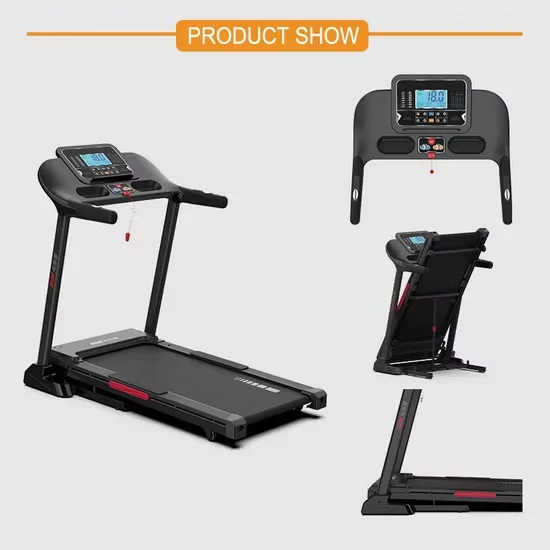
Whisper-Quiet Deployment — Foldable frame with sub-920 mm folded depth and DC motor architecture engineered for residential floors and space-constrained cardio zones.
Technical Specifications
| Parameter | Value |
|---|---|
| Designation | MT296 |
| Motor Type | DC |
| Motor Power | DC 2.0HP* |
| Speed Range | 1–20 km/h |
| Running Surface | 1200 x 520 mm |
| Console Type | LCD (Speed / Distance / Time / Calories / Pulse) |
| Programs | 16 |
| Heart Rate | Handgrip pulse sensors |
| Foldable | Yes |
| Product Unfold Size | 1580 x 865 x 1300 mm |
| Product Folded Size | 910 x 865 x 1345 mm |
| Net Weight | 64.0 kg |
| Material | ABS |
| Certification | CE, RoHS |
| OEM/ODM Custom | Available |
*Peak or continuous rating not specified in source — request motor specification sheet with thermal duty-cycle data before volume deployment.
Application Suitability
| Deployment Scenario | Typical Use |
|---|---|
| High-end residential home gym | Daily personal cardio with fold-away storage between sessions |
| Boutique personal training suite | Compact interval and steady-state programming for one-on-one coaching |
| Corporate wellness room | Multi-user light-duty cardio in shared multi-purpose spaces |
| Apartment building fitness room | Space-efficient treadmill deployment with noise-sensitive adjacent units |
| Hotel fitness center on guest room floors | 24-hour self-service cardio with foldable storage for housekeeping access |
Why Motor Duty Ratings Decide Whether a Foldable Treadmill Survives Its First Year in Shared Spaces
DC motor thermal limits under continuous load separate residential equipment from commercial-grade cardio.
Light-duty DC motors perform adequately during single-user home sessions, but shared residential fitness rooms and boutique studios often push daily run-times far beyond the original design envelope. When multiple users cycle through a single foldable motorized treadmill DC motor home use unit across a twelve-hour window, thermal accumulation inside the motor housing degrades insulation and eventually triggers shutdown or burnout [NEED_CITE: motor duty cycle classification for continuous commercial operation]. I have seen entire batches of treadmills replaced within a season because the procurement spec listed peak horsepower without verifying continuous-duty ratings against actual facility throughput.
Where This Foldable Treadmill Fits in a Multi-Discipline Cardio Layout
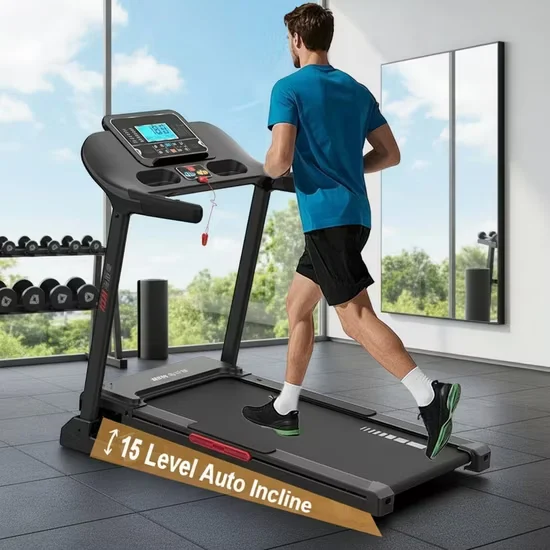
The MT296 occupies the steady-state and moderate-interval cardio slot, covering walking through 20 km/h running across a 1200 x 520 mm deck that accommodates most adult stride lengths. In a mixed cardio zone, this foldable motorized treadmill DC motor home use unit pairs naturally with ellipticals and rowing machines to distribute joint loading patterns across different movement planes. Its foldable frame allows placement against walls in multi-purpose rooms where the floor must clear for group classes. The handgrip pulse sensors and 16 pre-set programs support users who want structured workouts without external wearable integration.
Continuous Operation Thresholds and Deployment Environment Requirements
Facilities running this unit beyond four cumulative hours daily should verify motor thermal recovery intervals with the manufacturer before committing to volume orders. The foldable frame mechanism introduces a pivot joint that requires a level floor surface to prevent lateral drift during use, and a dedicated vibration-dampening mat is advisable on upper residential floors [NEED_CITE: vibration transmission standards for fitness equipment on suspended floors]. Power requirements must match destination market voltage before production, as plug and voltage mismatches discovered after container arrival create costly rework. The LCD console operates independently without network connectivity, which simplifies installation but means usage data remains on-device rather than feeding into facility management dashboards.
DC Motor Architecture, LCD Feedback, and the Foldable Frame Trade-Off
DC motors deliver lighter weight and lower initial cost compared to AC alternatives, making them practical for a 64 kg foldable unit that must be repositioned or stored regularly. The trade-off is thermal capacity: DC motors accumulate heat faster under sustained load, and the 2.0HP rating requires confirmation of whether it represents peak output or continuous duty. The LCD console displays speed, distance, time, calories, and pulse data across 16 programs, providing essential workout feedback without the complexity and failure points of touchscreen systems. Handgrip pulse sensors offer convenient casual monitoring, though users conducting structured HIIT sessions may find the reading stability insufficient for precise interval targets compared to chest-strap telemetry. The foldable mechanism reduces storage depth to under 920 mm, but the hinge joint inevitably introduces a degree of frame flex that rigid-frame commercial units avoid — an acceptable compromise for space-constrained deployments where daily folding is part of the operational routine.
The Hidden Cost of Underspecified Motor and Noise Ratings
Purchasing decisions based solely on peak horsepower and price per unit regularly lead to motor failures within the first high-throughput season, generating warranty claims that exceed the original savings. Noise complaints from adjacent rooms or floors frequently surface only after deployment, forcing facility operators to relocate or replace entire cardio zones at significant cost [NEED_CITE: noise transmission standards for fitness equipment in multi-story buildings]. When the motor specification sheet does not include thermal duty-cycle data, buyers have no basis to match equipment capability against expected daily usage volume. Heart rate monitoring that drifts during high-intensity efforts undermines programmed interval sessions, eroding member confidence in the facility’s equipment quality.
Why This Product Line Earns Repeat Deployment Orders
The sub-35dB operation verified across hotel installations addresses the most common complaint in upper-floor cardio deployments. Motors and bearings undergo 10,000-hour continuous-operation testing before production approval, providing a durability baseline that goes beyond standard compliance checks. The complete six-series cardio family allows facilities to source treadmills, bikes, ellipticals, rowers, stair climbers, and spinning bikes from a single engineering platform with consistent console interfaces. OEM customization extends to console UI, color, and logo, while the 3D cardio-zone layout service covers sightlines, airflow, and member traffic patterns — for the MT296 specifically, the foldable footprint and 865 mm width inform spacing calculations for wall-adjacent placement. Full technical support and spare parts availability operate around the clock across time zones.
Documentation & Test Records
- CE declaration of conformity for MT296 treadmill series
- EN 957 test report covering structural and safety requirements
- ISO 9001 manufacturing quality system certificate
- RoHS compliance documentation for electronic components
- Noise level test report with operating condition specifications
- Motor specification sheet with thermal duty-cycle data available on request
Installation, Commissioning & Maintenance
- Maintain minimum 600 mm clearance behind the unfolded 1580 mm frame length for safe user exit
- Place vibration-dampening mat beneath the 865 mm width footprint on upper-floor residential deployments
- Verify destination voltage and plug standard before production to match the DC motor power supply
- Calibrate belt tension and speed accuracy during initial commissioning before opening to users
- Inspect foldable hinge mechanism and lubricate pivot points at quarterly intervals under frequent folding use
- Clean LCD console surface and handgrip pulse sensors weekly to prevent sweat corrosion on contacts
Equipment Selection and Inquiry Process
Provide the cardio zone square footage and target equipment count to receive a 3D layout incorporating airflow planning and member traffic flow for the MT296 deployment. Specify expected daily usage hours per unit so the motor duty-cycle rating can be matched against actual throughput requirements. Indicate the deployment floor level and adjacent occupied spaces to confirm whether noise attenuation measures are necessary. State the destination market voltage and plug standard, and clarify whether console data export to facility management systems is required for your operation.
Frequently Asked Questions
Q: What is the difference between peak and continuous motor power on the MT296, and why does it matter?
A: Peak power represents the maximum output a DC motor can deliver in short bursts during acceleration or heavy load moments, while continuous power indicates what the motor sustains indefinitely without thermal degradation. For shared facilities where multiple users cycle through daily, continuous-duty rating determines whether the motor survives beyond its first season. Always request the motor specification sheet showing thermal duty-cycle data before committing to volume procurement.
Q: How does the DC motor in this treadmill compare to AC motors for long-term durability?
A: DC motors are lighter and more cost-effective, which suits a foldable 64 kg unit designed for repositioning. However, AC motors tolerate longer continuous run-times without thermal stress, making them standard in full-size commercial treadmills. For deployments exceeding four cumulative hours daily, verifying the DC motor’s continuous-duty rating against expected usage patterns is essential before ordering.
Q: Can the LCD console data be exported to facility management software?
A: The MT296 LCD console captures speed, distance, time, calories, and pulse metrics across 16 programs for individual session tracking. However, it does not include network connectivity or data export capability by default. Facilities requiring usage analytics integrated into management dashboards should specify console connectivity requirements during the OEM customization scoping phase.
Q: What noise level should buyers expect, and how does it affect shared-space deployment?
A: Noise output depends on motor type, belt speed, user weight, and floor surface. The MT296 DC motor architecture is inherently quieter than AC alternatives at moderate speeds, but upper-floor residential and hotel-adjacent deployments should request the noise level test report and plan vibration-dampening measures accordingly [NEED_CITE: acoustic measurement methodology for treadmill noise assessment].
Q: How does the foldable mechanism affect frame rigidity over time?
A: The folding hinge enables storage depth under 920 mm, a practical advantage in space-constrained rooms. The pivot joint introduces a structural discontinuity that rigid commercial frames avoid, meaning slight lateral flex may develop with heavy daily use. Quarterly inspection of the hinge hardware and pivot lubrication maintains structural integrity across the equipment lifecycle.

![Mt296 Impact Resistant Electric Treadmill for Bedroom Workout [WARN] draft identifier mismatch](https://bicksport.com/wp-content/uploads/2026/08/mt296-impact-resistant-electric-treadmill-for-bedroom-workout-warn-draft-identifier-mismatch-f8efd8.webp)
