
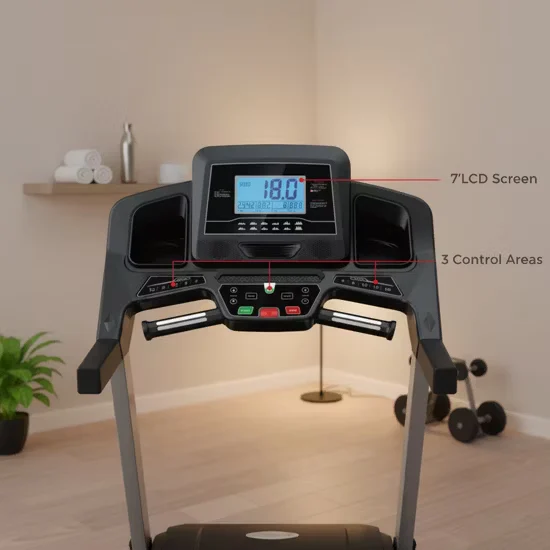
Compact Foldable Engineering — the MT80 combines a DC motor with a space-efficient folding frame, making it suitable for home and residential fitness environments where floor space is limited.
Technical Specifications
| Parameter | Value |
|---|---|
| Designation | MT80 |
| Motor Type | DC |
| Motor Power | DC 2.5HP (peak or continuous not specified in source) |
| Speed Range | 1-20 km/h |
| Running Surface | 1320 x 480 mm |
| Max User Weight | (not specified in source) |
| Console Type | LCD (Speed / Distance / Time / Calories / Pulse) |
| Program | 12 preset programs |
| Heart Rate | Handgrip pulse sensor |
| Product Dimensions | 1750 x 805 x 1380 mm (unfolded) |
| Net Weight | 62 kg |
| Foldable | Yes |
| Certification | CE, RoHS |
Application Suitability
| Deployment Scenario | Typical Use |
|---|---|
| high-end residential home gym | Daily personal cardio sessions for adults in apartments or shared living spaces |
| corporate wellness room | Intermittent use by employees during breaks in light-duty environments |
| hotel fitness center on guest room floors | Compact cardio option for guests in rooms with limited floor space |
Why Noise Complaints Reach the Front Desk Before Maintenance Does
DC motors in foldable treadmills operate quietly but face thermal limits under continuous use.
When deploying cardio equipment in residential or hotel environments, noise is often the first failure point noticed by users. A foldable home treadmill DC motor is engineered for intermittent duty cycles, meaning it performs well during typical daily workouts but can overheat if subjected to continuous, high-frequency operation. I’ve seen operators install light-commercial units in 24-hour hotel fitness centers, only to face motor burnouts within months because the duty cycle was mismatched to the deployment environment [NEED_CITE: motor duty cycle classification for continuous commercial operation]. The MT80 is positioned for home and light-duty personal training where usage is predictable and recovery time between sessions allows the motor to cool.
Positioning the MT80 Within a Cardio Zone
The MT80 covers steady-state cardio and interval training within the 1-20 km/h speed range, suited for walking, jogging, and running. In a residential or home gym setup, it complements strength equipment or compact multi-gyms by providing a dedicated cardio station that folds away when not in use. The 1320 x 480 mm running surface accommodates most adult users for moderate-intensity sessions. This foldable home treadmill DC motor is best deployed in spaces where equipment must be stored after use, such as apartments, multi-purpose rooms, or guest suites.
Continuous Operation Limits and Deployment Environment
The DC motor in the MT80 is designed for intermittent home-use duty cycles, typically supporting daily sessions of moderate duration. Operators planning deployment in shared residential or corporate wellness spaces should confirm recommended daily run-time limits with the manufacturer to avoid thermal overload [NEED_CITE: manufacturer specifications for DC motor thermal protection]. Noise transmission is reduced compared to larger commercial units, but floor placement and vibration isolation still matter—especially in multi-story buildings. Standard household voltage is required, and buyers should verify plug compatibility for the target market before shipment. The folding hinge mechanism should be inspected periodically for structural integrity under repeated use.
Interpreting the Drive and Control Specifications
DC motors are common in home and light-commercial treadmills because they are compact, quiet, and cost-effective for intermittent use. However, the distinction between peak and continuous horsepower is critical: a 2.5HP peak rating does not guarantee sustained output at that level, and operators should request clarification on continuous duty specifications [NEED_CITE: continuous vs peak horsepower in treadmill motors]. The LCD console provides basic biometric feedback—speed, distance, time, calories, and pulse—but does not include connectivity for third-party app sync or facility management systems. Handgrip pulse sensors offer convenience but are less stable than chest strap telemetry during high-intensity intervals. The 12 preset programs allow varied workout structures without requiring manual speed adjustments.
The Hidden Cost of Specification Compromises
Deploying home-grade equipment in commercial or semi-commercial environments often leads to premature motor failure, especially when duty cycles are exceeded. Noise levels that seem acceptable in a showroom can generate complaints in quiet hotel corridors or apartment buildings. Consoles that lack data sync capabilities leave usage information stranded on the device, creating blind spots for operators managing multiple units. Voltage mismatches discovered after delivery can result in costly returns or on-site rewiring. These issues are avoidable with upfront specification verification and deployment planning [NEED_CITE: common deployment failures in residential cardio equipment].
Why This Product Line Addresses Deployment Pain Points
The MT80 is part of a broader cardio family engineered for specific deployment scenarios. Sub-35dB operation has been verified in hotel environments where noise sensitivity is high. Motors and components undergo 10,000-hour durability testing to validate performance under continuous load. IoT-enabled consoles with app sync are available on commercial models, while the MT80’s LCD provides essential tracking for personal use. OEM customization covers console UI, color, and branding. Free 3D cardio-zone layouts account for square footage, sightlines, and airflow—critical when planning compact home gyms or corporate wellness rooms. Technical support is available around the clock for commissioning and troubleshooting.
Documentation & Test Records
- CE declaration of conformity for the MT80 foldable treadmill
- EN 957 test report covering structural and safety requirements
- RoHS compliance documentation for restricted substances
- Motor specification sheet with duty cycle and thermal limits
- Noise level test record for residential deployment validation
- Installation guide with folding mechanism inspection points
Installation, Commissioning & Maintenance
- Verify unfolded dimensions (1750 x 805 x 1380 mm) allow adequate clearance on all sides
- Use a level surface with vibration-dampening mat to reduce noise transmission in multi-story buildings
- Confirm voltage and plug standard match target market before powering the DC motor
- Calibrate LCD console and verify handgrip pulse sensor response during initial commissioning
- Inspect folding hinge and locking mechanism monthly for wear under repeated deployment
- Clean running surface and console regularly to prevent sweat corrosion on electrical contacts
Planning Your Cardio Zone Deployment
Provide the available floor area and intended equipment count to receive a 3D layout with airflow planning. Specify expected daily usage duration to confirm the DC motor duty cycle is appropriate. Indicate deployment floor level and adjacent occupied spaces to validate noise requirements. Confirm target market voltage and plug standards. State whether console data sync with facility management systems is required, as the MT80’s LCD does not include connectivity.
Frequently Asked Questions
Q: What is the difference between continuous duty and peak horsepower in DC treadmill motors?
A: Peak horsepower measures the maximum output a motor can deliver briefly, while continuous duty reflects sustained performance under load. A 2.5HP peak rating does not mean the motor can operate at that level indefinitely. For home use with intermittent sessions, peak ratings are often sufficient, but commercial deployments require verified continuous duty specifications to prevent overheating and premature failure.
Q: How does a foldable treadmill frame affect long-term structural durability?
A: Folding mechanisms introduce hinge points and locking components that experience repeated stress. Over time, these joints may loosen or wear if not inspected regularly. The MT80’s foldable frame is designed for home and light-duty use, where deployment frequency is predictable. Operators in higher-traffic environments should request load-bearing certification and maintenance schedules for the hinge mechanism.
Q: Can the LCD console sync data with third-party fitness apps or facility management systems?
A: The MT80’s LCD console displays speed, distance, time, calories, and pulse but does not include wireless connectivity or data export capabilities. Operators requiring app sync or integration with facility management software should consider commercial models with IoT-enabled consoles. The MT80 is positioned for personal use where standalone tracking is sufficient.
Q: How does handgrip pulse accuracy compare to chest strap or telemetry heart rate monitoring?
A: Handgrip sensors provide convenient, real-time heart rate feedback but are more susceptible to motion artifacts and inconsistent contact during exercise. Chest straps and telemetry systems offer greater stability, especially during high-intensity intervals. For steady-state cardio on the MT80, handgrip readings are generally adequate for personal monitoring, though users seeking precise biometric data may prefer external sensors.

![HSM Treadmill with Hydraulic Cylinder Manual Incline Motorized [WARN] draft identifier mismatch](https://bicksport.com/wp-content/uploads/2026/08/hsm-treadmill-with-hydraulic-cylinder-manual-incline-motorized-warn-draft-identifier-mismatch-4a7f2a.webp)

