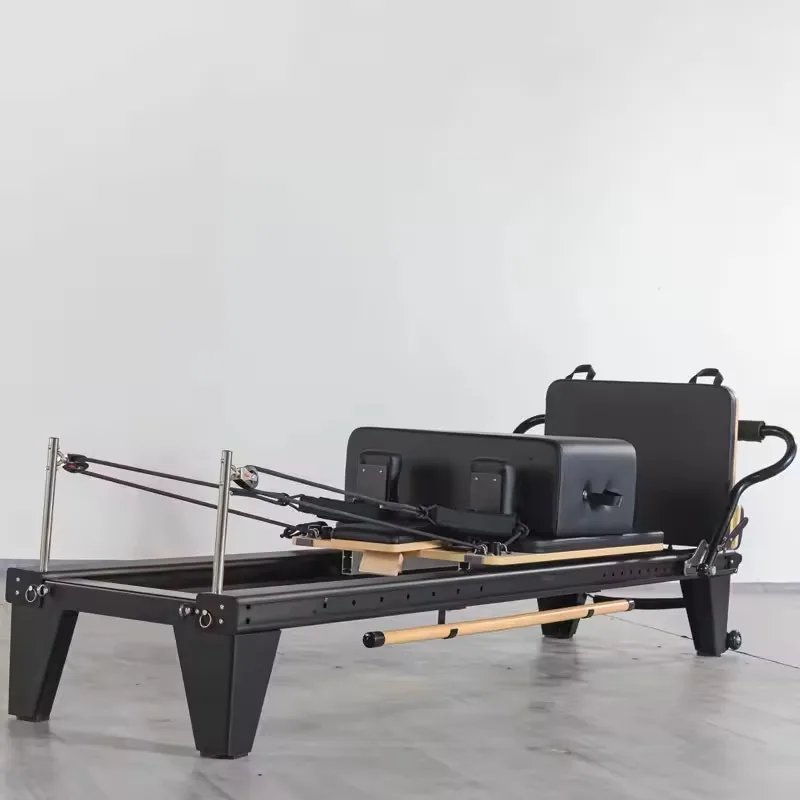
Natural Vibration Dampening — maple-core construction absorbs spring oscillation energy before it reaches the floor slab, protecting occupied rooms below from structure-borne resonance.
Technical Specifications
| Parameter | Value |
|---|---|
| Designation | SRY-02 |
| Product Type | Pilates Reformer |
| Frame Material | Maple Wood Core |
| Dimensions | 2460 × 730 × 680 mm |
| Net Weight | 100 kg |
| Included Accessories | Long Box, Jump Board, Platform |
| Color | Solid Color |
| User Profile | Adult, Unisex |
| OEM Logo | Customized Is Allowed |
| Warranty | 3 Years |
| Origin | China |
| HS Code | 9506911900 |
Application Suitability
| Deployment Scenario | Typical Use |
|---|---|
| Boutique Pilates studio group reformer rooms | Brand-matched aesthetic installations with full accessory kits for varied class programming |
| Five-star hotel wellness floors above guest rooms | Low-vibration core and flexibility training where structure-borne noise must be minimized |
| Rehabilitation and physiotherapy clinics | Stable, low-resistance platform for post-injury core stabilization and controlled range-of-motion work |
| High-end residential home gyms | Compact multi-discipline training station for daily core conditioning and plyometric sequences |
| Professional athlete training facilities | Loaded jump-board plyometrics and sport-specific core programming on an inertially stable chassis |
Why Spring Resonance Travels Through Floors Before the Studio Owner Notices
Maple wood core frames absorb vibration at the source instead of transmitting it into the building structure.
Steel-only reformers conduct spring oscillation directly through their rigid chassis into floor slabs, where it propagates as low-frequency structure-borne noise. Hotel operators discover this only after guests in rooms below file complaints about rhythmic thumping during morning classes [NEED_CITE: structure-borne vibration transmission in steel-frame fitness equipment on suspended concrete slabs]. The commercial Pilates reformer maple wood frame approach uses the natural cellulose structure of maple to dissipate that oscillation energy internally, reducing what reaches the floor. Facility managers who specify equipment for upper-floor wellness spaces often learn the acoustic difference the hard way — after the first round of noise complaints.
Where This Reformer Fits in a Studio or Wellness Floor Layout
The SRY-02 covers core stabilization, loaded stepping, and low-impact plyometric work on a single 2460 × 730 mm footprint, reducing the need for separate jump platforms or stepping stations. In a multi-unit reformer room, the accessory ecosystem — long box for supine series, jump board for plyometric sequences, platform for standing work — lets instructors program full-spectrum classes without participants moving between machines. The 100 kg net mass provides inertial anchoring during dynamic jump-board exercises, preventing chassis drift on non-bolted installations. A commercial Pilates reformer maple wood frame suits spaces where visual warmth and acoustic performance matter equally, typically placed in rooms directly above occupied zones.
Continuous Scheduling Demands and Deployment Environment Considerations
A studio running back-to-back group classes subjects reformer springs and carriage rollers to sustained loading cycles with minimal cool-down between sessions [NEED_CITE: duty cycle expectations for commercial Pilates equipment in group-class environments]. Maple-core frames handle this continuous cycling without the metallic fatigue resonance that develops in thin-gauge steel frames over extended use. Deployment on suspended floors benefits from the wood core’s inherent dampening, but installers must still ensure level subflooring to prevent carriage drift under load. Ventilation requirements are modest since there is no motor or electronics generating heat, though climate-controlled environments protect the maple from humidity-driven dimensional change. Power is not required, simplifying placement in rooms without dedicated circuits.
How Maple Core, Spring Gradient, and Accessory Load Ratings Interact
Maple wood’s fiber structure provides internal friction that dissipates vibrational energy, a mechanical property that steel lacks without added dampening layers. The spring resistance system delivers progressive loading — lighter springs for rehabilitation and foundational activation, heavier springs for athletic conditioning — and the maple frame’s rigidity ensures that resistance remains consistent across the full carriage travel range [NEED_CITE: spring resistance progression standards for commercial Pilates reformers]. The jump board attachment must handle repeated dynamic loading from plyometric sequences; its load rating and mounting interface are engineered for the inertial mass of the 100 kg chassis to absorb impact without shifting. The solid-color finish on the maple core protects against sweat and humidity while accepting OEM logo placement for brand-cohesive studio environments.
The Cost of Specifying Steel When Acoustics Matter
Facilities that choose all-steel reformers for upper-floor studios often face a pattern: initial installation proceeds smoothly, then within weeks the complaints begin from tenants or guests below who hear rhythmic spring resonance during peak class hours. The typical response — adding aftermarket rubber isolation pads — addresses floor contact but not the mid-frequency oscillation traveling through the frame itself [NEED_CITE: effectiveness of aftermarket vibration isolation for fitness equipment on suspended floors]. Studios then face the decision of either relocating the entire reformer zone to a ground-floor space or replacing the fleet with acoustically appropriate equipment. Either path costs significantly more than specifying the correct frame material during initial procurement.
What Sets This Product Line Apart for Facility Deployment
The maple-core frame construction is verified in hotel wellness floor deployments where sub-floor noise is a contractual concern. Every unit undergoes spring resistance gradient testing to ensure consistent progression across the full range. The complete accessory kit — long box, jump board, platform — ships with each chassis, eliminating aftermarket sourcing and fit-check delays. OEM customization covers logo placement and color matching, supporting brand integration across multi-site studio networks. Free 3D reformer room layout planning accounts for the 2460 mm carriage travel length plus instructor clearance on all sides, ensuring safe class flow without wasted square footage. Technical support is available around the clock for installation and commissioning questions.
Documentation & Test Records
- CE declaration of conformity for the SRY-02 Pilates reformer platform
- EN 957 test report covering structural integrity and load-bearing verification
- ISO 9001 certificate for the manufacturing quality management system
- Spring resistance gradient documentation with progression rates per spring
- Jump board dynamic load-rating test report for plyometric exercise sequences
- OEM logo placement proof with Pantone color-match confirmation
Installation, Commissioning & Maintenance
- Allow minimum 600 mm clearance on all sides of the 2460 × 730 mm footprint for safe carriage travel and accessory swaps
- Verify subfloor levelness before placement to prevent carriage drift during loaded exercises
- No electrical circuit required; position away from direct sunlight and HVAC vents to protect maple from dimensional change
- Inspect spring tension and carriage roller alignment after the first 200 hours of use, then quarterly
- Wipe maple surfaces with a damp cloth after each session; avoid chemical cleaners that degrade the solid-color finish
- Check jump board mounting hardware monthly for secure attachment under repeated dynamic loading
Planning Your Reformer Room Procurement
Provide your reformer studio dimensions and unit count to receive a 3D layout covering equipment spacing, instructor circulation paths, and accessory storage zones. Specify whether the room sits on a suspended floor above occupied spaces so the acoustic advantages of the maple-core frame can be fully leveraged in the deployment plan. Confirm target market requirements for wood treatment certifications if applicable. Indicate whether OEM logo customization and Pantone color matching are needed to align with your studio brand guidelines.
Frequently Asked Questions
Q: How does the maple wood core frame compare to steel for vibration control in upper-floor studios?
A: Maple’s natural cellulose fiber structure absorbs spring oscillation energy internally rather than conducting it through the chassis into the floor slab. In hotel wellness floors and shared residential buildings, this reduces the structure-borne noise that triggers complaints from occupants in rooms below. Steel frames transmit vibration directly unless supplemented with aftermarket isolation systems that rarely address mid-frequency resonance.
Q: How should spring resistance be matched to different client populations in a mixed-use studio?
A: Lighter springs suit rehabilitation clients and beginners working on foundational core activation with controlled range of motion. Heavier springs serve athletic conditioning programs requiring loaded resistance through full carriage travel. The progressive spring set included with each unit allows instructors to match resistance to individual client needs within the same class without equipment swaps.
Q: What dynamic exercises does the jump board safely support given the chassis weight?
A: The 100 kg chassis mass provides sufficient inertial stability for standard plyometric sequences including repetitive jumps, lateral bounds, and single-leg takeoffs on the jump board without the frame shifting on the floor. Dynamic exercises should follow the load-rating specifications in the included documentation to ensure safe operation across user weight ranges.
Q: What OEM customization is available for multi-site studio networks requiring brand consistency?
A: Logo placement on the maple frame and carriage upholstery, Pantone-matched solid-color finishes, and coordinated accessory kit colors are all available for OEM orders. This allows multi-site operators to maintain visual brand identity across locations without aftermarket refinishing, and each customization is verified with a production proof before manufacturing proceeds.
Q: What clearance and spacing does the reformer require for safe group class operation?
A: Each unit needs the full 2460 mm length for carriage travel plus minimum 600 mm on all sides for instructor access and accessory swaps like the long box and platform. In group configurations, side-by-side spacing should account for lateral movements during standing series exercises. A 3D layout plan ensures safe participant flow without wasted floor area.