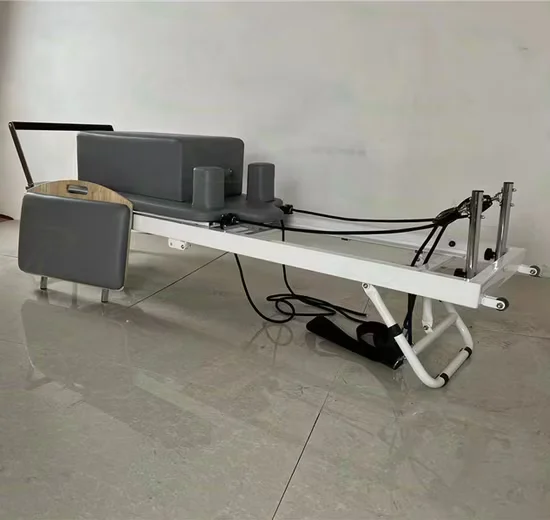
10,000-Hour Endurance Validated — Every SRY-02 frame and spring assembly undergoes continuous high-frequency cycle testing to verify structural integrity under studio-class daily operation.
Technical Specifications
| Parameter | Value |
|---|---|
| Designation | SRY-02 |
| Product Type | Pilates Cadillac / Pilates Reformer |
| Product Dimensions | 2460 × 730 × 680 mm |
| Net Weight | 100 kg |
| Frame Construction | Reinforced steel |
| Resistance Type | Spring-based |
| Accessories | Long Box / Jump Board / Platform |
| Color | Solid Color (customizable options available) |
| Logo | Customization available |
| Max User Weight | 180 kg |
| Age Group | Adult |
| Gender | Unisex |
| Warranty | 3 Years |
| Certification | CE, ISO 9001 |
| Production Capacity | 80 Pieces/Month |
| HS Code | 9506911900 |
Application Suitability
| Deployment Scenario | Typical Use |
|---|---|
| Pilates studio networks | Standardized reformer fleets across multi-location group class schedules |
| Fitness center Pilates zones | High-frequency class rotations with quick accessory changeovers between sessions |
| Rehabilitation and physical therapy facilities | Adjustable spring resistance for progressive patient recovery protocols |
| High-end residential home gyms | Durable reformer for daily personal use with full movement repertoire |
| Corporate wellness centers | Compact footprint reformer for employee movement and flexibility programs |
Why Springs Fatigue Long Before the Frame Shows Wear
Spring replacement intervals define the true operating cost of any commercial Pilates Cadillac reformer equipment.
In studio environments running six or more classes daily, the spring resistance system endures thousands of extension and compression cycles each week. Consumer-grade springs lose their calibrated tension noticeably within months, producing uneven resistance that instructors feel immediately during assisted movements. When a reformer’s spring set drifts from its original specification, the entire resistance curve becomes unreliable — light settings feel too heavy, and heavy settings fail to provide adequate load for advanced practitioners [NEED_CITE: spring fatigue testing standards for commercial resistance equipment]. Facility operators then face a choice between frequent full-set replacements or accepting degraded performance that generates member complaints.
Positioning the Reformer Within a Studio Equipment Matrix
The SRY-02 Pilates Cadillac / Pilates Reformer covers the full resistance spectrum from rehabilitation-grade light tension through advanced athletic loading, accommodating practitioners across the complete experience range. In a studio equipment plan, this unit anchors the reformer zone while complementing Cadillac tower attachments for vertical movement patterns and Wunda chairs for isolated limb work. The 2460 mm footprint requires standard studio spacing allowances, and the reinforced steel frame handles back-to-back class scheduling without structural fatigue. The spring resistance system delivers smooth progression across levels, allowing instructors to program flowing sequences without abrupt resistance jumps between movements. Users from petite to large body frames find stable support within the 180 kg capacity rating.
Continuous Class Scheduling and Facility Environment Requirements
A studio running consecutive classes from early morning through evening places cumulative load demands on every spring, carriage roller, and attachment point throughout the operating day [NEED_CITE: duty cycle expectations for commercial studio equipment]. The SRY-02’s reinforced steel frame and sealed bearing carriage maintain alignment under this sustained use, but facility ventilation remains essential — elevated room temperatures accelerate spring metal fatigue and degrade rubber stop components over time. Ground-level installation avoids floor-loading concerns, while upper-floor studios should verify structural capacity for the 100 kg unit weight plus dynamic user loading during jump board exercises. Adequate clearance around all four sides allows safe entry and exit during group class transitions, and rubber flooring beneath the unit dampens carriage return noise during rapid directional changes.
Spring Resistance Mechanics and Frame Engineering
The spring-based resistance system operates on a straightforward physical principle: extension springs store and release energy proportional to their coil diameter, wire gauge, and number of active coils. Heavier-gauge springs deliver higher resistance per unit of extension but require more force to initiate movement, which is why the SRY-02 includes multiple spring weight options for progressive loading. The reinforced steel frame provides a rigid anchor structure that prevents lateral flex during asymmetrical movements — when a practitioner performs single-leg work at high resistance, the frame must resist torsional deflection that would otherwise cause the carriage to track off-center. The 2460 mm length accommodates full-body extension for taller users while the carriage travel range supports complete limb extension patterns. Long Box, Jump Board, and Platform accessories attach to standardized mounting points, each engineered for repeated attachment and removal cycles without fastener wear.
The Hidden Cost of Underspecified Components
Consumer-grade reformers deployed in commercial studios routinely develop carriage wobble, spring tension drift, and frame joint looseness within the first year of high-frequency use [NEED_CITE: failure mode analysis for light-commercial versus commercial equipment]. When springs lose calibration, instructors compensate by modifying exercise cues rather than addressing the equipment deficit, and experienced members notice the inconsistency immediately. Carriage tracking issues accelerate roller wear unevenly, eventually requiring complete carriage rebuilds that pull units offline for days. Facilities that initially saved on equipment cost face cumulative maintenance expenses that surpass the price differential of commercial-spec reformers well before the end of a standard depreciation cycle.
What This Product Line Delivers for Facility Buyers
Every SRY-02 unit undergoes frame load testing and spring calibration verification before leaving the production line, ensuring that resistance levels match specification sheets upon delivery. The 10,000-hour durability testing protocol extends to carriage rollers, spring attachment hardware, and accessory mounting points — the components most vulnerable to high-frequency class scheduling. Customization extends beyond color and logo: console accessories and facility-matched finishes support brand consistency across multi-location studio networks. The 3D layout and airflow planning service addresses reformer placement within the broader studio zone, accounting for sightlines, instructor circulation paths, and HVAC airflow patterns that affect both practitioner comfort and component longevity. Full documentation packages accompany each shipment, and 24/7 technical support covers commissioning questions and field troubleshooting.
Documentation & Test Records
- CE declaration of conformity for SRY-02 structural and material compliance
- EN 957 test report covering frame load capacity and safety requirements
- ISO 9001 certificate verifying manufacturing quality management processes
- Spring resistance calibration and fatigue cycle test records
- Frame structural load testing documentation for 180 kg user capacity
- Accessory mounting point durability and quick-change mechanism test data
Installation, Commissioning & Maintenance
- Verify floor levelness within tolerance across the full 2460 × 730 mm footprint before anchoring
- Maintain minimum clearance on all sides for safe group class entry and exit patterns
- Calibrate spring resistance levels against specification chart during initial commissioning
- Inspect carriage roller alignment and tracking at scheduled intervals based on class volume
- Lubricate carriage rail contact surfaces per maintenance schedule to prevent tracking drift
- Clean frame and spring surfaces regularly to remove sweat residue and prevent corrosion
Equipment Specification and Deployment Inquiry
Provide studio floor area and planned reformer count to receive a 3D layout with equipment spacing and airflow recommendations. Specify expected daily class volume so spring and roller durability can be matched to operational intensity. Confirm target market for any region-specific compliance documentation requirements. Indicate whether customization of color, logo, or accessory packages is needed for multi-location standardization.
Frequently Asked Questions
Q: What distinguishes commercial-grade from consumer Pilates reformer durability?
A: Commercial reformers use reinforced steel frames rated for continuous multi-class daily operation, while consumer models typically employ lighter materials designed for occasional home use. Commercial spring systems maintain calibrated tension through thousands of extension cycles, whereas consumer springs drift noticeably within months of studio-frequency use. Carriage rollers and tracking systems on commercial units handle repeated directional changes without developing lateral wobble or uneven wear patterns.
Q: How often should the spring resistance system be inspected or replaced?
A: Spring inspection should occur at intervals determined by daily class volume and resistance levels used most frequently. Higher-tension springs under constant heavy loading fatigue faster than lighter springs used for rehabilitation protocols. Visual inspection for coil deformation, audible clicking during extension, and resistance drift from calibrated values all indicate replacement need. Maintaining inspection logs tied to class scheduling helps predict replacement timing before springs affect exercise quality.
Q: Which accessories integrate with the SRY-02 and what movements do they enable?
A: The Long Box enables seated and supine upper body work with extended range of motion patterns. The Jump Board introduces cardiovascular plyometric sequences on the reformer carriage, expanding the movement repertoire beyond traditional spring-loaded exercises. The Platform provides stable standing and balance work surfaces. All three accessories use standardized quick-change mounting points for rapid changeover between class segments.
Q: What customization options support multi-location facility standardization?
A: Frame color, logo placement, and accessory package configuration can all be specified to match facility branding across locations. Customization lead times vary based on scope and order volume, with flexible minimum order quantities available. This standardization approach ensures that members experience consistent equipment appearance and functionality regardless of which studio location they visit.
Q: What documentation verifies the frame load capacity and safety compliance?
A: The EN 957 test report covers structural load testing and safety requirements specific to fitness equipment. Frame load testing documentation confirms the 180 kg user weight rating under dynamic loading conditions. The CE declaration of conformity summarizes all applicable compliance standards met by the unit. These documents ship with each order and are available for facility inspection records.