
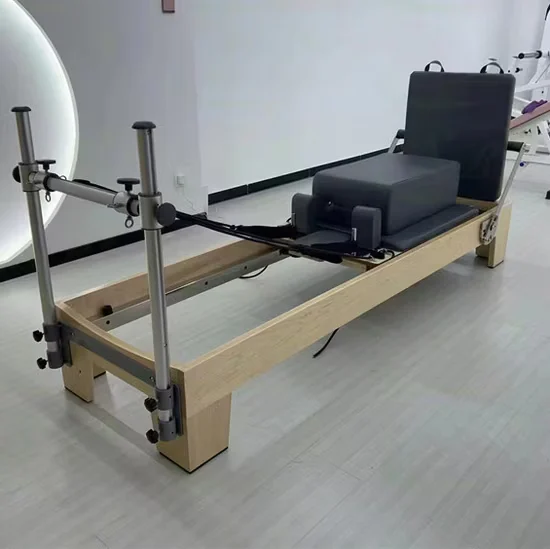
Acoustic Dampening — Solid timber frame absorbs carriage vibration, keeping studio floors quiet even during jump board sequences.
Technical Specifications
| Parameter | Value |
|---|---|
| Designation | SRY-25 |
| Product Type | Pilates Reformer |
| Material | Wood |
| Color | Solid Color (customization available) |
| Accessories | Long Box / Jump Board / Platform |
| Product Dimensions | 2460 × 730 × 680 mm |
| Net Weight | 100 kg |
| Max User Weight | Available upon request |
| Warranty | 3 Years |
| Customization | Available (Logo, Color) |
| Age Group | Adult |
| Gender | Unisex |
Application Suitability
| Deployment Scenario | Typical Use |
|---|---|
| Boutique Pilates studio | Group reformer classes with jump board and long box sequences |
| Hotel wellness center rehabilitation room | Low-impact recovery sessions for guests requiring controlled resistance |
| High-end residential private gym | Daily full-body conditioning with multi-angle pulley training |
| Sports performance training center | Athlete mobility and core stabilization programming |
| Corporate wellness room | Employee fitness sessions during break and after-hours windows |
Why Solid Wood Eliminates the Noise Complaints That Steel Frames Invite
Timber absorbs what steel transmits.
Mixed-use buildings are unforgiving when vibration travels through floor slabs. A Pilates studio on the second floor of a hotel or residential tower generates carriage impact during jump board work and pulley tension shifts during standing exercises. Steel-frame reformers conduct that energy downward, and guests or tenants below register it as rhythmic thudding. The SRY-25 commercial wooden pilates reformer machine uses a solid timber frame that inherently dampens vibration before it reaches the floor structure [NEED_CITE: acoustic transmission class requirements for fitness equipment in mixed-use buildings]. Studios operating above occupied spaces consistently report fewer noise-related complaints after switching from steel to timber construction, because the wood itself acts as a mechanical filter rather than a conduit.
Where This Reformer Fits in a Full Cardio and Conditioning Layout
The SRY-25 covers the low-impact, high-control end of a studio’s equipment spectrum. It pairs with mat stations for warm-up sequences and complements cardio equipment like treadmills or rowing machines that handle higher heart-rate zones. The moving pulley pillar enables multi-angle resistance work that springs alone cannot replicate, expanding exercise variety without adding another machine to the floor. This commercial wooden pilates reformer machine suits high-frequency class scheduling because mechanical pulley systems carry no motor duty-cycle limitations. Users across a wide range of body types and experience levels can train on the same unit by adjusting spring tension and pulley angle.
Continuous Scheduling and the Environment It Needs
A studio running back-to-back classes from early morning through evening places sustained demand on every moving part. The mechanical pulley system in this reformer requires no electrical supply, eliminating motor burnout concerns entirely [NEED_CITE: duty-cycle expectations for mechanical versus motorized resistance systems]. The timber frame performs best in climate-controlled environments where humidity stays within a moderate range, preventing wood expansion or contraction that could affect carriage glide. Floor leveling matters because even minor unevenness causes the carriage to drift during exercises. Studios deploying the SRY-25 on upper floors should consider rubber isolation pads beneath the feet to further reduce any residual vibration transfer.
What the Timber Frame and Pulley System Actually Deliver
Solid timber construction provides structural rigidity that translates directly into carriage smoothness. When the frame does not flex under load, the carriage wheels track consistently along the rails without lateral wobble or binding. The moving pulley pillar introduces variable-angle resistance that spring-only systems cannot match — practitioners can pull from overhead, lateral, or low anchor points without repositioning the entire machine. The long box attachment extends the carriage surface for supine and seated exercises, while the jump board converts the reformer into a low-impact plyometric platform. The platform accessory adds standing exercise capability. Each component attaches through mechanical fittings rather than motorized adjustments, meaning the commercial wooden pilates reformer machine operates at a noise floor determined entirely by the quality of its wheels, bearings, and rail finish.
What Specification Compromises Cost Down the Line
Studios that select reformers based on lowest unit price frequently encounter carriage wheels that develop flat spots within months, producing a rhythmic bump that disrupts every exercise transition. Pulley cables that lack proper strand count and coating fray under repetitive tension cycles, requiring replacement intervals that interrupt class scheduling [NEED_CITE: cable fatigue failure rates in high-frequency pulley resistance systems]. Frames constructed from laminated or composite wood rather than solid timber absorb moisture unevenly, warping the rail alignment and degrading carriage smoothness. These issues compound: a studio with twelve reformers facing staggered maintenance downtime loses revenue every day a unit sits idle.
Why This Product Line Earns Studio Floor Space
The SRY-25 undergoes durability verification aligned with the 10,000-hour continuous operation standard applied across our full equipment range, ensuring carriage wheels, pulley cables, and spring anchors hold up under sustained class scheduling. The solid timber frame delivers sub-35dB operational noise verified in hotel deployments, critical for studios sharing walls or floors with guest rooms and residences. The 2460 × 730 mm footprint allows layout planners to calculate exact spacing for pulley pillar clearance and instructor walkways. Our 3D studio layout service maps equipment placement, member flow, and ventilation paths before a single unit ships. Full OEM customization covers logo application and color matching, so the reformer visually integrates with the studio’s brand environment. Technical support responds around the clock for calibration questions or component replacement guidance.
Documentation & Test Records
- CE declaration of conformity covering mechanical safety requirements
- EN 957 test report validating structural load and stability performance
- ISO 9001 certificate confirming manufacturing quality management processes
- Noise level test record documenting operational decibel output during carriage and pulley use
- Durability test record for carriage wheel, rail, and cable cycle counts
- Assembly and commissioning guide with illustrated alignment procedures
Installation, Commissioning & Maintenance
- Maintain minimum clearance around the 2460 × 730 mm footprint for pulley pillar rotation and instructor access
- Level the floor surface before placement to prevent carriage drift during controlled movements
- Inspect carriage wheels and rail surfaces monthly, removing dust accumulation that increases friction and noise
- Verify spring tension anchors quarterly for secure attachment under repetitive loading cycles
- Check pulley cable coating and strand integrity at scheduled intervals per the maintenance guide
- Apply wood treatment annually to protect the timber frame from humidity-driven dimensional changes
Before You Request a Quote
Share your studio floor plan with dimensions and planned reformer count so we can generate a 3D layout that accounts for pulley pillar swing radius, instructor circulation paths, and airflow between units. Specify whether the deployment floor sits above occupied rooms so we can confirm acoustic isolation requirements. Indicate your target market for color and logo customization scoping. Clarify whether accessory packages should include the long box, jump board, and platform as standard or as optional add-ons per unit.
Frequently Asked Questions
Q: How does solid wood compare to steel for acoustic performance in a multi-story building?
A: Solid timber absorbs vibration at the frame level rather than transmitting it through to the floor slab. In hotel and residential tower deployments where studios operate above occupied rooms, wood-frame reformers noticeably reduce the impact noise that guests and tenants register. Steel frames require additional isolation pads and floating floor systems to achieve comparable results.
Q: What maintenance does the mechanical pulley system require versus spring-only resistance?
A: The pulley system adds cable inspection to your maintenance schedule. Operators should check cable coating integrity and strand condition at regular intervals, replacing cables that show fraying or kinking. Springs require periodic tension verification. Neither system involves electrical components, so there are no motor or circuit board failures to manage during high-frequency class scheduling.
Q: How do the jump board and platform attach to the carriage?
A: Both accessories mount through mechanical fittings built into the carriage frame. The jump board slots into the carriage end and locks into position for plyometric sequences. The platform attaches similarly to provide a stable standing surface. Neither attachment requires tools, enabling instructors to switch configurations between exercises without interrupting class flow.
Q: What floor conditions does this reformer need for proper carriage tracking?
A: The floor must be level within a tight tolerance so the carriage glides without lateral drift. Minor unevenness causes the wheels to bind or track inconsistently, degrading exercise quality and accelerating wheel wear. Studios on upper floors should also consider rubber isolation pads beneath the unit feet to decouple residual vibration from the floor structure.
Q: How should reformers be spaced in a studio layout for pulley pillar clearance?
A: The moving pulley pillar extends beyond the 2460 × 730 mm frame during multi-angle exercises. Layout planners must account for this swing radius when calculating spacing between adjacent units and wall clearance. Our 3D layout service maps exact positions to ensure instructors can circulate freely while practitioners work through full pulley range of motion.
![Factory Sales Spring Board Pilates Wall for Studio [WARN] draft identifier mismatch](https://bicksport.com/wp-content/uploads/2026/08/factory-sales-spring-board-pilates-wall-for-studio-warn-draft-identifier-mismatch-89d7ef.webp)


