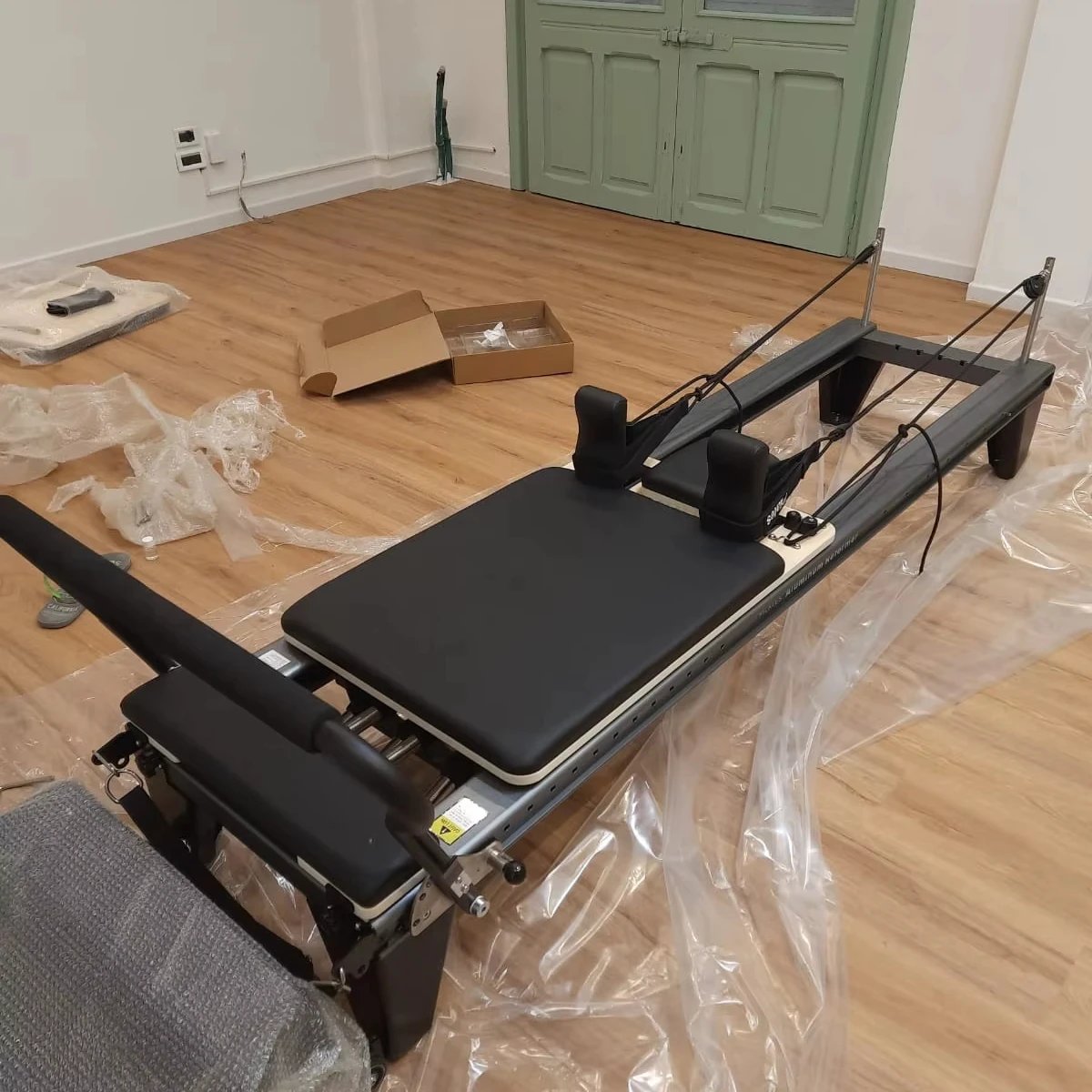
![Senrui Fitness Aluminum Alloy Reformer with Tower Pilates Machine [WARN] draft identifier mismatch](https://bicksport.com/wp-content/uploads/2026/08/senrui-fitness-aluminum-alloy-reformer-with-tower-pilates-machine-warn-draft-identifier-mismatch-e52269.webp)
Whisper-Quiet Operation — Verified across hospitality deployments where cardio equipment runs directly above occupied guest rooms.
Technical Specifications
| Parameter | Value |
|---|---|
| Designation | SRY-11 |
| Product Type | Pilates Reformer with Tower |
| Frame Material | Aluminum Alloy |
| Color | Black |
| Accessory Options | Long Box, Jump Board, Platform |
| Product Dimensions | 2390 × 900 × 1960 mm |
| Net Weight | 120 kg |
| Warranty | 3 Years |
| Logo Customization | Available |
| Target User | Adult, Unisex |
| Production Capacity | 80 Pieces / Month |
Application Suitability
| Deployment Scenario | Typical Use |
|---|---|
| Boutique Pilates studio | Group reformer classes and private sessions across classical and contemporary disciplines |
| Commercial fitness center reformer zone | High-frequency scheduling in a dedicated mind-body area alongside mat and apparatus work |
| Rehabilitation and physiotherapy clinic | Controlled spring-resistance protocols for post-injury and post-surgical recovery programs |
| High-end residential wellness suite | Private or semi-private use in luxury apartment amenity floors and villa fitness rooms |
| Hospitality wellness center | Guest-accessible apparatus sessions in five-star hotel spas and resort fitness facilities |
What Frame Resonance Costs a Multi-Story Studio Deployment
An aluminum alloy carriage platform dampens vibration before it transfers through the floor slab.
When reformers sit above occupied rooms — a physiotherapy clinic below a shared studio, or guest rooms beneath a hotel wellness floor — the carriage travel and spring snap-back generate low-frequency resonance through steel frames and into the structure. Operators discover this only after complaints arrive, not during equipment selection. The frame material, carriage wheel composition, and rail interface all determine whether that vibration stays local or propagates downward [NEED_CITE: structural vibration transfer thresholds for fitness equipment on suspended floor slabs]. Senrui Fitness Aluminum Alloy Reformer with Tower Pilates Machine addresses this at the structural level rather than relying on aftermarket isolation pads alone.
Positioning Within a Dedicated Reformer Zone
The commercial aluminum alloy Pilates reformer with tower covers the full range of classical and contemporary reformer work from a single footprint. The tower attachment adds spring-loaded overhead and lateral resistance vectors without requiring a separate Cadillac or half-Cadillac unit, which matters when studio square footage carries real cost per square meter. In a group class layout, the 2390 mm length and 900 mm width allow standard spacing configurations while keeping instructor sightlines clear across the room. The included long box, jump board, and platform let a single station serve seated, supine, prone, and plyometric work without swapping apparatus between class formats. This unit fits facilities targeting adult users of varying body sizes and conditioning levels across both introductory and advanced programming.
Continuous Scheduling and Floor-Level Deployment Constraints
A reformer zone running four or five back-to-back classes daily puts sustained demand on carriage wheels, springs, and rail surfaces. Unlike motorized cardio equipment, the duty cycle here is mechanical — wheel flat-spotting, spring fatigue, and rail wear all accelerate under high-frequency studio schedules [NEED_CITE: mechanical fatigue intervals for reformer carriage wheels under commercial class scheduling]. The 120 kg net weight of the aluminum alloy frame contributes to stability during dynamic jump board work and standing exercises, reducing the lateral drift that lighter platforms develop over weeks of use. Facilities deploying on upper floors or above noise-sensitive spaces should evaluate whether the carriage wheel material and rail finish produce acceptable sound transmission at the specific class intensity their schedule demands. Adequate spacing between units and perimeter ventilation both affect how heat and humidity accumulate in a fully booked reformer room.
Aluminum Alloy Frame, Spring Resistance, and Accessory Ecosystem
The aluminum alloy construction reduces frame mass compared to equivalent steel platforms while maintaining rigidity under the asymmetric loading that reformer exercises produce. A rigid frame keeps the carriage rail parallel under load, which directly affects travel smoothness and wheel wear patterns over time. The tower integrates multiple spring anchor points at different heights, enabling resistance vectors that a flat-bed reformer alone cannot produce — overhead pulls, lateral rotations, and assisted standing work all become available from the same station. The long box supports seated and kneeling exercises with a stable, padded surface; the jump board converts the carriage into a low-impact plyometric platform; the platform extends the working surface for standing and balance exercises. Spring tension grading across the unit should match the user population, since rehabilitation clients and advanced practitioners require meaningfully different resistance ranges [NEED_CITE: spring tension grading standards for therapeutic versus athletic Pilates populations]. The carriage rail interface — wheel material, rail profile, and lubrication requirements — determines both the acoustic signature during use and the maintenance interval between service visits.
The Hidden Cost of Specifying Below Commercial Grade
Studios that install residential-grade reformers in commercial scheduling environments typically encounter carriage wheel degradation and spring fatigue well before the anticipated replacement cycle. The frame itself may hold up, but the moving components wear under repetitive class loads in ways that private-use volumes never expose. Noise from worn carriage wheels and fatigued springs becomes a complaint driver in shared-wall and multi-story environments, pushing facilities toward premature full-unit replacement rather than component-level service [NEED_CITE: comparative service intervals for residential versus commercial-grade reformer components]. Data gaps also emerge when studios cannot track equipment utilization per unit, leaving scheduling decisions based on instructor preference rather than actual station demand. Facilities that skip 3D layout planning often discover after installation that sightlines, airflow, and instructor circulation paths compromise the class experience in ways that equipment quality alone cannot fix.
Why This Product Line Covers the Reformer Requirement
The sub-35dB operational target that applies across the cardio range reflects the same acoustic discipline needed in reformer studios sharing walls or floors with occupied spaces. Mechanical components on the SRY-11 are evaluated against a 10,000-hour durability benchmark adapted from the continuous-use testing protocol applied to motorized equipment, translated here to carriage travel cycles, spring fatigue life, and rail surface wear. The full six-series cardio and apparatus family lets a facility source reformer, treadmill, bike, and elliptical requirements from a single manufacturing relationship, reducing integration risk across the fitness floor. OEM customization covers logo, color, and finish to align with studio branding or hospitality design standards. The 3D layout service extends to reformer zones, addressing unit spacing, instructor circulation paths, mirror placement, and ventilation requirements specific to the 2390 × 900 mm footprint. Technical support covers commissioning and component-level service guidance around the clock.
Documentation & Test Records
- CE declaration of conformity applicable to the SRY-11 reformer with tower configuration
- EN 957 test report covering structural loading and mechanical safety requirements
- ISO 9001 certificate for the manufacturing quality management system
- Durability test record documenting carriage cycle and spring fatigue validation
- Noise level test report measuring carriage travel and spring return acoustic output
- Installation and commissioning guide with spare parts list for the aluminum alloy platform
Installation, Commissioning & Maintenance
- Verify 2390 × 900 mm footprint plus clearance on all sides for safe carriage travel and instructor access
- Level the aluminum alloy frame on a flat surface using isolation pads appropriate for the floor construction
- Inspect carriage rail alignment and wheel seating before first loaded use to confirm smooth travel
- Confirm spring anchor points on the tower are seated correctly and tension grades match the intended user population
- Schedule carriage wheel inspection and rail lubrication at intervals matching the studio class frequency
- Clean frame surfaces and carriage rails after each class cycle to prevent sweat corrosion on the aluminum alloy finish
Equipment Selection and Zone Planning Inquiry
Provide the reformer zone dimensions and target class capacity to receive a 3D layout addressing unit spacing, instructor sightlines, and airflow planning around the SRY-11 footprint. Specify whether the deployment floor sits above noise-sensitive occupied rooms so that carriage and spring acoustic requirements can be confirmed against the environment. Indicate the expected daily class volume to align component service intervals with the actual scheduling load. Note any logo, color, or finish customization requirements so that OEM scoping covers the visual integration with the broader studio or hospitality design standard.
Frequently Asked Questions
Q: What practical differences does an aluminum alloy frame make compared to steel for a commercial reformer?
A: Aluminum alloy reduces overall frame mass while maintaining rigidity under the asymmetric loads that reformer exercises produce. A rigid frame keeps carriage rails parallel, which preserves travel smoothness and extends wheel life. The material also dampens low-frequency resonance differently than steel, which matters when reformers are deployed on suspended floors above occupied rooms where vibration transfer generates complaints.
Q: What exercise capabilities does the tower attachment add to the reformer?
A: The tower provides spring anchor points at multiple heights, enabling overhead pulls, lateral rotations, and assisted standing exercises that a flat-bed reformer cannot produce alone. This effectively expands the exercise repertoire without adding a separate Cadillac unit to the floor plan. For studios with limited square footage, the tower consolidates apparatus capabilities into a single station footprint.
Q: How should carriage rail maintenance be planned for a high-frequency studio schedule?
A: Carriage wheels and rails require periodic inspection for flat-spotting, debris accumulation, and lubrication breakdown, all of which accelerate under back-to-back class scheduling. The maintenance interval depends directly on daily class volume and the wheel material specification. Facilities running four or more classes per day per unit should establish a shorter inspection cycle than single-session environments to prevent noise and travel degradation.
Q: How do you match spring tension grading to different user populations?
A: Rehabilitation clients typically require lower, more precisely graduated spring tensions for controlled joint loading, while advanced practitioners need higher tensions for strength and power development. The spring set on the SRY-11 should be specified to cover the expected user range, and studios serving mixed populations may need supplementary spring sets to avoid compromising either therapeutic precision or athletic resistance across different class formats.
Q: What layout factors matter most when planning a multi-unit reformer zone?
A: Unit spacing must accommodate full carriage travel, instructor circulation between stations, and adequate mirror sightlines for form correction. Airflow planning is critical in a fully booked room where sustained group exertion raises temperature and humidity quickly. The 2390 × 900 mm footprint of the commercial aluminum alloy Pilates reformer with tower determines minimum spacing, and a 3D layout helps verify that all functional zones remain accessible at full class capacity.
![Commercial Foldable Aluminum Pilates Reformer Bed for Home Studio [WARN] draft identifier mismatch](https://bicksport.com/wp-content/uploads/2026/08/commercial-foldable-aluminum-pilates-reformer-bed-for-home-studio-warn-draft-identifier-mismatch-a7cd88.webp)