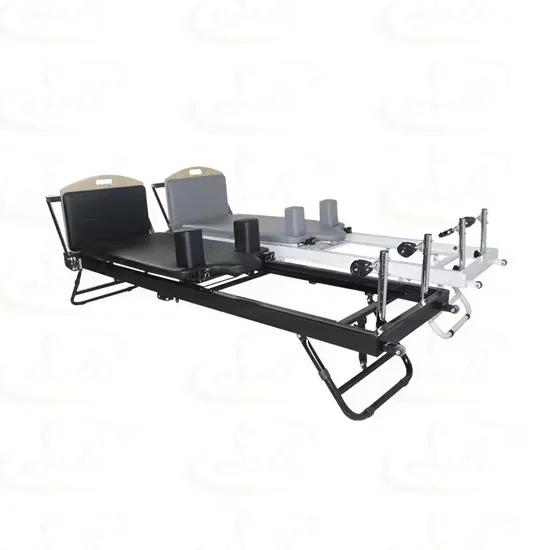
Vibration Dampening Mass — Solid oak joinery absorbs resonance during dynamic carriage movements, keeping multi-story studios quiet.
Technical Specifications
| Parameter | Value |
|---|---|
| Product Type | Pilates Reformer |
| Material | Wood (Oak) |
| Product Dimensions | 24007702160mm |
| Net Weight | 150kgs |
| Accessory | Long Box / Jump Board / Platform |
| Customization | Available (Logo, Color) |
| Warranty | 3 Years |
Application Suitability
| Deployment Scenario | Typical Use |
|---|---|
| boutique Pilates studio | high-frequency group reformer classes with full trapeze tower integration |
| luxury residential fitness center | quiet operation on shared floors where vibration transmission is critical |
| rehabilitation facility | precise spring-loaded resistance for controlled therapeutic movement protocols |
| high-end home gym | comprehensive full-body training without multiple separate equipment pieces |
| professional sports training center | athlete conditioning with adjustable eccentric and concentric loading patterns |
Why Studio Floors Carry Every Vibration a Reformer Produces
A professional oak pilates reformer with trapeze tower must manage kinetic energy that lighter frames simply pass through to the structure below.
When reformer frames lack sufficient mass or proper joinery, carriage movement and spring-loaded exercises transmit vibration directly through floor systems. In multi-story studio environments, this resonance reaches occupied spaces below, generating complaints that arrive at the front desk long before maintenance notices a problem. Wood-frame reformers with solid oak construction address this at the source: the frame itself becomes a dampening element rather than a transmission pathway. Metal frames, while durable, tend to propagate harmonic frequencies that solid wood naturally absorbs [NEED_CITE: vibration transmission characteristics of solid wood versus tubular steel in fitness equipment frames]. The difference becomes apparent during repetitive carriage movements and jump board exercises where impact forces cycle hundreds of times per class session.
Where This Reformer Fits in a Studio Equipment Layout
The full trapeze tower configuration positions this unit as the primary apparatus for comprehensive Pilates programming, covering mat-work equivalents through advanced suspension-based movements. In a studio equipment plan, it pairs with half-cadillacs or wall-mounted spring boards for facilities offering tiered class formats. The 2400mm length accommodates tall users during full-body extension exercises, while the 150kg net weight anchors the unit firmly without requiring permanent floor mounting. This professional oak pilates reformer with trapeze tower serves both group class rotations and private sessions where instructors need access to the complete spring resistance range for progressive client programming.
Daily Class Schedules and What They Demand From Frame Construction
A studio running six to eight classes daily puts each reformer through hundreds of carriage cycles, spring tension changes, and tower attachment transitions before the next maintenance window. Solid oak frames handle this repetitive loading differently than engineered composites or lighter hardwoods: the density of oak maintains joint integrity under continuous stress without developing the play that leads to rattling and misalignment. Adequate spacing between units — at minimum 600mm on each side — allows safe passage during trapeze work where limbs extend beyond the carriage footprint [NEED_CITE: recommended spacing standards for commercial Pilates reformer deployment]. Floor leveling becomes critical at this weight class; even minor unevenness causes the carriage to drift during supine exercises.
Reading the Spring and Rail Specifications That Matter
The spring resistance system on this reformer provides adjustable load for both concentric and eccentric training phases, with progressive tension that instructors calibrate per exercise and client capability. Carriage wheel and rail design determines operational smoothness: precision-machined rails paired with sealed wheel bearings maintain consistent glide across thousands of repetitions without the lateral play that develops in lighter-duty track systems. The trapeze tower attaches to the oak frame at reinforced load points, providing vertical and horizontal resistance vectors that expand the exercise library without requiring a separate Cadillac unit. Oak’s natural grain structure contributes to vibration absorption during jump board sequences, where impact forces travel through the frame at frequencies that would cause resonance in hollow-section metal construction.
What Happens When Frame Specifications Get Compromised
Reformers built with undersized timber or particle-core laminates develop joint looseness within months of commercial use, creating carriage wobble that instructors work around rather than address. Vibration that escapes through inadequate frame mass travels to adjacent rooms and floors, accumulating noise complaints that eventually force equipment replacement in batches. Spring anchor points in softer materials lose calibration accuracy, making resistance inconsistent between units of the same model — a problem that surfaces during group classes where clients compare experience side by side. Trapeze tower attachments on underbuilt frames introduce safety concerns that limit the exercises an instructor can confidently program [NEED_CITE: load rating verification for trapeze tower attachment points on wood-frame reformers].
Why This Product Line Addresses Studio Procurement Concerns
Every oak frame undergoes load testing at the joinery points before assembly, confirming structural integrity for continuous class scheduling. The 150kg unit mass provides inherent vibration dampening verified across multi-story studio deployments where floor-transmitted noise is a primary concern. Full OEM customization covers logo application and color matching, allowing studios to maintain brand consistency across equipment fleets. The complete trapeze tower system ships integrated rather than as a field-install add-on, eliminating alignment issues that arise from aftermarket assembly. Our engineering team provides 3D studio layout planning that accounts for this reformer’s 2400*770mm footprint plus required user clearance and instructor circulation paths. Technical support covers spring replacement calibration and carriage rail maintenance intervals specific to this oak platform.
Documentation & Test Records
- Load testing records for oak frame joinery and trapeze tower anchor points
- EN 957 compliance documentation covering structural safety requirements
- ISO 9001 quality management certificate for manufacturing processes
- Spring resistance calibration records and replacement cycle specifications
- Carriage rail smoothness and alignment verification reports
- Installation guide with floor leveling and clearance requirements
Installation, Commissioning & Maintenance
- Maintain minimum 600mm lateral clearance around the 2400*770mm footprint for safe trapeze exercise extension
- Level floor surface before placement; the 150kg oak frame requires even load distribution across all contact points
- Verify spring tension calibration on first assembly and recalibrate after the initial 500 carriage cycles
- Inspect carriage wheel bearings and rail alignment monthly under commercial class-frequency conditions
- Clean oak surfaces with pH-neutral products only; avoid solvent-based cleaners that degrade wood finish
- Replace springs according to documented cycle intervals to maintain consistent resistance across all units
Equipment Selection Starts With Your Floor Plan
Provide your studio square footage and planned unit count to receive a 3D layout accounting for reformer footprint, trapeze tower clearance, and instructor circulation paths. Specify your daily class schedule so we can confirm spring and carriage specifications match your usage intensity. Indicate whether the installation floor sits above occupied spaces to determine if supplemental vibration isolation is advisable. Note your target market for any customization requirements including logo placement and color matching.
Frequently Asked Questions
Q: How does solid oak frame construction compare to metal frames in vibration behavior?
A: Solid oak absorbs harmonic frequencies generated during carriage movement and jump board exercises rather than transmitting them through the structure. Metal frames, particularly tubular steel, tend to propagate these vibrations to floor systems. The 150kg mass of the oak frame further stabilizes the unit during dynamic movements, reducing the resonance that reaches adjacent rooms or floors below in multi-story studio environments.
Q: What is the spring replacement interval under commercial studio conditions?
A: Spring fatigue depends on class frequency and the resistance levels programmed most often. Springs in daily commercial use require periodic calibration checks and replacement when tension output drifts from baseline specifications. We document the expected cycle life for each spring weight in the technical package, and replacement springs ship with recalibration instructions so resistance remains consistent across all reformers on the studio floor.
Q: What carriage rail maintenance does a high-frequency studio schedule require?
A: Carriage wheels and rails accumulate particulate matter from studio environments that degrades glide smoothness over time. Monthly inspection of wheel bearings and rail surface condition catches wear before it affects class experience. Sealed bearings on this reformer reduce contamination ingress, extending maintenance intervals compared to open-bearing carriage systems commonly found on lighter-duty units.
Q: How should a studio plan floor space for the reformer with full trapeze tower?
A: The 2400*770mm footprint represents the equipment envelope only. Add minimum 600mm on each side for instructor access and trapeze exercises where limbs extend beyond the carriage. Ceiling height must accommodate the 2160mm tower plus user clearance during overhead suspension work. Our 3D layout service models these clearances against your actual room dimensions before equipment ships.
Q: Can the trapeze tower handle advanced suspension exercises safely?
A: The tower attaches to reinforced anchor points in the oak frame, load-tested to handle forces generated during full-body suspension work. Each attachment point carries a documented load rating with safety factor verification. Instructors receive a compatibility guide listing approved exercises and tower configuration settings to ensure safe programming across all client capability levels.
![Maple Wood Pilates Reformer for Studio and Hotel Fitness Use [WARN] draft identifier mismatch](https://bicksport.com/wp-content/uploads/2026/08/maple-wood-pilates-reformer-for-studio-and-hotel-fitness-use-warn-draft-identifier-mismatch-75468b.webp)