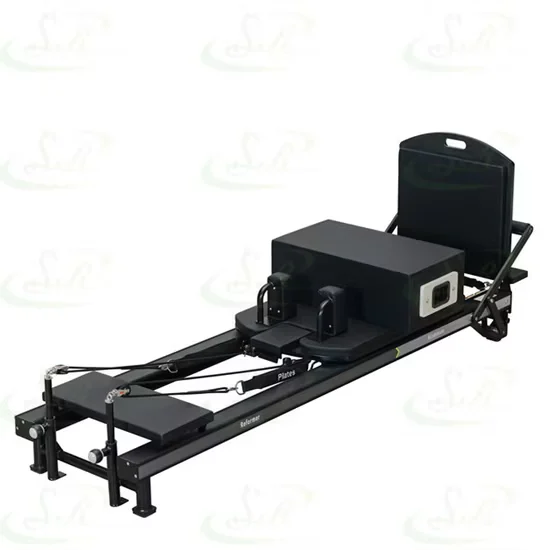
Acoustic-Optimized Frame Design — Solid wood construction dampens vibration transmission, addressing noise complaints in multi-tenant commercial fitness spaces where metal-framed reformers create resonance issues across shared floors.
Technical Specifications
| Parameter | Value |
|---|---|
| Designation | SRY-20B |
| Product Type | Foldable Pilates Reformer |
| Frame Material | Solid Wood |
| Dimensions (L×W×H) | 2400×600×350mm |
| Net Weight | 100kg |
| Foldable | Yes |
| Accessories | Long Box / Jump Board / Platform |
| Logo Customization | Available |
| Target User | Adult, Unisex |
| Warranty | 3 Years |
| Certification | CE, EN 957, ISO 9001 |
| Monthly Production Capacity | 80 Units |
Application Suitability
| Deployment Scenario | Typical Use |
|---|---|
| Boutique Pilates studio with shared walls | Group reformer classes requiring acoustic isolation from adjacent tenants |
| Rehabilitation and physical therapy clinic | Progressive resistance programming for post-injury recovery with controlled spring tension |
| High-end residential fitness integrator | Home gym installations where floor-transmitted vibration concerns rule out metal-frame alternatives |
| Corporate wellness room in office tower | Space-efficient deployment with foldable storage between scheduled class blocks |
| Wellness center with multi-studio layout | Flexible reconfiguration for varied class formats using accessory ecosystem |
What Carriage Noise Reveals About Frame Engineering in Commercial Studios
Wood frame construction absorbs harmonic resonance that metal frames amplify through bolted joints.
Studio operators expanding into shared commercial buildings encounter complaints from neighboring tenants within weeks of opening. The carriage gliding along aluminum rails transmits vibration through metal frames directly into floor structures, especially during dynamic jump board sequences where impact forces spike repeatedly [NEED_CITE: vibration transmission coefficients for wood versus metal fitness equipment frames]. Metal-to-metal contact points at spring attachment brackets and pulley housings generate secondary resonance that propagates through structural connections. This commercial foldable Pilates reformer wood frame addresses the root cause by substituting solid timber for steel tubing at primary vibration pathways.
Positioning Within the Studio Equipment Matrix
This reformer serves as the primary resistance-training station in boutique Pilates environments, covering rehabilitation through athletic conditioning intensity ranges. The accessory ecosystem—long box for supine work, jump board for plyometric loading, platform for standing balance drills—allows programming progression without adding dedicated apparatus. In multi-studio facilities, the foldable design enables storage during floor-based mat classes or functional training sessions. The 2400mm length accommodates users across typical adult anthropometric ranges while maintaining footprint efficiency for high-rent urban deployments.
Continuous Operation and Environmental Deployment Factors
Daily class schedules running five to eight sessions create cumulative load cycles that stress frame joints and spring tension mechanisms. Wood frame construction requires stable humidity environments to prevent dimensional drift affecting carriage alignment. Facilities deploying on upper floors benefit from the inherent vibration damping, reducing structural transmission to occupied spaces below [NEED_CITE: commercial fitness equipment deployment guidelines for multi-story buildings]. Floor leveling tolerances become critical as uneven surfaces induce carriage binding and premature rail wear. The 100kg unit mass provides stability during dynamic exercises while remaining repositionable for studio reconfiguration when equipped with transport casters.
Frame Material Selection and Mechanical Transmission Logic
Solid wood frames exhibit different resonance profiles compared to welded steel or extruded aluminum alternatives. Timber’s natural cellular structure dissipates vibrational energy through internal friction rather than transmitting it through rigid connections. This matters when reformers operate simultaneously in group class formats—six units running synchronized sequences create cumulative acoustic loading that metal frames compound through sympathetic resonance. The foldable mechanism introduces additional pivot points requiring precision machining to prevent carriage play developing over thousands of articulation cycles. Spring tension progression depends on anchor point geometry and pulley routing rather than electronic control, making mechanical tolerances the primary determinant of resistance feel consistency across units.
Specification Trade-offs and Field Failure Patterns
Operators selecting reformers based primarily on upfront cost encounter recurring expenses through carriage bearing replacements, spring recalibration, and frame joint reinforcement. Metal frames deployed on upper floors generate tenant complaints that trigger expensive acoustic retrofitting or complete equipment relocation. Units lacking foldable capability consume permanent floor area, reducing revenue potential in space-constrained urban studios where per-square-meter economics demand flexible layouts. Spring systems with limited tension ranges force instructors to adapt programming to equipment limitations rather than client needs, creating member attrition as practitioners seek facilities with proper apparatus [NEED_CITE: Pilates studio equipment replacement cycles and total cost of ownership].
Why This Product Line Addresses Deployment Pain Points
Wood frame construction directly targets acoustic complaints that shut down studio expansion plans in mixed-use buildings. The foldable mechanism enables operators to maximize class scheduling density without permanent equipment footprint commitments. Accessory compatibility across the reformer range allows progressive programming from clinical rehabilitation through athletic performance without capital outlay for specialized apparatus. Three-year warranty coverage on commercial-grade components reduces unplanned maintenance disruptions during peak booking periods. The 80-unit monthly production capacity supports multi-location rollouts with consistent specification matching across deployments [NEED_CITE: commercial Pilates equipment durability testing protocols].
Documentation & Test Records
- CE conformity declaration confirming European market safety compliance for commercial fitness deployment
- EN 957 test report validating structural integrity under repeated loading cycles
- ISO 9001 certificate covering manufacturing quality management systems
- Frame material specification sheet detailing wood species and moisture content tolerances
- Accessory compatibility matrix confirming interchangeability across reformer models
- Spring tension range documentation with progression calibration procedures
Installation, Commissioning & Maintenance
- Maintain 600mm clearance on all sides for safe carriage travel and instructor circulation during group classes
- Verify floor levelness within 3mm tolerance across 2400mm frame length to prevent carriage binding
- Inspect fold mechanism pivot points quarterly for wear and lubricate with manufacturer-specified grease
- Calibrate spring tension anchors annually using certified force gauge to maintain resistance progression accuracy
- Clean wood surfaces with pH-neutral products only to prevent finish degradation from sweat exposure
- Store in vertical folded position with carriage locked when not scheduled for use to preserve rail alignment
Equipment Selection and Deployment Planning
Provide studio floor plans with equipment count requirements to receive acoustic modeling and spacing recommendations. Specify daily class schedule density to confirm spring system durability matches operational load expectations. Indicate building construction type and floor level for vibration transmission assessment. Confirm accessory package requirements based on programming scope from rehabilitation through athletic conditioning. State target market certification requirements to ensure documentation package completeness before shipment.
Frequently Asked Questions
Q: How does wood frame acoustic performance compare to metal construction in multi-tenant buildings?
A: Wood frames absorb vibration energy through natural cellular structure rather than transmitting it through rigid connections. Metal frames amplify carriage movement harmonics through bolted joints and welded connections, creating secondary resonance that propagates into floor structures. The difference becomes pronounced during group classes where multiple reformers operate synchronized sequences, generating cumulative acoustic loading that triggers tenant complaints in shared commercial spaces.
Q: What durability testing validates the fold mechanism for commercial use cycles?
A: The folding pivot mechanism undergoes repeated articulation testing simulating thousands of deployment cycles representative of multi-class daily schedules. Commercial environments require the mechanism to maintain precise alignment without developing carriage play or rail binding over extended operation. Quarterly inspection protocols verify pivot point integrity and lubrication status to prevent premature wear from accumulated use cycles in high-frequency studio deployments.
Q: Are accessories interchangeable across different reformer models in this product range?
A: The long box, jump board, and platform accessories follow standardized mounting geometry across the reformer lineup, allowing programming flexibility without equipment-specific limitations. This compatibility supports facilities operating mixed inventory from different production batches or expanding equipment counts incrementally. Instructors design class sequences knowing accessories function consistently regardless of which specific unit clients occupy during group sessions.
Q: What spring tension range supports both rehabilitation and athletic conditioning programming?
A: The spring system provides graduated resistance levels accommodating post-injury recovery protocols requiring minimal loading through advanced athletic conditioning sequences demanding maximal resistance. This range allows single-equipment deployment serving diverse client populations within the same facility. Instructors progress clients through programming stages without requiring specialized rehabilitation apparatus or separate athletic performance equipment installations.
Q: How should foldable reformers factor into multi-studio facility space planning?
A: Foldable units enable flexible studio configurations where the same space serves reformer classes during scheduled blocks and floor-based functional training or mat work during alternate time slots. This flexibility increases revenue potential per square meter in high-rent urban locations where permanent equipment footprint reduces scheduling options. Storage planning requires vertical clearance and secure locking mechanisms to prevent accidental deployment during non-reformer programming hours.