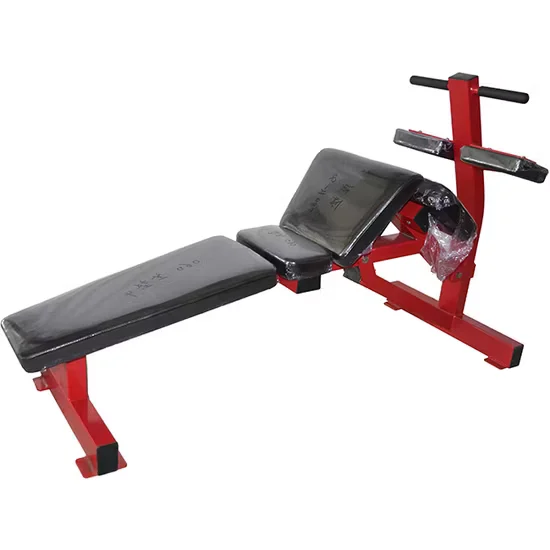
Heavy-Duty Frame — 250kg net weight steel construction tested for continuous commercial leg training without structural fatigue.
Technical Specifications
| Parameter | Value |
|---|---|
| Designation | 5039 |
| Product Type | Linear Leg Press |
| Power Source | Manual |
| Exercise Part | Leg |
| Material | Steel |
| Product Dimensions | 237515001475mm |
| Net Weight | 250kg |
| Foldable | Unfolded |
| Certification | ISO9001, CE |
| OEM/ODM | Available |
| Production Capacity | 500 PCS/Month |
| HS Code | 9506911900 |
Application Suitability
| Deployment Scenario | Typical Use |
|---|---|
| Chain gym strength training zone | High-frequency plate loaded leg work during peak membership hours |
| Corporate wellness room | Supervised leg strengthening sessions for employee fitness programs |
| Sports performance training center | Athlete lower-body power development under coach guidance |
| Community recreation gymnasium | General population leg conditioning with adjustable seat positioning |
Why Plate Loaded Linear Leg Press Equipment Fails Before the Warranty Expires
Linear guide rails eliminate the pivot-point wear that destroys lever-based leg presses under continuous commercial loading.
I spent years debugging cardio decks, but strength zone failures follow a different pattern. Lever-style leg presses develop lateral play at the pivot bearing after months of uneven loading, and the frame begins to deflect off-axis [NEED_CITE: structural fatigue patterns in pivot-based commercial leg press equipment]. Linear guide systems distribute the load across parallel rails, so the carriage travels the same path on repetition five hundred as it did on repetition five. When a chain gym in our region cycled through lever-type units every eighteen months, the maintenance cost exceeded the original purchase price before the second replacement set arrived.
Positioning This Unit Within the Strength Training Floor
The 5039 occupies the heavy compound movement anchor in any commercial gym strength zone. It pairs with hack squat machines and leg extension units to cover the full quadriceps-hamstring-glute training spectrum without redundant movement patterns. The linear trajectory suits users who need controlled, repeatable loading for hypertrophy and rehabilitation protocols. The seat and backrest adjustment range accommodates users across a wide body-type spectrum, keeping the pressing path consistent whether the operator is a competitive powerlifter or a first-time gym member. The commercial linear leg press plate loaded design fits naturally between free-weight racks and isolation machines where floor space supports a dedicated lower-body station.
Continuous Operation Demands and Facility Infrastructure
This unit draws no electrical power, which removes voltage compatibility issues and dedicated circuit requirements from the deployment checklist. The 250kg net weight and 2375mm length demand a reinforced concrete subfloor with leveling tolerances under three millimeters across the footprint [NEED_CITE: subfloor flatness requirements for heavy commercial plate loaded equipment]. Rubber isolation pads beneath the base rails prevent vibration transfer to adjacent flooring during heavy drop sets. Ventilation planning should account for the user’s position — the reclined pressing angle generates significant metabolic heat output, so overhead airflow paths need to cover the station without creating dead zones. Facility management systems do not require data integration for manual plate loaded equipment, simplifying the IT infrastructure.
Reading the Engineering Behind the Guide Rail Choice
The linear rail system uses sealed bearing blocks that travel along hardened steel tracks, converting the user’s leg drive into straight-line carriage motion. Unlike pivot-based designs where the arc of travel introduces shear forces at the hip and knee joints, the linear path keeps the force vector aligned with the user’s femur throughout the full range of motion. The manual plate loading horns accept standard Olympic plates, giving users incremental loading flexibility that pin-selector stacks cannot match at high weight ranges. The all-steel welded frame resists the torsional forces generated when users load plates asymmetrically or press with uneven leg drive. Seat and backrest angle adjustments use pin-lock mechanisms that hold position under maximum load without slippage [NEED_CITE: EN 957 static load testing requirements for commercial leg press equipment].
What Happens When Facilities Spec Below Commercial Grade
Light-commercial leg presses with thinner wall tubing begin to flex under repeated heavy loading, and the guide rails develop lateral play that users feel as wobble during the eccentric phase. Pivot-based designs concentrate stress at a single bearing point, and when that bearing develops play, the entire carriage path shifts off-axis — generating noise complaints from nearby training zones and accelerating wear on adjacent structural welds [NEED_CITE: failure mode analysis for sub-commercial grade leg press pivot bearings]. Facilities that purchased home-grade or light-commercial units for high-traffic strength zones report complete frame replacement within two years, turning what should have been a ten-year asset into a recurring capital expense.
Why This Product Line Earns the Floor Space
The 10,000-hour durability testing protocol validates the welded frame and guide rail assembly under simulated continuous commercial use cycles. The sub-35dB operation standard from our cardio engineering division extends to strength equipment — sealed linear bearings produce negligible acoustic output compared to pivot designs with developing play. Full OEM and ODM capability covers frame color, logo placement, and seat upholstery customization at flexible minimum order quantities. The 2375 by 1500mm footprint integrates into the free 3D strength zone layout planning service, where sightlines, plate storage proximity, and member flow paths are mapped before equipment ships. Technical support responds within the 24/7 window, and the spare parts catalog covers every wear component from bearing blocks to seat adjustment pins.
Documentation & Test Records
- CE declaration of conformity for commercial plate loaded leg training equipment
- EN 957 test report covering static and dynamic load verification
- ISO 9001 certificate for manufacturing quality management
- Structural durability test record for frame and guide rail assembly
- Installation guide with subfloor preparation and leveling procedures
Installation, Commissioning & Maintenance
- Maintain 1500mm clearance behind the carriage travel path and 1000mm on each side for plate loading access
- Install on reinforced concrete with vibration isolation pads beneath all four base rail contact points
- Perform initial guide rail alignment verification and bearing block tension adjustment before first user session
- Schedule sealed bearing inspection and guide rail lubrication at six-month intervals under standard commercial use
- Wipe down seat upholstery and backrest with pH-neutral cleaner after each use to prevent sweat corrosion on steel contact surfaces
Equipment Selection and Deployment Inquiry
Provide the strength zone square footage and planned equipment list to receive a 3D layout with member flow analysis and plate storage positioning. Specify the expected daily user volume so the guide rail duty cycle can be matched to the facility’s operating hours. Confirm subfloor construction type and any upper-floor deployment constraints to validate the 250kg equipment load. State the target market region so OEM customization options including language-specific instructional placards can be scoped into the quotation.
Frequently Asked Questions
Q: How does the linear guide rail path differ from a traditional lever-based leg press in terms of joint loading?
A: The linear rail constrains carriage movement to a straight track, keeping the force vector aligned with the user’s femur throughout the full range of motion. Lever-based designs follow an arc that introduces lateral shear forces at the knee joint, particularly at the bottom of the pressing movement where the angle between the tibia and the load direction becomes less favorable for joint stability.
Q: Can the steel frame withstand daily high-frequency use in a commercial gym without developing structural play?
A: The welded steel frame and hardened guide rails undergo testing protocols simulating continuous commercial loading cycles. Unlike light-commercial frames with thinner tubing that deflect under repeated heavy use, the reinforced construction maintains dimensional stability. The sealed bearing blocks eliminate the lubrication gaps where contaminant ingress typically accelerates wear in pivot-based competitor designs.
Q: What maintenance advantages does manual plate loading offer over pin-selector weight stacks?
A: Manual plate loading eliminates the selector pin mechanism, cable routing, and weight stack guide rods that require periodic adjustment and eventual replacement in pin-loaded machines. Olympic plates are universally available, and the loading horns have no moving parts to wear. This design reduces scheduled maintenance visits and removes the cable-snap failure mode that takes pin-selector units offline unexpectedly.
Q: How should facility planners position this leg press within the strength zone layout?
A: The 2375 by 1500mm footprint requires dedicated floor space with clearance for plate storage racks positioned within arm’s reach of the loading horns. Planners should orient the unit so the carriage travel path does not face high-traffic walkways, and overhead ventilation must cover the reclined user position. Pairing with adjacent isolation machines creates a logical lower-body training circuit.
Q: What user body types does the seat adjustment range accommodate?
A: The seat and backrest angle adjustment uses pin-lock positioning to cover a range that fits users from shorter statures requiring a closer starting knee angle to taller users needing extended carriage travel. The ergonomic contour supports proper lumbar contact across this spectrum, ensuring consistent force transfer regardless of the user’s proportions or training experience level.
![Reverse Hyper Extension Machine OS-H5073 Commercial Gym Equipment [WARN] draft identifier mismatch](https://bicksport.com/wp-content/uploads/2026/08/reverse-hyper-extension-machine-os-h5073-commercial-gym-equipment-warn-draft-identifier-mismatch-4ecf9f.webp)