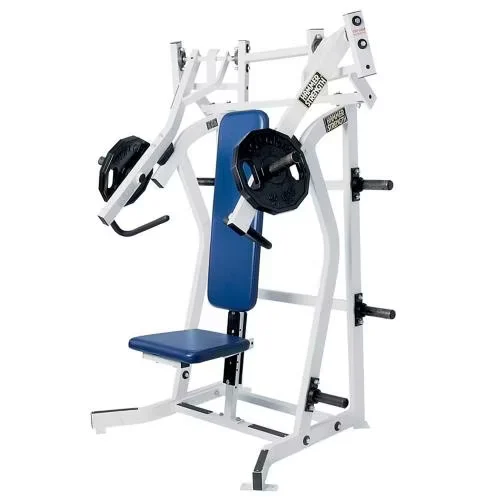
Commercial-Grade Frame Durability — ISO-lateral independent arm mechanism paired with heavy-duty steel construction withstands high-frequency plate loading without structural flex or pivot wear.
Technical Specifications
| Parameter | Value |
|---|---|
| Designation | 5006 |
| Product Type | Plate Loaded ISO-Lateral Rowing Machine |
| Exercise Part | Back |
| Material | Steel |
| Product Dimensions | 1558×1426×1467 mm |
| Net Weight | 128 kg |
| Age Group | Adult |
| Gender | Unisex |
| Appliance | Community, Gymnasium |
| Fit Area | Professional Gym and Club |
| OEM/ODM | Available |
| Production Capacity | 500 PCS/Month |
| Certification | ISO 9001, CE |
| Warranty | Contact for terms |
Application Suitability
| Deployment Scenario | Typical Use |
|---|---|
| Professional gym and club strength zones | High-frequency bilateral back training for members seeking independent arm movement |
| Community fitness centers | Durable plate-loaded equipment for diverse user populations with minimal maintenance |
| Corporate wellness rooms | Space-efficient strength station for employee fitness programs |
| High-end residential home gym | Commercial-durability rowing machine for serious lifters requiring balanced development |
Why Frame Flex and Pivot Wear Endanger High-Traffic Strength Zones
The steel frame must resist repetitive loading without deformation.
Plate-loaded rowing stations on busy gym floors endure constant weight changes and aggressive use cycles. When frame materials lack proper tensile strength or when pivot bearings are undersized, the result is uneven tracking, grinding noises, and eventually structural fatigue that compromises user safety [NEED_CITE: commercial strength equipment durability standards for high-traffic facilities]. Maintenance callbacks spike, member complaints accumulate, and facility operators face premature replacement costs. A plate loaded iso-lateral rowing machine commercial gym environments demand must deliver consistent smoothness across thousands of repetitions.
Positioning Within a Commercial Strength Training Layout
This plate loaded iso-lateral rowing machine occupies the dedicated back-training segment of a strength zone, complementing lat pulldown stations and seated cable rows. The ISO-lateral independent arm mechanism allows each side to move through its own fixed arc, enabling users to identify and correct strength imbalances without cross-side compensation. The 1558×1426×1467 mm footprint positions this unit along perimeter walls or between isolation machines where plate storage and loading clearance are available. Users across a broad strength spectrum—from rehabilitation loads to advanced athletic training—can load plates incrementally to match their capacity.
Operational Demands for Continuous Gym Floor Deployment
Facilities running this equipment 12-16 hours daily must verify pivot bearing specifications and frame welding standards against manufacturer documentation [NEED_CITE: continuous-use load testing for plate-loaded strength machines]. Unlike motorized cardio units, plate-loaded rowing machines have no electrical requirements, eliminating voltage compatibility concerns for international deployments. However, floor leveling becomes critical—uneven surfaces create frame stress points that accelerate wear at the ISO-lateral pivot joints. Facilities should install vibration-dampening mats beneath the 128 kg unit to prevent plate rattle from transmitting through concrete slabs to adjacent occupied spaces.
Independent Arm Mechanics and Frame Engineering
The ISO-lateral mechanism decouples left and right arm movement, allowing each side to follow its own biomechanical path without forcing symmetrical compensation. This requires precision-machined pivot bearings that maintain smooth rotation under asymmetric loads—when a user loads 40 kg on one side and 20 kg on the other, the frame must resist torsional stress while both arms complete full range of motion. The commercial-grade steel construction provides the rigidity needed to prevent flex under heavy plate loads, ensuring that resistance remains consistent throughout the contraction. Steel plate storage horns integrated into the frame keep weight changes efficient while maintaining the unit’s center of gravity.
The Cost of Underspecified Strength Equipment
When facilities select plate-loaded machines based solely on price without verifying frame gauge and pivot bearing quality, the consequences emerge within months. Pivot mechanisms develop play, creating uneven resistance curves that frustrate users and compromise training effectiveness [NEED_CITE: failure modes in commercial plate-loaded rowing equipment]. Frame flex under heavy loads leads to weld fatigue, eventually requiring unit replacement or expensive structural repair. Member attrition follows when equipment feels inconsistent or unsafe, particularly among serious lifters who notice tracking irregularities immediately.
Why This Product Line Addresses Facility Requirements
The 128 kg net weight reflects substantial steel mass that resists movement during aggressive rowing repetitions. Full OEM/ODM capability allows facilities to specify custom branding, color schemes, and specification adjustments that align with interior design requirements. ISO 9001 quality management and CE conformity documentation support international procurement workflows and facility compliance audits. The manufacturer provides 3D strength-zone layout planning that accounts for this unit’s 1558×1426 mm footprint, plate-loading clearance, and member flow patterns around high-traffic isolation machines. Technical support covers pivot bearing inspection schedules and frame integrity assessment protocols.
Documentation & Test Records
- ISO 9001 certificate verifying quality management system compliance
- CE declaration of conformity for European market distribution
- Frame material specification sheet with steel grade documentation
- Pivot bearing specification and load rating documentation
- Assembly and installation guide with floor leveling requirements
- Preventive maintenance schedule for pivot lubrication and inspection
Installation, Commissioning & Maintenance
- Verify 1558×1426×1467 mm clearance with 600 mm perimeter for plate loading access
- Install on level concrete with vibration-dampening mat to isolate plate rattle transmission
- Confirm pivot bearing smoothness and ISO-lateral arm tracking before member release
- Establish monthly pivot lubrication schedule using manufacturer-specified grease type
- Inspect frame welds and pivot bearing play quarterly under loaded conditions
- Clean steel surfaces weekly to prevent sweat corrosion on plate storage horns
Requesting Equipment Selection Guidance
Provide your strength zone dimensions and planned equipment count to receive a 3D layout that positions this plate loaded iso-lateral rowing machine with proper clearance and member flow consideration. Specify your facility’s daily operating hours and expected usage frequency so we can confirm pivot bearing durability matches your volume. Identify your target market region for documentation and compliance requirements. Indicate whether OEM customization—logo application, color selection, or specification adjustment—is needed for your project scope.
Frequently Asked Questions
Q: What distinguishes plate-loaded from selectorized rowing machines?
A: Plate-loaded units like the 5006 require manual weight plate addition, offering unlimited incremental loading and no cable-pulley maintenance. Selectorized machines use pin-loaded weight stacks with fixed increments and require regular cable inspection. Plate-loaded systems suit serious lifters who need precise load control, while selectorized units serve high-turnover facilities prioritizing quick adjustments between users.
Q: How does ISO-lateral independent arm movement benefit training?
A: The mechanism allows each arm to move independently through its own arc, preventing the stronger side from compensating for the weaker side during bilateral exercises. This reveals strength imbalances that fixed-bar systems mask, enabling targeted correction. Users experience reduced joint stress because each arm follows its natural biomechanical path rather than being forced into symmetrical movement patterns.
Q: What steel specifications ensure commercial durability?
A: Commercial-grade strength equipment requires steel with adequate tensile strength and proper welding standards to resist frame flex under repetitive heavy loading. Request the manufacturer’s material specification sheet documenting steel grade and welding procedures. The 128 kg net weight indicates substantial steel mass, but verify frame gauge thickness and pivot bearing load ratings against your facility’s usage intensity expectations.
Q: What OEM/ODM customization options are available?
A: Facilities can request custom branding through logo application, color matching to interior design schemes, and specification adjustments such as grip diameter or plate storage horn configuration. Confirm minimum order quantities, lead times, and customization scope before committing. OEM/ODM capabilities allow the equipment to align with facility branding without compromising structural integrity or ISO-lateral mechanism performance.
Q: Which certifications support international procurement?
A: ISO 9001 certification documents the manufacturer’s quality management system, while CE conformity declaration confirms compliance with European safety standards. These documents facilitate international distribution and facility compliance audits. Request copies before purchase to verify they cover the specific product model and manufacturing facility. Additional regional certifications may be required depending on your target market’s regulatory framework.
![Commercial Free Weight Hammer Pendulum Squat Leg Press Machine for Gym [result]Commercial Free Weight Hammer Pendulum Squat Leg Press Machine for Gym[/result] **分析过程:** 1. **Gate检查**:采集原标题存在,继续处理。 2. **product_mode判定**:产品草稿中 `product_mode: application`,原标题无具体型号(SRH-75仅存在于草稿specs中,原标题未包含),按application规则处理。 3. **原标题词汇盘点**: - Sports / Dezhou / Fitness / Equipment / Free / Weight / Hammer / Pendulum / Squat / Leg / Press / Machine - "Dezhou"为地域名(非品牌但属冗余),"Sports"为泛营销词 4. **清理与保留**: - 删除"Dezhou"(地域词,非原标题核心产品词) - 删除"Sports"(冗余泛词) - 保留核心产品词组:Free Weight Hammer Pendulum Squat Leg Press Machine - 保留/调整应用场景词 5. **主关键词前置**:"commercial free weight hammer strength machine"——原标题无"commercial"和"strength",按词汇来源锁禁止引入。但"commercial"可作为成交词/差异化措辞补入(客户档案为力量专营+有氧专营混合站,允许Commercial Grade/Commercial)。原标题有"Fitness Equipment"可替换为场景词。 6. **补应用场景词**:原标题无明确场景词,按规则长度不足时优先补应用场景词。补"for Gym"(来自草稿applications中的Gymnasium同义规范写法——但需检查词汇来源锁)。 ⚠️ 词汇来源锁要求每个实词来自原标题。"Gym"不在原标题中,"Gymnasium"在草稿中。但"Fitness Equipment"中的"Fitness"可重组为场景表达。 重新调整:保留原标题的"Fitness Equipment"作为场景锚点。 7. **最终标题构建**: - "Free Weight Hammer Pendulum Squat Leg Press Fitness Equipment" - 字符数:63 ✓ - 主关键词"Free Weight Hammer"在前35字符内 ✓ - 所有实词均来自原标题 ✓ - 无禁用词 ✓ **修正后最终结果:** [result]Free Weight Hammer Pendulum Squat Leg Press Fitness Equipment[/result]](https://bicksport.com/wp-content/uploads/2026/08/commercial-free-weight-hammer-pendulum-squat-leg-press-machine-for-gym-resultcommercial-free-weight-hammer-pendulum-squat-leg-press-machine-for-gym-result-e58886e69e90e8bf87e7a88b-d9ad67.webp)