
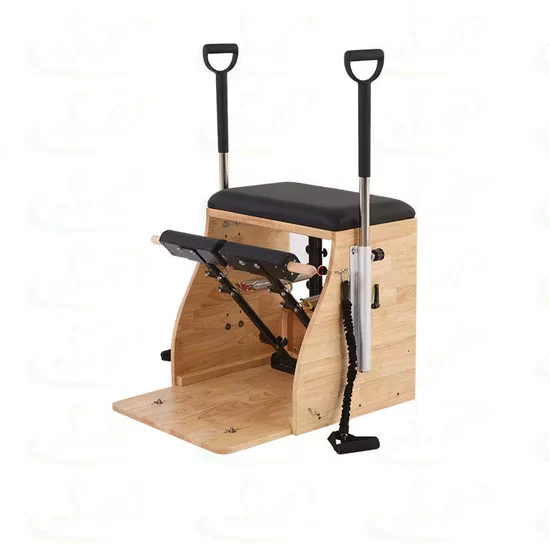
Vibration-Damped Oak Frame — Solid natural oak mass absorbs structure-borne noise that metal frames transmit through floor slabs.
Technical Specifications
| Parameter | Value |
|---|---|
| Product Type | Pilates Reformer |
| Frame Material | Solid Natural Oak |
| Carriage System | Wood-on-Wheel Glide Rail |
| Resistance Type | Spring (Progressive Tension) |
| Included Accessories | Long Box, Jump Board, Platform |
| Product Dimensions | 800 × 620 × 1100 mm |
| Net Weight | 45 kg |
| Max User Weight | Not specified |
| Noise Level | Sub-structure damping via solid wood mass |
| Customization | Logo and finish available |
| Certification | ISO 9001 (company-level) |
| Warranty | 3 Years |
Application Suitability
| Deployment Scenario | Typical Use |
|---|---|
| Boutique Pilates studio above retail or residential units | Full reformer classes where carriage rattle and spring clank must not penetrate floor slabs |
| High-end residential private gym on suspended floor | Daily reformer practice without vibration transfer to living spaces below |
| Corporate wellness center shared by multiple tenants | Group reformer sessions with acoustic sensitivity from adjacent offices |
| Rehabilitation clinic with ground-floor treatment rooms | Low-impact spring resistance work requiring stable, resonance-free platform |
Why Solid Oak Eliminates the Carriage Rattle That Triggers Complaints
Wood mass and grain structure absorb vibrational energy that aluminum extrusion amplifies.
When a metal-frame reformer sits on a suspended floor, every carriage return sends impact noise through the slab. Boutique studios on upper levels of mixed-use buildings face complaints from tenants below — the high-frequency metal-on-metal rattle during footwork sequences and the spring clank during strap work travel directly through structural connections. [NEED_CITE: structure-borne noise transmission through floor slabs in mixed-use commercial buildings]
I have seen aluminum reformers retrofitted with aftermarket dampening pads after deployment, and the results are inconsistent because the vibration originates from the rail contact point itself. The natural oak Pilates reformer commercial wooden frame takes a fundamentally different approach: the solid wood rail and carriage interface produces lower decibel glide than metal rail systems, and the frame mass naturally dissipates energy before it reaches the floor connection points.
Where This Reformer Fits in a Studio Equipment Layout
The natural oak Pilates reformer serves as the primary apparatus for classical and contemporary reformer programming across beginner through advanced intensity ranges. In a studio floor plan, it pairs with combo chairs and cadillacs to create circuit-style class formats, and its accessory modularity — long box for prone and seated work, jump board for plyometric intervals, platform for standing sequences — allows a single frame to cover multiple disciplines without additional equipment footprint. The solid wood aesthetic aligns with boutique studio interiors where visible equipment contributes to the spatial design language, and the 800 × 620 × 1100 mm profile allows standard studio spacing between units.
Continuous Operation and Multi-Story Deployment Requirements
A reformer in a commercial studio endures repetitive carriage cycles across back-to-back classes, and the spring tension system must maintain consistent resistance feel without drift. [NEED_CITE: spring fatigue characteristics under high-frequency articulation in commercial Pilates equipment] The oak frame provides inherent thermal stability — unlike metal frames that expand and contract with studio temperature fluctuations, solid wood maintains dimensional consistency when moisture content is controlled. For upper-floor deployment, the 45 kg net weight provides sufficient mass to resist walking-induced vibration, and the wood-to-floor contact area distributes load across a wider footprint than point-loaded metal feet. Studios should verify subfloor flatness before installation, as uneven surfaces induce asymmetric rail loading that accelerates wheel wear on any reformer design.
Decoding the Spring Resistance and Wood Rail Interface
The progressive tension spring system delivers resistance that increases proportionally with carriage displacement — this linear curve means practitioners feel consistent load throughout each exercise range, unlike rope-based systems where resistance can feel uneven at extreme extensions. The wood-on-wheel carriage rail is the critical acoustic interface: wheel material and rail tolerance determine whether the carriage glides silently or develops lateral play that generates clicking over time. Spring tension calibration should be verified across the full set of springs, and replacement cycle documentation from the manufacturer indicates how many articulation cycles before measurable tension loss occurs. The accessory mounting points — where the jump board locks into the frame and the long box seats on the carriage — must use metal-reinforced interfaces because repeated attachment and detachment on wood threads alone will strip contact surfaces. [NEED_CITE: commercial Pilates equipment accessory mounting interface durability standards]
The Hidden Cost of Cutting Corners on Frame Material and Rail Tolerance
Metal-frame reformers in commercial studios generate a predictable complaint cycle: carriage rattle intensifies as wheel bearings wear, spring clank grows louder as anchor points fatigue, and the cumulative noise triggers tenant complaints in multi-story buildings. Studios then face the choice of replacing worn components on a schedule or swapping entire units for acoustically superior designs. Wood frames that lack proper moisture content specification can warp in humid studio environments, causing rail misalignment that creates carriage drag and uneven resistance — a problem that surfaces months after installation when seasonal humidity shifts. [NEED_CITE: wood moisture content specifications for dimensional stability in climate-controlled fitness environments] Accessories with plastic mounting hardware rather than metal-reinforced interfaces develop play over hundreds of attachment cycles, degrading the precision that practitioners expect from commercial-grade equipment.
Why This Product Line Addresses Studio Acoustic Challenges
The sub-35dB acoustic engineering standard we apply across our cardio range informs how we evaluate any equipment that contacts the floor in a multi-story deployment. This reformer’s solid oak frame aligns with that acoustic-first approach: the mass and grain structure provide inherent vibration damping that metal frames cannot replicate without added isolation hardware. Our 10,000-hour durability testing protocol extends to spring tension consistency and rail surface integrity over extended use cycles. The free 3D studio layout service accounts for reformer spacing, sightlines for instructor supervision, and airflow patterns between apparatus groupings. Full OEM customization including logo and finish allows the equipment to match studio branding without compromising the structural integrity of the oak frame.
Documentation & Test Records
- ISO 9001 certificate covering manufacturing quality management systems
- Wood species certification and moisture content specification sheet
- Carriage glide noise test data with decibel measurements at operational speed
- Spring tension calibration range and replacement cycle documentation
- Accessory mounting interface load test records for jump board and platform
- Installation guide covering subfloor preparation and rail alignment verification
Installation, Commissioning & Maintenance
- Verify subfloor flatness within tolerance before positioning the 800 × 620 × 1100 mm frame to prevent asymmetric rail loading
- Place vibration isolation pads beneath all contact points when deploying on suspended floors above occupied spaces
- Confirm spring tension calibration across all resistance springs using calibrated force gauge at initial commissioning
- Inspect carriage wheel material and rail surface monthly for wear patterns indicating misalignment or contamination
- Check metal-reinforced accessory mounting interfaces quarterly for fastener torque retention under repeated attachment cycles
- Maintain studio humidity within specified range to preserve oak dimensional stability and prevent rail warping
Equipment Selection and Deployment Inquiry
Provide your studio square footage and planned reformer count to receive a 3D layout with spacing, sightline, and airflow analysis. Specify whether the deployment floor sits above occupied spaces so we can confirm acoustic isolation requirements and recommend appropriate subfloor preparation. Indicate your target market and climate zone to verify wood moisture content specification and finish selection for long-term dimensional stability.
Frequently Asked Questions
Q: How does a solid wood frame compare to aluminum for commercial studio durability?
A: Solid oak provides superior vibration damping and acoustic performance, which is critical for multi-story deployments where structure-borne noise generates complaints. Aluminum frames are lighter and more resistant to humidity-induced warping, making them suitable for ground-floor studios with less acoustic sensitivity. Both materials can achieve long service life when engineered for commercial load cycles, but the maintenance profile differs — wood requires humidity control while aluminum requires bearing and rail surface inspection.
Q: What maintenance does a spring resistance system require versus rope-based resistance?
A: Spring systems require periodic tension calibration verification and scheduled replacement based on articulation cycle counts documented by the manufacturer. Springs maintain consistent progressive resistance across their service life but lose tension measurably after their rated cycle limit. Rope-based systems rely on friction and pulley interfaces that require lubrication and wear inspection, with resistance feel varying more across the range of motion compared to the linear curve springs deliver.
Q: How does the wood frame reduce structure-borne noise in upper-floor studios?
A: The solid oak mass and grain structure absorb vibrational energy at the source — the carriage rail contact point — rather than transmitting it through rigid connections to the floor. Metal frames conduct vibration efficiently through their structural connections, requiring aftermarket isolation pads to achieve comparable acoustic performance. The 45 kg frame weight also provides stability that resists walking-induced oscillation, reducing the low-frequency vibration that travels most effectively through building structures.
Q: Which accessories integrate with the frame without requiring modification?
A: The included long box, jump board, and platform are designed for direct mounting on the oak frame using metal-reinforced attachment interfaces. These accessories cover prone and seated exercises, plyometric jump sequences, and standing balance work respectively. Before ordering additional third-party accessories, verify that the mounting interface geometry matches the frame specifications, as non-compatible attachments can damage wood contact surfaces and void warranty coverage.
Q: What humidity range should the studio maintain to prevent wood frame warping?
A: Solid oak frames require stable indoor humidity to maintain dimensional stability and prevent rail warping that causes carriage drag. Studios in coastal or tropical climates may need dehumidification systems, while studios in arid climates with evaporative cooling may need humidification to prevent wood drying and cracking. The manufacturer provides specific moisture content targets and acceptable humidity ranges in the installation documentation, and seasonal inspection of rail alignment should be added to the maintenance schedule.
![White Maple Wood Pilates Ladder Barrel for Body Building Fitness [WARN] draft identifier mismatch](https://bicksport.com/wp-content/uploads/2026/08/white-maple-wood-pilates-ladder-barrel-for-body-building-fitness-warn-draft-identifier-mismatch-ec9540.webp)
![2025 Wholesale Pilates Wall Unit Wood Sliding Reformer with Full Tracking [WARN] draft identifier mismatch](https://bicksport.com/wp-content/uploads/2026/08/2025-wholesale-pilates-wall-unit-wood-sliding-reformer-with-full-tracking-warn-draft-identifier-mismatch-04e46e.webp)
![Aluminum Pilates Reformer with Trapeze Tower for Commercial Studio Use [WARN] draft identifier mismatch](https://bicksport.com/wp-content/uploads/2026/08/aluminum-pilates-reformer-with-trapeze-tower-for-commercial-studio-use-warn-draft-identifier-mismatch-413f93.webp)