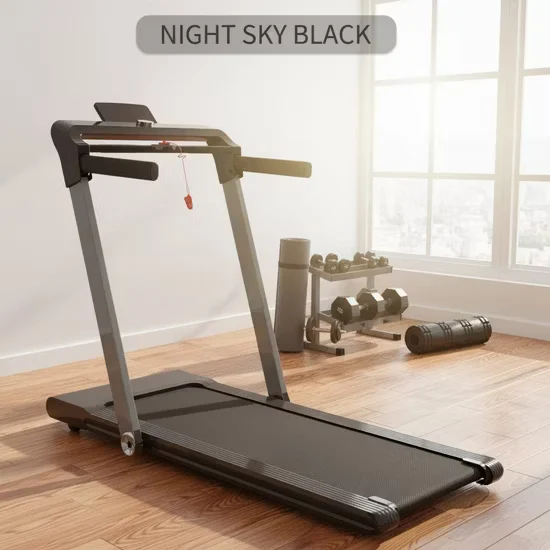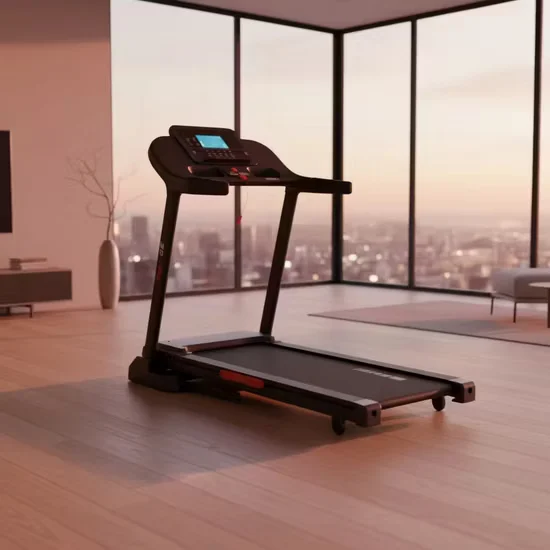
Space-efficient deployment — The MT296 foldable electric treadmill with DC motor home fitness design reduces stored footprint for residential and light-commercial zones.
Technical Specifications
| Parameter | Value |
|---|---|
| Product Type | Foldable Treadmill |
| Designation | MT296 |
| Motor Type | DC |
| Motor Power | DC 2.0 HP (peak or continuous not specified in source) |
| Speed Range | 1–20 km/h |
| Running Surface | 1200 x 520 mm |
| Console Type | LCD (Speed / Dist. / Time / Cal. / Pulse) |
| Programs | 16 preset |
| Heart Rate | Handgrip pulse sensors |
| Foldable | Yes |
| Product Unfold Size | 1580 x 865 x 1300 mm |
| Product Folded Size | 910 x 865 x 1345 mm |
| Net Weight | 64.0 kg |
| Certification | CE, RoHS |
| OEM/ODM Custom | Available |
Application Suitability
| Deployment Scenario | Typical Use |
|---|---|
| High-end residential home gym | Daily walking and jogging in space-constrained apartments |
| Boutique hotel guest fitness center | Compact cardio option for guest-room floors with shared walls |
| Corporate wellness room | Intermittent use during breaks with fold-and-store convenience |
| Light-commercial studio | Low-density cardio supplement alongside strength equipment |
Why DC Motor Treadmills Fail in Shared-Wall Deployments
Match motor duty cycle to actual daily run-time before specifying equipment.
Noise complaints surface in residential towers and boutique hotels when operators deploy treadmills without verifying acoustic performance under load. A motor that performs adequately at 30 minutes per day can generate noticeable vibration and heat after two continuous hours, triggering guest complaints that reach the front desk before maintenance receives the work order [NEED_CITE: motor duty cycle classification for continuous residential operation]. Specifying a foldable electric treadmill DC motor home fitness unit requires confirming whether the facility expects intermittent residential patterns or continuous rotation among multiple users. Operators who skip this step often face batch replacement costs within the first year of deployment.
Cardio Zone Positioning for Compact Environments
The MT296 serves walking and steady-state jogging within the 1–20 km/h range, fitting users who train at low to moderate intensity. In a residential fitness room, it pairs with a stationary bike or elliptical to cover both impact and non-impact cardio modalities without requiring a large floor area. Its 1200 x 520 mm running surface accommodates users of average stride length, and the foldable frame allows the unit to occupy a storage closet between sessions. This foldable electric treadmill DC motor home fitness configuration suits deployment densities where square footage remains limited and equipment must clear the floor for multi-purpose use.
Deployment Environment Constraints for Foldable Treadmills
Daily run-time expectations directly affect motor thermal management; facilities planning back-to-back user sessions should verify the DC motor’s duty cycle rating against projected hourly throughput [NEED_CITE: thermal management requirements for DC motors in shared fitness spaces]. Shared-wall residential floors require attention to vibration transmission through the frame into the subfloor, making rubber isolation pads a standard installation requirement. The unit’s power draw must align with local voltage standards before the shipment leaves the factory, as plug and frequency mismatches discovered on-site delay commissioning. Operators deploying on upper floors should also confirm elevator dimensions accommodate the unfolded frame during delivery.
Drive System and Console Specifications Explained
DC motors deliver smooth acceleration at lower speeds and operate at reduced noise levels compared to equivalent AC units, making them appropriate for residential zones where acoustic thresholds are strict. However, DC motors carry thermal limits under continuous load that differ from AC continuous-duty ratings; the distinction between peak and continuous horsepower becomes critical when specifying for environments where multiple users share a single unit throughout the day. The LCD console displays speed, distance, time, calories, and pulse through handgrip sensors, providing immediate feedback without facility management software integration. Sixteen preset programs supply structured workout variety for users who prefer guided sessions over manual control. The foldable mechanism reduces the stored footprint from 1580 mm to 910 mm in length, a reduction that matters in rooms serving dual purposes.
The Cost of Overlooking Specification Gaps
Residential-grade motors installed in light-commercial settings frequently overheat within months, leading to warranty disputes and unplanned equipment swaps that disrupt member routines [NEED_CITE: failure rate comparison between residential and commercial treadmill motors]. Facilities that deploy treadmills above occupied rooms without noise test documentation encounter repeated guest complaints, sometimes resulting in entire cardio zones being relocated at significant renovation expense. Handgrip-only heart rate monitoring suffices for casual use but proves unreliable during interval training, where users release the rails and data capture drops. Voltage mismatches between the factory configuration and the destination market force on-site rewiring or transformer installation, delaying opening schedules.
Why Operators Source from This Cardio Line
Every unit in the Biketon Sport cardio family undergoes 10,000-hour continuous operation testing on motors, frames, and sealed bearings, providing documented durability records rather than marketing claims. The MT296 occupies a compact footprint that fits within 3D cardio zone layouts designed for apartment fitness rooms and hotel guest floors, where aisle spacing and airflow around each unit affect both user comfort and equipment thermal performance. OEM customization extends to console UI language, color matching, and logo placement at flexible minimum order quantities. Facility operators receive a complete 3D layout plan covering equipment placement, sightlines, and ventilation before committing to a purchase order. Technical support remains available around the clock for commissioning and spare parts inquiries.
Documentation & Test Records
- CE declaration of conformity for the MT296 treadmill
- EN 957 safety and performance test report
- ISO 9001 quality management certificate
- RoHS compliance statement for electronic components
- Motor specification sheet with duty cycle data
- Console technical documentation and wiring diagram
Installation, Commissioning & Maintenance
- Maintain minimum 500 mm clearance behind the MT296 running deck for safe dismount and ventilation
- Place vibration-dampening pads under all four feet to reduce structural transmission in multi-story buildings
- Verify dedicated 220–240V circuit with correct plug type before initial power-on
- Calibrate LCD console speed readings and pulse sensor accuracy during first commissioning
- Inspect running belt tension and alignment after the first 50 hours of operation
- Wipe handgrip pulse sensors and console screen after each use to prevent sweat corrosion
Equipment Selection and Inquiry Guidance
Provide the cardio zone floor area and target unit count to receive a 3D layout plan covering spacing, sightlines, and airflow. Specify expected daily usage hours per treadmill so motor duty cycle can be matched to operational demand. Identify the deployment floor and adjacent occupied spaces to confirm acoustic requirements. State the destination market voltage and plug standard to ensure factory configuration accuracy. Indicate whether console data export to facility management systems is required for your operational workflow.
Frequently Asked Questions
Q: What is the difference between peak and continuous motor power ratings?
A: Peak horsepower measures the maximum output a motor can produce for short bursts, while continuous horsepower reflects sustained output under ongoing load. For shared facilities where multiple users rotate through the MT296 daily, continuous rating matters more than peak. Request the motor specification sheet to verify which rating applies before finalizing your equipment order.
Q: Is a DC motor suitable for commercial gym deployment?
A: DC motors provide quieter operation and smoother low-speed acceleration, which benefits residential and boutique hotel environments. However, commercial facilities with high user throughput should confirm the continuous duty cycle rating. The MT296 DC motor suits light-commercial and residential applications where daily run-time remains within the manufacturer’s recommended thermal limits.
Q: How does foldable design affect structural stability?
A: Foldable frames incorporate hinge mechanisms that introduce additional flex points compared to fixed-frame treadmills. The MT296 addresses this through reinforced locking pins at the fold joint. Users should verify that the locking mechanism engages fully before each session and inspect hinge wear during routine maintenance intervals specified in the installation guide.
Q: Can the LCD console export data to facility management software?
A: The MT296 LCD console displays real-time metrics including speed, distance, time, calories, and pulse without built-in wireless connectivity. Facilities requiring automated usage tracking should evaluate whether external monitoring solutions are compatible or consider upgrading to a console model with IoT capability from the broader product line.
![Rust Proof Mt026m Fold Running Motorized Treadmill for Training [WARN] draft identifier mismatch](https://bicksport.com/wp-content/uploads/2026/08/rust-proof-mt026m-fold-running-motorized-treadmill-for-training-warn-draft-identifier-mismatch-92741f.webp)

![Anti-Tipping Mt296 Electric Treadmill for Home Fitness Running [WARN] draft identifier mismatch](https://bicksport.com/wp-content/uploads/2026/08/anti-tipping-mt296-electric-treadmill-for-home-fitness-running-warn-draft-identifier-mismatch-f67a1d.webp)