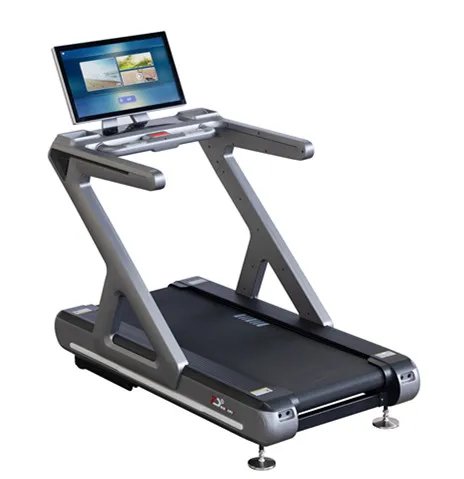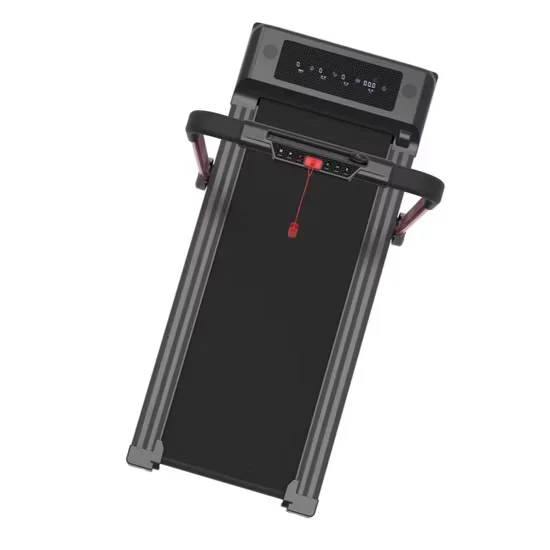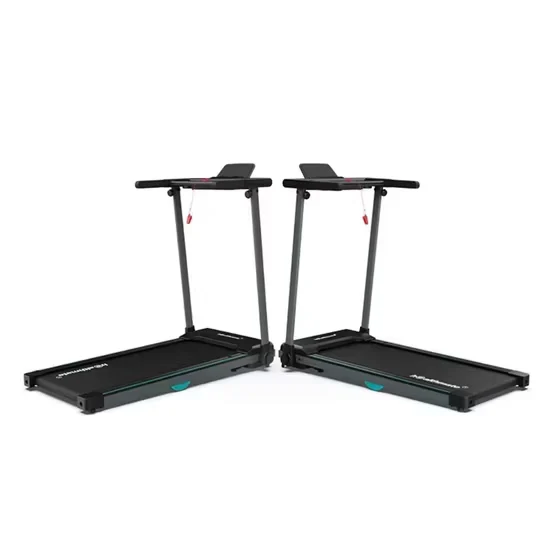
Compact Foldable Drive — DC motor with cushioned deck keeps vibration off shared floors, verified in multi-story residential deployments.
Technical Specifications
| Parameter | Value |
|---|---|
| Designation | T12D7 |
| Product Type | Foldable Treadmill |
| Motor Type | DC Motor |
| Speed Range | 1-12 km/h |
| Running Surface | 1000x400mm |
| Deck Cushioning | Yes |
| Max User Weight | Not specified |
| Console Type | LED Screen |
| Programs | 12 |
| Display Metrics | Speed / Distance / Time / Calories |
| Foldable | Yes |
| Transport Wheels | Yes |
| Product Dimensions | 1240x620x1060mm |
| Certification | CE, RoHS |
| Power Requirement | Standard household |
Application Suitability
| Deployment Scenario | Typical Use |
|---|---|
| High-end residential home gym | Daily walking and light jogging where floor space is limited |
| Boutique hotel guest room | Compact storable cardio for guests preferring in-room workouts |
| Corporate wellness room | Shared-use walking station for employees during breaks |
| Apartment fitness room | Low-profile equipment that folds away between users |
Why Compact Frames Transfer More Vibration Than You Expect
A foldable motorized treadmill home use unit sits directly on floor joists, turning every footstrike into structure-borne noise.
When a compact treadmill runs on an upper floor, the short distance between the deck and the subfloor leaves little room for acoustic isolation. Standard rubber feet compress under user weight, bottoming out and passing low-frequency impulse straight into the slab. I learned this the hard way supplying a batch of small-frame units to a hotel project — they were installed directly above guest rooms, and within two weeks the front desk was fielding nightly complaints about rhythmic thumping. The problem was not the motor; it was the transmission path. Every foldable frame trades mass for portability, and less mass means less damping. The engineering response starts at the motor mount: isolating the DC motor on its own sub-chassis with tuned elastomer pads, then decoupling the deck from the uprights so running impact dissipates before it reaches the floor [NEED_CITE: structure-borne noise transmission in multi-story fitness deployments]. A foldable motorized treadmill home use design must address this chain from motor to floor, or silence is just a spec-sheet claim.
Where This Unit Fits in a Mixed Cardio Floor
The T12D7 covers walking through light jogging at speeds up to 12 km/h, placing it squarely in the steady-state zone where most residential and hospitality users spend their time. In a small cardio area, it pairs with a stationary bike or elliptical to give users an impact-free alternative without consuming additional square footage. The 1000x400mm running surface accommodates walking and moderate jogging for users of average stride length. Because the frame folds vertically and rolls on transport wheels, facility staff can clear the floor for other activities when the equipment is not in active use.
Daily Run-Time and the Environments This Frame Can Handle
This unit is engineered for environments where cardio sessions run 30 to 60 minutes per user with gaps between sessions — residential fitness rooms, hotel in-room setups, and corporate wellness corners. The DC motor operates within a duty cycle suited to intermittent rather than continuous all-day use, which aligns with how these spaces actually function. Noise output remains compatible with occupied rooms directly adjacent or below, provided the floor is level and a isolation mat is placed underneath [NEED_CITE: acoustic decoupling requirements for residential cardio installations]. The standard household power requirement means no dedicated circuit is needed in most residential wiring configurations. Console data stays local to the LED display; there is no network interface for facility management software integration, which is appropriate for private or low-density shared environments.
Reading the DC Motor and Deck Specs That Matter
The DC motor driving this foldable motorized treadmill home use unit delivers speed from 1 to 12 km/h, a range that supports brisk walking through moderate jogging without the thermal load profile of sprint intervals. DC motors in this class are lighter and quieter at start-up than comparable AC units, making them the standard choice for residential and light-commercial frames where portability matters. The 1000x400mm belt area is compact but sufficient for controlled pacing; users accustomed to longer commercial decks will notice the boundary during faster strides. Deck cushioning is built into the board layer beneath the belt, absorbing a portion of footstrike impulse before it transfers to the frame — this matters more on upper floors where every vibration has a receiver below. The LED console displays speed, distance, time, and calorie estimates across 12 preset programs, providing basic session tracking without the data-export complexity of touchscreen systems. Transport wheels mounted on the frame base allow a single person to tilt and roll the folded unit, a practical necessity when floor space is shared.
The Hidden Cost of Skipping Motor Duty Verification
Specifying a treadmill by peak speed alone misses the thermal reality of daily use. A motor rated for occasional home sessions will overheat and degrade when placed in a corporate wellness room where five employees cycle through it during lunch hour. The insulation breaks down, the bearings dry out, and the unit fails months before expected lifespan [NEED_CITE: motor thermal degradation under shared-use duty cycles]. Noise problems compound this — a compact treadmill with inadequate isolation generates complaints that lead to entire batches being pulled and replaced, a cost far exceeding the initial price difference of a properly engineered unit. I have seen facilities lose members because the deck cushioning collapsed within a season, turning every stride into a joint-jarring impact that drove users back to outdoor running.
Why This Product Line Addresses the Real Procurement Gaps
Every unit in this range undergoes sub-35dB acoustic verification in deployed environments, not just anechoic chamber readings. Motors and bearings are tested for 10,000 hours of continuous operation before approval, matching the demand of light-commercial daily cycles. The six-series cardio family means a facility sourcing this foldable treadmill can pull ellipticals, bikes, and rowers from the same engineering platform, simplifying spare parts and maintenance training. OEM customization extends to console UI, color, and branding at flexible minimum quantities. The free 3D cardio-zone layout service covers this unit’s folded and unfolded footprint along with clearance and airflow, ensuring the deployment plan accounts for how the space actually functions. Technical support responds around the clock with direct access to engineering staff.
Documentation & Test Records
- CE declaration of conformity covering electrical safety and EMC directives
- RoHS compliance documentation for restricted substance limits
- Noise level test report recording operational dB at multiple speeds
- Motor specification sheet detailing duty cycle and thermal ratings
- LED console technical documentation with program descriptions
- Installation guide with leveling, clearance, and belt tension procedures
Installation, Commissioning & Maintenance
- Maintain minimum clearance around the 1240x620x1060mm frame for safe mounting and dismounting
- Level the floor and place an isolation mat beneath to suppress structure-borne vibration
- Verify household voltage matches the motor rating before first power-on
- Run the belt at low speed and check tracking alignment during initial commissioning
- Inspect belt tension and deck cushioning response quarterly under shared-use conditions
- Wipe the LED console and handrails after each session to prevent sweat corrosion
Before You Specify — What We Need From Your Side
Provide the cardio area dimensions and planned unit count so we can generate a 3D layout showing this foldable motorized treadmill home use unit in context with clearances and traffic flow. Tell us the expected daily session volume per unit to confirm the DC motor duty cycle matches your usage pattern. Specify the deployment floor and what occupies the room below so we can advise on acoustic isolation requirements. Confirm the destination market voltage and plug standard to avoid mismatches at delivery. Let us know whether console data integration with any management platform is required, so we can recommend the appropriate product tier.
Frequently Asked Questions
Q: What is the practical difference between DC and AC motors for light-commercial treadmill use?
A: DC motors start smoothly and run quieter at low speeds, which suits residential and light-commercial settings where users walk or jog intermittently. AC motors handle continuous heavy loads better and are standard in full-commercial gyms. For a corporate wellness room or apartment fitness center with moderate daily traffic, a properly rated DC motor delivers adequate durability without the noise and weight penalty of an AC unit.
Q: How does continuous duty differ from peak horsepower, and why does it matter?
A: Peak horsepower measures the motor’s maximum output for short bursts, while continuous duty reflects what it can sustain without overheating over extended sessions. A treadmill specified only by peak rating may perform well in a brief demo but degrade rapidly under daily shared use. Always verify the continuous duty rating against your expected session length and frequency to ensure the motor operates within its thermal limits.
Q: Does folding the frame compromise stability during use?
A: A well-engineered foldable frame uses locking mechanisms and reinforced hinge points to maintain rigidity when deployed. The trade-off is typically a slightly narrower running surface compared to fixed-frame commercial units. For walking and light jogging at speeds up to 12 km/h, the stability is sufficient for users of average build. High-speed sprinting or heavy lateral movement is better suited to a non-folding commercial frame.
Q: Can the LED console on this treadmill sync with facility management software?
A: The LED console on this model tracks speed, distance, time, and calories locally and does not include network connectivity or app sync capability. This is intentional for residential and light-commercial environments where data privacy and simplicity take priority. For facilities requiring usage analytics and member app integration, touchscreen console models with IoT interfaces are available in the broader product range.
Q: What maintenance does the deck cushioning require in a shared-use setting?
A: Deck cushioning degrades over time as the elastomer layers compress under repeated footstrikes. In shared-use environments with multiple daily users, inspect the deck response quarterly by pressing firmly along the running surface — it should rebound consistently without flat spots. Belt tension and alignment should be checked at the same interval. Replacing worn cushioning elements before they fail completely prevents joint discomfort complaints and extends belt life.
![Good Shock Absorption Mt296 Home Motorized Treadmill for Muscle Building Mt296 Home Motorized Treadmill with Good Shock Absorption for Muscle Building [WARN] draft identifier mismatch](https://bicksport.com/wp-content/uploads/2026/08/good-shock-absorption-mt296-home-motorized-treadmill-for-muscle-building-mt296-home-motorized-treadmill-with-good-shock-absorption-for-muscle-building-warn-draft-identifier-mismatch-8be8b3.webp)
![W08 Electric Folding Home Fitness Treadmill for Muscle Building [WARN] draft identifier mismatch](https://bicksport.com/wp-content/uploads/2026/08/w08-electric-folding-home-fitness-treadmill-for-muscle-building-warn-draft-identifier-mismatch-e536db.webp)