

Vibration-Free Stability — Solid maple construction and reinforced steel frame eliminate flex during dynamic Pilates movements.
Technical Specifications
| Parameter | Value |
|---|---|
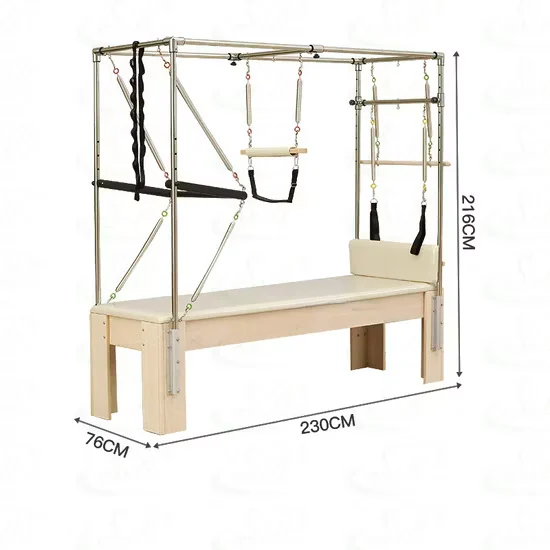
| Product Type | Ladder Barrel Reformer |
| Designation | SRY-03 |
| Brand | Senrui |
| Construction Material | Solid Maple Wood |
| Frame Material | Reinforced Steel |
| Dimensions | 1100 × 770 × 980 mm |
| Net Weight | 50 kg |
| Accessories Included | Long Box, Jump Board, Platform |
| Logo Customization | Available upon request |
| Finish | Solid Color |
| Target User | Adult, Unisex |
| Warranty | 3 Years |
| Production Capacity | 800 Pieces/Month |
| HS Code | 9506911900 |
Application Suitability
| Deployment Scenario | Typical Use |
|---|---|
| Boutique Pilates studio | Group reformer classes running multiple sessions daily with continuous member turnover |
| Rehabilitation and physiotherapy center | Patient recovery protocols requiring stable, vibration-free equipment under clinical supervision |
| High-end residential home gym | Private training environments where equipment aesthetics and noise transmission matter |
| Corporate wellness facility | Employee fitness rooms with moderate daily use and diverse user fitness levels |
| Professional sports training center | Athlete conditioning programs demanding precise equipment response under high-intensity loading |
Why Pilates Studios Face Equipment Wobble Within Months of Opening
Consumer-grade reformers cannot survive continuous class schedules without developing structural play.
Studio operators outfitting group reformer rooms often specify equipment based on unit cost rather than duty cycle, only to discover that frame joints loosen and barrel surfaces develop micro-movements within the first six months of heavy programming. When a maple ladder barrel reformer Pilates equipment unit flexes during peak contractions, the spring tension becomes inconsistent, instructors lose confidence in the apparatus, and members notice the instability during advanced sequences [NEED_CITE: commercial Pilates equipment fatigue testing standards]. The result is premature replacement cycles and member complaints that arrive before maintenance teams even open a work order.
How This Reformer Fits Into a Commercial Pilates Floor Plan
The SRY-03 occupies a defined footprint within the studio layout, complementing reformer carriages and cadillac towers by providing dedicated spinal articulation and hip flexion work that those apparatuses cannot replicate. In a six-unit group class configuration, operators typically intersperse ladder barrels between reformer stations to enable circuit-based programming without requiring members to leave their assigned zones. The 180 kg structural capacity accommodates the full spectrum of adult body types, while the solid maple surface provides the tactile feedback that synthetic materials cannot reproduce. Studios scheduling back-to-back classes from early morning through evening will find this maple ladder barrel reformer Pilates equipment maintains dimensional stability under continuous loading cycles.
Continuous Operation Requirements for Pilates Studio Environments
A commercial Pilates studio running four to six group sessions daily subjects each apparatus to sustained mechanical stress that residential equipment never encounters. The reinforced steel frame in this unit is engineered to resist joint loosening under repeated mounting and dismounting sequences, but proper deployment still requires level flooring with adequate load distribution across the base contact points. Studios installing on upper floors should verify structural slab capacity for concentrated point loads at the 50 kg unit weight. Temperature and humidity control within the studio environment protects the solid maple from seasonal moisture expansion that could alter barrel curvature over time [NEED_CITE: hardwood fitness equipment environmental requirements]. Facilities planning back-to-back class schedules with minimal changeover intervals should establish weekly inspection protocols for frame joint torque verification.
Material Science Behind Solid Maple Versus Synthetic Barrel Construction
Solid maple delivers inherent vibration dampening characteristics that molded plastic and composite materials cannot replicate, absorbing micro-vibrations at the molecular level rather than transmitting them through the frame to the studio floor. The wood’s natural grain structure distributes compressive loads across a broader surface area, reducing point stress concentrations that cause synthetic barrels to crack under cyclic loading. Reinforced steel framing provides the structural backbone that prevents frame twist during asymmetric exercises where the user’s weight shifts laterally across the apparatus. The long box accessory extends the effective work surface for supine spinal articulation sequences, while the jump board attachment transforms the unit into a plyometric platform for athletic conditioning protocols. Each accessory mounting point is integrated into the primary frame structure rather than bolted on as an afterthought, ensuring load paths remain continuous under dynamic use.
The Hidden Cost of Specifying Residential Equipment for Commercial Deployment
Studio operators who purchase consumer-grade reformers based on initial unit cost discover within months that frame joints develop play, barrel surfaces lose their precise curvature, and accessory mounting points begin to shift under repeated loading. The resulting maintenance calls interrupt class schedules, frustrate instructors who cannot trust the equipment during advanced cueing, and generate member complaints about apparatus stability during peak contractions. Facilities that batch-replace failing units after the first year end up paying twice while losing member confidence in the interim [NEED_CITE: commercial fitness equipment total cost of ownership analysis]. Studios committed to long-term operation specify commercial-grade construction from the outset because the alternative is discovering your equipment budget was actually a two-year rental agreement disguised as a purchase.
Why This Product Line Addresses Commercial Studio Requirements
Every unit undergoes frame load testing that simulates years of cyclic studio use before shipment, verifying that joints maintain torque specification under repeated dynamic loading. The solid maple barrel construction provides acoustic dampening that prevents vibration transmission to adjacent studio spaces, a consideration that matters when Pilates rooms share walls with massage therapy or yoga zones. OEM customization including logo placement, upholstery color and frame finish allows multi-location operators to maintain visual branding consistency across all deployed units. The complete accessory ecosystem ships integrated rather than as aftermarket add-ons, eliminating compatibility questions during installation. Facilities planning full studio buildouts receive three-dimensional layout planning that accounts for instructor sightlines, member circulation paths and equipment spacing requirements specific to this apparatus footprint. Technical support remains available around the clock for commissioning questions and operational guidance.
Documentation & Test Records
- Frame load testing documentation verifying structural integrity under dynamic cyclic loading
- Solid maple material grade certification including moisture content and treatment specification
- Accessory compatibility verification for long box, jump board and platform mounting interfaces
- OEM customization lead time and minimum order confirmation for logo and finish requirements
- Installation and commissioning guide with floor preparation and assembly sequence specifications
- Warranty terms and spare parts availability documentation for long-term operational planning
Installation, Commissioning & Maintenance
- Verify floor levelness within tolerance before assembly to prevent frame twist under the 1100 × 770 × 980 mm footprint
- Maintain minimum clearance on all sides for safe member mounting and instructor access during class sessions
- Inspect frame joint torque specifications weekly during initial deployment period, then monthly once stabilized
- Apply wood surface treatment per manufacturer schedule to protect solid maple from humidity fluctuation and sweat exposure
- Verify accessory mounting point security before each class session when long box or jump board attachments are in rotation
- Establish quarterly inspection protocol for steel frame finish integrity and upholstery wear assessment
Equipment Selection and Deployment Planning
Provide your studio square footage and planned apparatus count to receive a three-dimensional layout showing member flow, instructor positioning and equipment spacing optimized for this footprint. Specify your daily class schedule and expected member throughput so we can verify the frame and maple construction match your operational intensity. Indicate whether this deployment shares walls or floors with noise-sensitive spaces so we can confirm acoustic transmission characteristics. Clarify whether you require OEM customization including logo placement and upholstery color matching for your studio branding standards.
Frequently Asked Questions
Q: How does solid maple compare to synthetic materials for ladder barrel durability?
A: Solid maple provides natural vibration dampening that synthetic composites cannot replicate, absorbing micro-vibrations rather than transmitting them through the frame. The wood’s grain structure distributes compressive loads across broader surface areas, reducing point stress that causes plastic barrels to crack under cyclic loading. Maple also maintains dimensional stability across temperature variations when properly finished and maintained in climate-controlled studio environments.
Q: Can the long box and jump board accessories be used during the same class session?
A: Yes, both accessories mount to integrated frame points that allow rapid changeover between exercises without requiring complete disassembly. Instructors planning circuit-based classes can program spinal articulation sequences on the long box, then transition members to plyometric work on the jump board within the same station. The mounting system maintains frame rigidity regardless of which accessory is currently deployed.
Q: What elements can be customized through OEM branding options?
A: Logo placement on the frame, upholstery color selection and solid color finish options are all available for customization with flexible minimum order quantities. Multi-location studio operators typically standardize these elements across all deployed units to maintain visual consistency. Customization scoping occurs during the quotation phase so lead times and specifications are confirmed before production begins.
Q: How does this reformer perform under continuous commercial class schedules?
A: The reinforced steel frame and solid maple construction are engineered for studio environments running multiple daily sessions with continuous member turnover. Frame joints maintain torque specification under repeated mounting cycles, while the maple barrel resists surface wear that would alter exercise biomechanics over time. Facilities running four to six classes daily should establish weekly inspection protocols during the initial break-in period.
Q: What maintenance does the solid maple surface require in a studio environment?
A: Regular wiping with manufacturer-approved cleaning solutions removes sweat residue and prevents surface degradation. Periodic wood treatment application protects against humidity fluctuation that could cause seasonal expansion or contraction. Studios should avoid abrasive cleaning agents that strip the protective finish, and any surface scratches should be addressed promptly to prevent moisture intrusion into the wood grain structure.

![Senrui Fitness Foldable Pilates Training Bed Exercise Pilates Reformer【产品草稿】product_mode: designation 原标题含型号吗?不含具体型号标识符如 T-9000,但草稿中 identifier 是 SRY-20B。原标题无型号。 实际 product_mode = designation,但原标题 "Senrui Fitness Foldable Pilates Training Bed Exercise Pilates Reformer" 中没有出现 SRY-20B 或其他型号。 等等,让我重新审视: - 原标题:Senrui Fitness Foldable Pilates Training Bed Exercise Pilates Reformer - 产品草稿 identifier: SRY-20B - product_mode: designation 原标题中没有型号,但 product_mode 标记为 designation。按规则:product_mode = designation 时,型号段从采集原标题原样复制。但原标题没有型号。 实际上原标题确实不含型号,但草稿说 designation。按规则第3条:若产品草稿 identifier 与原标题型号不一致 → 以原标题为准,并在标题下另起一行输出 [WARN] draft identifier mismatch。 原标题没有型号,identifier 是 SRY-20B,不一致,需输出 WARN。 词汇来源锁:每个实词必须来自原标题。 原标题词汇:Senrui, Fitness, Foldable, Pilates, Training, Bed, Exercise, Reformer 禁止引入:SRY-20B, commercial, studio 等原标题没有的词。 等等,"商业"相关的词呢?客户档案是普拉提站→可用 Studio / Solid Wood / Professional。但这些词原标题没有,按词汇来源锁不能用。 让我重新看规则: - 允许把原标题已有的词换成同义规范写法 - 类型词补全例外 主关键词是 "commercial foldable Pilates reformer",要尽量在前35字符内。但 "commercial" 原标题没有。 按词汇来源锁,不能用 commercial。 那就用原标题有的词重组。 原标题:Senrui Fitness Foldable Pilates Training Bed Exercise Pilates Reformer 核心产品词:Foldable Pilates Reformer (主关键词去掉 commercial) 原标题还有:Training Bed, Exercise, Senrui Fitness 优化标题:保留核心词,去冗余。"Pilates" 出现两次,"Exercise" 和 "Training Bed" 冗余。 可选:Foldable Pilates Reformer Training Bed Exercise Fitness 字符数计算... 让我构建一个50-70字符的标题: "Foldable Pilates Reformer Training Bed Exercise Equipment" - 原标题没有 Equipment "Foldable Pilates Reformer Exercise Training Bed Senrui Fitness" - 62字符 检查词汇:Foldable✓, Pilates✓, Reformer✓, Exercise✓, Training✓, Bed✓, Senrui✓, Fitness✓ 主关键词 "foldable Pilates reformer" 在前25字符内 ✓ 长度:Foldable Pilates Reformer Exercise Training Bed Senrui Fitness F-o-l-d-a-b-l-e(8) (9)P-i-l-a-t-e-s(16) (17)R-e-f-o-r-m-e-r(25) (26)E-x-e-r-c-i-s-e(34) (35)T-r-a-i-n-i-n-g(43) (44)B-e-d(47) (48)S-e-n-r-u-i(54) (55)F-i-t-n-e-s-s(62) = 62字符 ✓ WARN:草稿 identifier SRY-20B 与原标题不一致。Senrui Fitness Foldable Pilates Reformer Exercise Training Bed [WARN] draft identifier mismatch](https://bicksport.com/wp-content/uploads/2026/08/senrui-fitness-foldable-pilates-training-bed-exercise-pilates-reformere38090e4baa7e59381e88d89e7a8bfe38091product_mode-designation-e58e9fe6a087e9a298e590abe59e8b-1e2e8b.webp)
![Commercial Aluminum Pilates Reformer for Yoga Studio Use [WARN] draft identifier mismatch](https://bicksport.com/wp-content/uploads/2026/08/commercial-aluminum-pilates-reformer-for-yoga-studio-use-warn-draft-identifier-mismatch-799d04.webp)