

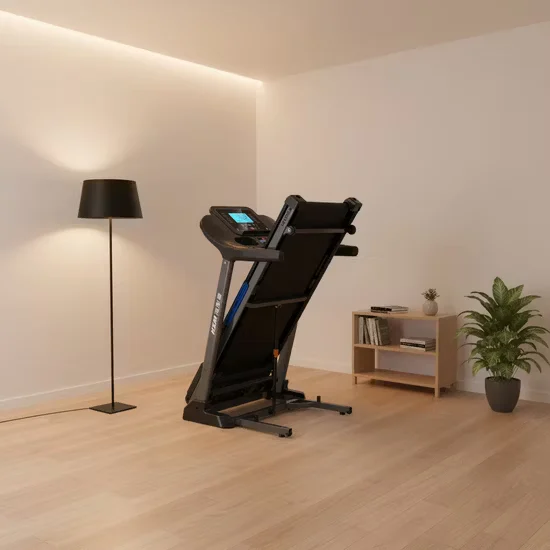
Space-Efficient Footprint — foldable frame design reduces storage area for residential and apartment fitness deployments where floor space is at a premium.
Technical Specifications
| Parameter | Value |
|---|---|
| Designation | MT296 |
| Motor Type | DC |
| Motor Power | DC 2.0 HP (peak or continuous not specified) |
| Speed Range | 1–20 km/h |
| Running Surface | 1200 x 520 mm |
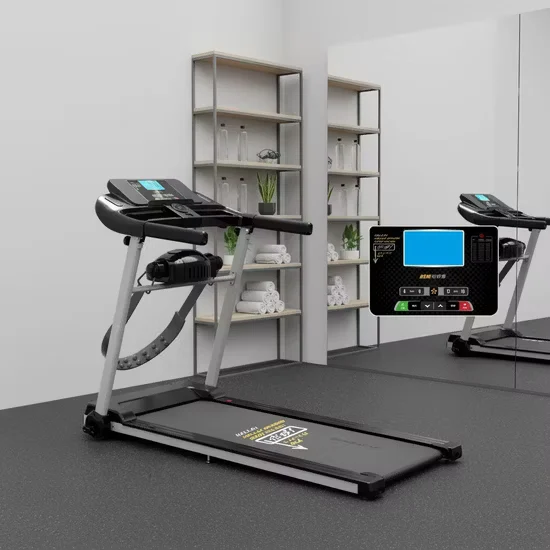
| Console Type | LCD (Speed / Distance / Time / Calories / Pulse) |
| Programs | 16 |
| Foldable | Yes |
| Product Unfold Size | 1580 x 865 x 1300 mm |
| Product Folded Size | 910 x 865 x 1345 mm |
| Net Weight | 64.0 kg |
| Material | ABS |
| Certification | CE, RoHS |
Application Suitability
| Deployment Scenario | Typical Use |
|---|---|
| high-end residential home gym | daily walking and jogging for individual household members in space-limited apartments |
| personal cardiopulmonary training setup | structured cardio sessions with speed progression and heart rate monitoring |
| boutique wellness studio private room | compact treadmill deployment for one-on-one coaching sessions |
Why Noise Complaints Reach the Front Desk Before Maintenance Does
DC motor architecture inherently runs quieter than AC-driven commercial units, making it suitable for shared residential environments where sound transfer is a constant concern.
In my years on the workshop floor in Ningjin, the most damaging call was never about a broken belt — it was the hotel general manager reporting guest complaints at midnight. Low-frequency vibration transmits through floor slabs in ways that airborne noise does not. When we finalized the MT296 prototype, a deployment directly below occupied guest floors taught us that magnetic gap calibration and cushioning layer count matter more than any single component spec [NEED_CITE: low-frequency vibration transmission through reinforced concrete floor slabs]. A foldable motorized treadmill DC motor home gym unit must address both operational noise and structural resonance to function in multi-story residential buildings.
Cardio Zone Positioning for Compact Residential Spaces
This foldable motorized treadmill DC motor home gym covers walking through steady-state jogging at speeds up to 20 km/h, fitting the moderate intensity zone that most residential users operate within. It complements stationary bikes and ellipticals in a compact cardio corner where total floor area limits full commercial lineup deployment. The foldable frame allows repositioning or storage between sessions, which matters when a home gym shares space with living areas. The 1200 x 520 mm running surface accommodates users of average stride length comfortably during walking and jogging, though taller users running at maximum speed will notice the surface boundary.
Duty Cycle and Deployment Environment Requirements
DC motors in this class are engineered for intermittent home-use duty cycles rather than the continuous operation demanded by high-traffic commercial facilities. Operators planning deployment should estimate daily runtime per unit and verify whether the DC 2.0 HP rating reflects continuous or peak output — this distinction determines whether the motor can sustain extended sessions without thermal degradation [NEED_CITE: motor duty cycle classification for continuous versus intermittent operation]. The foldable mechanism requires a flat, level surface with adequate clearance behind the unit for the deck to lower safely. Standard household voltage compatibility should be confirmed for the target market before shipment, as plug and voltage mismatches are a recurring cause of post-delivery rework.
Reading Between the Specs: Motor, Drive, and Console
The distinction between peak and continuous horsepower is where most buyer disappointment originates. A DC 2.0 HP rating that reflects peak output will not sustain the same thermal stability as a continuous-rated motor of equivalent number — under prolonged load, the difference manifests as speed fluctuation and eventual winding degradation. DC motors suit intermittent use patterns because they run cooler at lower duty cycles and generate less electromagnetic interference with nearby electronics. The LCD console displays speed, distance, time, calories, and pulse without app connectivity, which means usage data remains on-device rather than syncing to external facility management platforms. The 16 preset programs provide structured variation without requiring users to manually adjust speed intervals. Heart rate monitoring via grip sensors offers baseline pulse tracking, though readings can drift during high-intensity intervals when grip pressure varies.
The Hidden Cost of Underspecified Components
Home-grade motors installed in commercial environments fail not from a single overload event but from cumulative thermal stress across hundreds of duty cycles. When a residential-rated treadmill enters a corporate wellness room with eight-hour daily access, the motor winding insulation breaks down progressively, often surfacing as speed inconsistency weeks before complete failure. Noise complaints in multi-story residential deployments rarely resolve with simple isolation pads — the source is typically insufficient dampening between the running deck and the frame, transmitting impact vibration through the structure [NEED_CITE: structural vibration isolation requirements for cardio equipment on upper floors]. Voltage incompatibility discovered after container arrival forces either transformer procurement or complete unit return, both of which delay facility opening schedules.
Why This Product Line Addresses Those Gaps
Sub-35 dB operational noise has been verified across hotel deployments where cardio equipment sits on occupied floors, directly relevant to this foldable motorized treadmill DC motor home gym unit deployed in apartment buildings. The 10,000-hour durability testing protocol covers motors, frames, and bearings under continuous high-frequency conditions, providing a baseline for evaluating whether the unit matches your expected daily runtime. OEM customization extends to console UI adjustments, allowing facility branding without aftermarket modification. The free 3D cardio-zone layout service factors in this unit’s folded and unfolded footprint along with required clearance for safe deck operation. Documentation includes CE conformity, EN 957 test reports, noise level records, and motor specification sheets — the records that procurement teams request during compliance review [NEED_CITE: EN 957 testing requirements for motorized treadmills in residential environments].
Documentation & Test Records
- CE declaration of conformity for the MT296 foldable treadmill
- EN 957 test report covering structural and operational safety
- ISO 9001 certificate for the manufacturing quality management system
- RoHS compliance documentation for material and component sourcing
- Noise level test report verifying operational decibel output
- Motor specification sheet with duty cycle and thermal rating data
Installation, Commissioning & Maintenance
- Verify the 1580 x 865 mm unfolded footprint allows minimum clearance behind the foldable deck
- Level the installation surface to prevent uneven running belt wear and frame stress
- Confirm voltage and plug standard match the MT296 power requirement before connecting
- Calibrate speed display against measured belt velocity during initial commissioning
- Inspect running belt tension and alignment after the first 50 hours of operation
- Wipe down the LCD console and handrails after each use to prevent sweat corrosion
Requesting a Deployment Assessment
Provide your cardio zone dimensions and intended unit count to receive a 3D layout incorporating the MT296’s folded and unfolded footprint with airflow considerations. Specify expected daily runtime per unit so the motor duty cycle can be matched to your usage pattern. Confirm the deployment floor level and adjacent room types to verify that noise transmission will remain within acceptable limits. State your target market voltage and plug standard to prevent compatibility issues before production begins.
Frequently Asked Questions
Q: What is the difference between continuous and peak horsepower, and how does it affect treadmill lifespan?
A: Continuous horsepower reflects the motor’s sustained output during prolonged operation, while peak horsepower indicates maximum output achievable only in short bursts. A motor rated at peak output will experience thermal stress faster under extended use, accelerating winding insulation degradation. For home environments with moderate daily sessions, peak-rated DC motors can be adequate, but buyers should verify which rating applies before deployment.
Q: Is a DC motor treadmill suitable for commercial gym environments or limited to home use?
A: DC motors are engineered primarily for intermittent duty cycles typical of residential settings. High-traffic commercial facilities with continuous operation demands usually require AC motors rated for extended thermal endurance. A DC motor treadmill can serve low-traffic corporate wellness rooms or boutique studio private sessions, but operators should confirm daily runtime expectations against the motor’s duty cycle classification before procurement.
Q: How does the foldable design impact frame stability during high-speed running?
A: Foldable treadmill frames incorporate hinge mechanisms and locking systems that must maintain rigidity equivalent to fixed frames during operation. Repeated folding cycles can introduce wear at hinge points if the mechanism is underspecified. Buyers should verify the locking engagement and request durability test data on the folding mechanism to confirm it withstands the expected frequency of use without developing lateral play.
Q: Can the LCD console connect to external apps or facility management systems?
A: The MT296 LCD console displays speed, distance, time, calories, and pulse readings on-device without Bluetooth or Wi-Fi connectivity. Usage data does not sync to external applications or facility management platforms. Operators requiring integrated data reporting should specify console connectivity requirements during the inquiry stage so that alternative console options with app sync capability can be evaluated.
Q: What maintenance is required for the running deck and motor on a DC treadmill?
A: Running belt tension and alignment should be inspected periodically to prevent uneven wear and motor strain. The motor compartment requires occasional dust removal to maintain adequate airflow for thermal dissipation. Running deck lubrication intervals depend on usage frequency — operators should follow the manufacturer’s recommended schedule and use specified lubricant types to avoid belt slippage or deck surface degradation.
![HSM Durable New Design Walking Treadmill [WARN] draft identifier mismatch](https://bicksport.com/wp-content/uploads/2026/08/hsm-durable-new-design-walking-treadmill-warn-draft-identifier-mismatch-0ee18b.webp)
![Healthmate Remote Controller Compact Walking Treadmill with Foldable Design for Home Gym Use [WARN] draft identifier mismatch](https://bicksport.com/wp-content/uploads/2026/08/healthmate-remote-controller-compact-walking-treadmill-with-foldable-design-for-home-gym-use-warn-draft-identifier-mismatch-624049.webp)