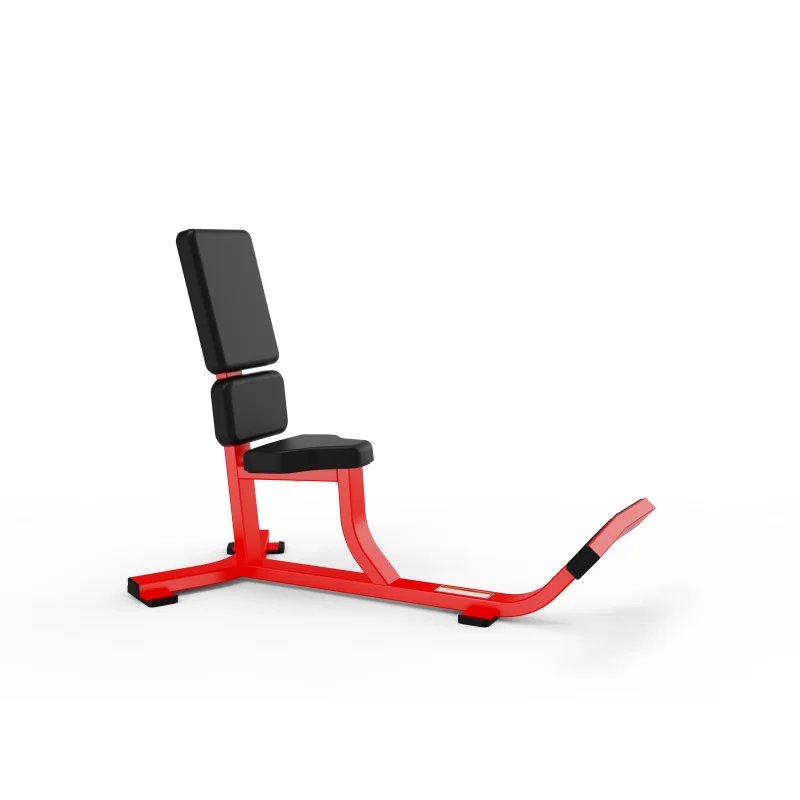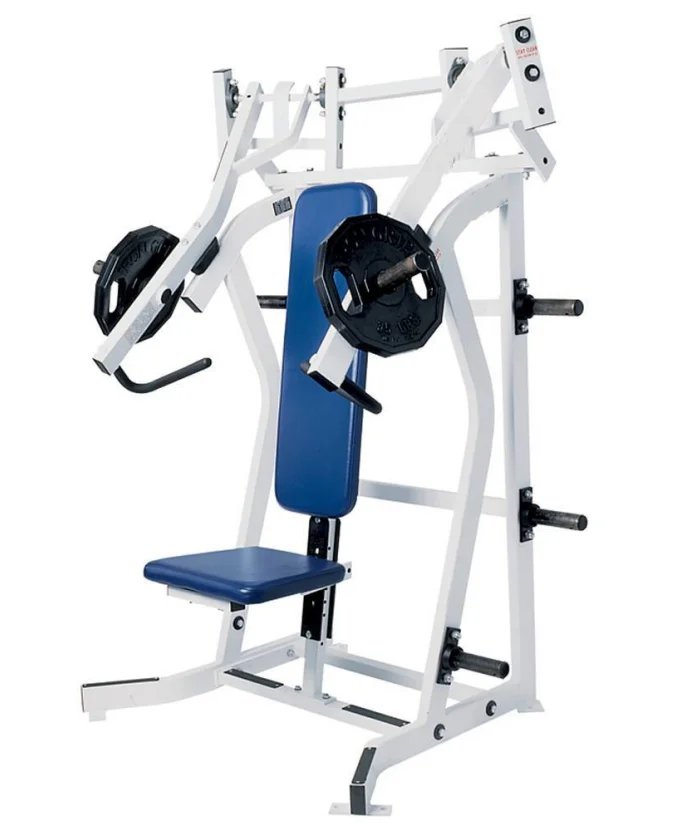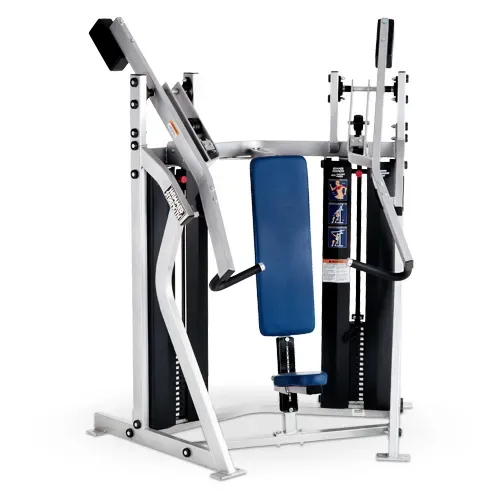
MTS-8008 ISO-Lateral Row — dual 80 kg weight stacks with independent lateral arms deliver smooth resistance through reinforced steel frames tested for continuous high-frequency facility use.
Technical Specifications
| Parameter | Value |
|---|---|
| Designation | MTS-8008 |
| Product Type | ISO-Lateral Row Machine |
| Resistance Type | Dual weight stack, selectorized |
| Weight Stack | 80 kg × 2 stacks |
| Dimensions (L × W × H) | 130 cm × 158 cm × 208 cm |
| Net Weight | 347 kg |
| Machine Grade | Commercial use |
| Max User Weight | Up to 180 kg |
| Condition | New |
| Customization | OEM / ODM available |
| Certification | CE, ISO, RoHS, SGS |
Application Suitability
| Deployment Scenario | Typical Use |
|---|---|
| Chain gym strength floor | High-frequency back and pulling work in multi-station circuits |
| Hotel fitness center on guest room floors | 24-hour self-service training with minimal noise transfer |
| Corporate wellness room | Midday row sessions for office workers with varied strength levels |
| High-end residential home gym | Independent bilateral pulling for dedicated strength zones |
| Sports performance training center | Athlete-specific unilateral row patterns for imbalanced load work |
Why Weight Stack Drag Destroys the Training Experience Before It Shows on the Maintenance Log
Smooth resistance output depends on pulley alignment and cable tension, not just the plates themselves.
In commercial strength areas, members cycle through machines quickly. When pulley bearings wear unevenly or cables stretch under repeated loading, the resistance curve becomes inconsistent — heavier at the start, lighter at peak contraction. Members stop using the station without reporting it, and usage data from floor walk-throughs often misreads the problem as programming rather than equipment degradation [NEED_CITE: commercial strength equipment maintenance intervals for pulley and cable systems].
Positioning the MTS-8008 in a Commercial Strength Layout
The MTS-8008 Hammer Strength MTS ISO-Lateral Row Machine commercial gym equipment fills the pulling-dominant slot in a strength circuit, complementing lat pulldowns and chest-supported rows by allowing independent arm movement. It supports moderate-to-heavy loads across rehabilitation through advanced hypertrophy ranges, fitting high-density floors where members rotate between machines at varied intervals. The 130 cm × 158 cm footprint requires standard spacing on both sides for entry and plate clearance, accommodating users across a broad height and torso-length range.
Floor Load, Noise Transfer, and What 347 kg Actually Means for Deployment
At 347 kg, the MTS-8008 sits firmly without anchoring on most commercial floors, but vibration from plate return during eccentric phases can transmit through slab joints. Placement away from shared walls and above occupied rooms requires rubber isolation pads rated for dynamic loads. Ventilation around the frame matters less than for cardio units, but dust accumulation on guide rods accelerates bearing wear in unfiltered HVAC environments. Standard single-phase power is not required since this is a purely mechanical system, though facilities planning adjacent smart console integration should route conduit during installation [NEED_CITE: structural load distribution for free-standing commercial strength machines].
Reading the Drive System: Guide Rods, Pulleys, and Cable Path Geometry
The dual 80 kg stacks ride on precision guide rods — their surface finish and alignment tolerance determine whether plates bind at mid-travel. Commercial-grade linear bearings outperform simple bushings under sustained lateral load, maintaining consistent friction across thousands of cycles. Cable routing through multiple pulley points creates the resistance curve: more redirects smooth the feel but introduce cumulative friction loss, while fewer redirects preserve raw load transfer at the expense of a less linear feel. The ISO-lateral arm design means each side operates on its own pivot, eliminating the mechanical coupling that causes one arm to compensate when the user pulls unevenly.
What Happens When Stack Guides and Cable Hardware Are Sourced to Cost Targets
Weight stacks that wobble on undersized guide rods develop uneven wear tracks, leading to plate-on-plate contact that produces metallic clatter audible across the strength floor. Cables with insufficient tensile rating stretch within months, requiring frequent re-tensioning that facility staff often defer. Pulleys with sealed but non-serviceable bearings fail silently until the resistance suddenly drops mid-set — a liability in unsupervised hotel and residential settings where members train without staff oversight [NEED_CITE: cable fatigue failure modes in selectorized strength equipment].
Why This Configuration Over Alternatives in the Pulling Category
The 347 kg frame mass and dual-stack layout position the MTS-8008 Hammer Strength MTS ISO-Lateral Row Machine commercial gym equipment for environments where equipment turnover must be high and downtime minimal. The independent lateral arms address a specific training gap that fixed-bar rows cannot fill. OEM customization covers frame color, pad material, and brand integration without altering the core mechanical spec. Deployment plans account for the 158 cm width when spacing adjacent pulling stations, and the full documentation package supports compliance audits without additional certification requests. Facilities outfitting from a single product family can match this unit with complementary pressing and leg stations for cohesive procurement.
Documentation & Test Records
- CE declaration of conformity for the MTS-8008 strength platform
- EN 957 test report covering static and dynamic load verification
- ISO 9001 certificate for manufacturing process control
- RoHS compliance statement for material composition
- Structural weld inspection and frame load test record
- OEM customization scope and approval documentation
Installation, Commissioning & Maintenance
- Allocate 130 cm × 158 cm footprint plus 80 cm clearance per side for safe entry and plate loading
- Level frame on vibration-dampening pads before tightening all anchor bolts to specified torque
- Inspect cable tension and pulley bearing play at monthly intervals under high-frequency deployment
- Lubricate guide rods with manufacturer-specified dry lubricant to prevent dust adhesion
- Replace selector pin detents when engagement becomes inconsistent under repeated use
Planning Your Inquiry Around Facility Requirements
Provide the total strength-zone square footage and adjacent equipment list to receive a scaled 3D layout that accounts for the MTS-8008 footprint and user flow. Specify the expected daily member volume so duty-cycle matching can confirm whether the dual-stack configuration meets your throughput needs. Identify the deployment floor and any noise-sensitive adjacent spaces to determine whether isolation pads or structural decoupling is necessary. Confirm your target market’s voltage standards only if powered accessories or integrated digital consoles are part of the scope.
Frequently Asked Questions
Q: How does ISO-Lateral arm movement differ from a fixed-bar row machine?
A: ISO-lateral arms pivot independently, allowing each side of the body to move through its own range without mechanical coupling. This means a user with unilateral strength imbalances cannot compensate with the stronger side, and the movement pattern matches natural shoulder and scapular mechanics more closely than a fixed bar path.
Q: What does the dual 80 kg stack configuration support in progressive loading?
A: Two independent 80 kg stacks let users load each arm separately, which is necessary for unilateral work and for accommodating left-right strength differences. The selectorized pin system allows small increments, supporting gradual overload across rehabilitation through advanced training phases without swapping hardware.
Q: Why does commercial-grade frame weight matter for a row machine?
A: A 347 kg frame resists rocking and lateral shift during heavy pulling, particularly when users generate explosive concentric force. Lighter frames require floor anchoring in most installations and may develop fatigue cracks at weld junctions under sustained high-frequency use, leading to premature retirement from commercial floors.
Q: What customization options are available under OEM and ODM agreements?
A: Customization covers frame powder-coat color, pad upholstery material and stitching, brand logo placement, and selector label graphics. Minimum order quantities are flexible depending on configuration complexity, and all custom units undergo the same assembly and QC testing as standard production units.
Q: How should strength-zone layout account for the MTS-8008 footprint?
A: The 130 cm × 158 cm footprint requires lateral clearance for independent arm travel and rear clearance for user entry. Plan for at least 80 cm between adjacent stations, and position pulling machines along sightlines that allow floor staff to monitor form without obstructing member flow through the strength circuit.