
![ISO-Lateral Incline Press 18 Commercial Gym Equipment [WARN] draft identifier mismatch](https://bicksport.com/wp-content/uploads/2026/08/iso-lateral-incline-press-18-commercial-gym-equipment-warn-draft-identifier-mismatch-568aee.webp)
Reinforced Steel Frame — Continuous high-frequency pivot testing confirms structural integrity across thousands of loading cycles.
Technical Specifications
| Parameter | Value |
|---|---|
| Designation | 2019 Hammer Strength ISO-Lateral Incline Press 18 |
| Product Type | Integrated Gym Trainer |
| Model NO. | OS — H5018 |
| Main Frame Material | Steel |
| Product Dimensions | 1435 × 1666 × 1978 mm |
| Net Weight | 139 kg |
| Main Frame Color | Available per customer requirements |
| Cushion Color | Available per customer requirements |
| Exercise Part | Back |
| Age Group | Adult |
| Gender | Unisex |
| Fit Area | Professional Gym and Club |
| OEM/ODM | Acceptable |
| Certification | ISO 9001, CE |
| Production Capacity | 1000 units |
| HS Code | 9506911900 |
Application Suitability
| Deployment Scenario | Typical Use |
|---|---|
| Hotel fitness center on guest room floors | Low-noise strength training for early-morning and late-night guest sessions |
| Chain gym cardio and strength zone | High-frequency incline pressing for general membership circuits |
| Corporate wellness room | Compact footprint upper-body station for time-limited employee workouts |
| High-end residential home gym | Premium aesthetic strength trainer matching interior design specifications |
| Sports performance training center | Independent-arm pressing for athlete hypertrophy and muscular balance work |
Why Frame Rigidity Matters More Than Plate Stack Weight
A flexing frame steals force before it reaches the muscle.
When an Integrated Gym Trainer sees eight hours of continuous loading in a busy commercial facility, micro-deflections at weld joints and pivot sleeves compound into noticeable play. Members feel it as a vague, unstable press path — and they stop using the machine. We have seen facilities cycle through multiple brands before realizing the problem was never the resistance mechanism but the frame absorbing energy through flex [NEED_CITE: structural fatigue in commercial strength equipment frames under cyclic loading].
The ISO-Lateral Incline Press commercial strength equipment addresses this with a reinforced steel main frame and sealed pivot bearings designed to hold alignment through extended duty cycles.
Where This Press Fits in a Strength Floor Layout
This Integrated Gym Trainer targets the incline pressing movement pattern, covering upper-chest and anterior-deltoid loading in a guided converging path. It pairs naturally with flat and decline press stations to complete a comprehensive pressing trio, and complements cable crossover and shoulder press units for full upper-body programming. The 1435 × 1666 mm footprint positions it along perimeter walls or as an anchor in a dedicated plate-loaded or selectorized cluster. Suitable for users across a broad体型 range thanks to the adjustable seat and independent arm design. The ISO-Lateral Incline Press commercial strength equipment supports balanced unilateral loading, letting each arm work through its own arc without the dominant side compensating.
Continuous-Use Environment and Deployment Clearances
In a chain gym running sixteen hours daily, this station may see sixty or more sets between open and close. Sealed bearings at every pivot point reduce maintenance intervals, which matters when a technician would otherwise need weekly greasing access [NEED_CITE: bearing service intervals for commercial gym pivot systems]. The 1978 mm overall height requires ceiling clearance verification — particularly in hotel fitness rooms built within standard floor-to-floor heights where suspended HVAC ducting hangs low. Floor leveling within tolerance prevents frame racking that accelerates bushing wear. Adequate side clearance allows full arm convergence without the user’s elbows approaching adjacent equipment or walls.
Dissecting the ISO-Lateral Arm and Pivot Engineering
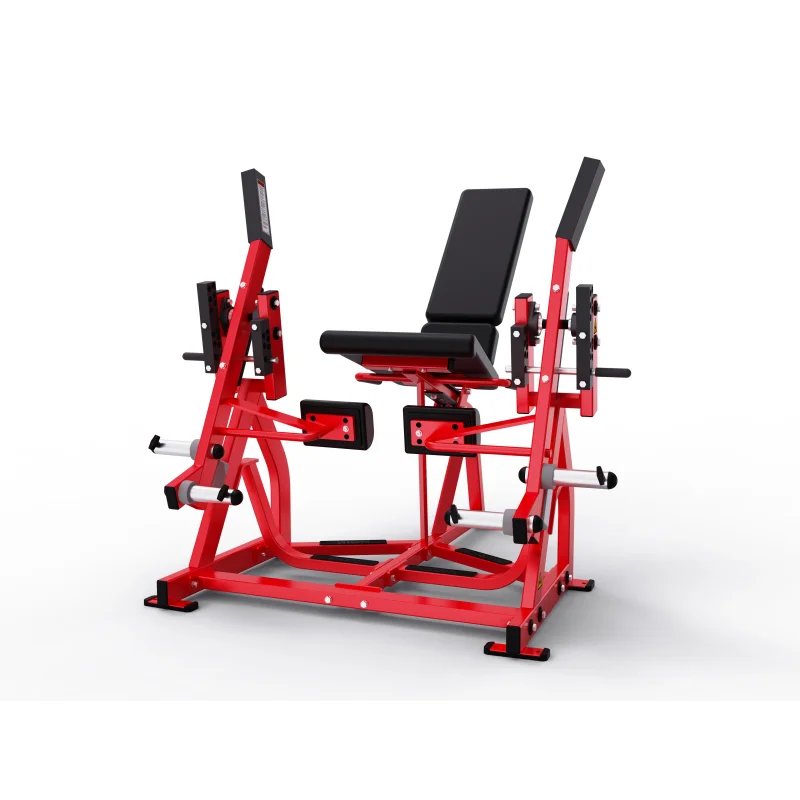
The independent ISO-lateral arm design lets each side follow a natural converging press path, which differs fundamentally from a fixed-bar machine where both hands are locked to one rigid axis. This means a user with asymmetrical shoulder mobility can press through a comfortable arc on each side independently. Sealed bearings at the pivot points eliminate the metal-on-metal wear that creates looseness over time — a common failure mode in high-traffic environments. The reinforced steel frame resists torsional load during heavy unilateral pressing, keeping the pivot geometry stable. OEM customization extends to frame and cushion color, allowing facility operators to match branding without compromising structural specification. The ISO-Lateral Incline Press commercial strength equipment delivers this through a mechanical system with no electronic components to fail, keeping lifetime maintenance cost predictable.
What Happens When Specs Are Compromised
Facilities that source strength equipment based solely on plate stack weight or aesthetic finish often discover problems within the first year. Pivot bushings made from unsealed nylon develop play under continuous loading, producing a knocking sound that members interpret as equipment failure. Thin-gauge steel frames flex under heavy sets, causing the press path to drift and placing uneven stress on the user’s shoulder joints [NEED_CITE: joint loading asymmetry caused by frame deflection in press machines]. Cushion foam that lacks adequate density compresses permanently within months, leaving users pressing from an unstable base. These failures rarely appear in a showroom test — they surface only after thousands of real-world cycles.
Why This Product Line Earns Its Floor Space
Every unit undergoes durability verification aligned with the 10,000-hour continuous operation standard applied across our cardio and strength families. The ISO-Lateral Incline Press commercial strength equipment benefits from the same sealed-bearing and reinforced-frame philosophy that keeps our treadmills running quietly above hotel guest rooms. Full OEM and ODM capability covers frame color, cushion color, and branding so the machine integrates visually with any facility identity. Our 3D layout service positions this station with correct spacing for safe arm travel and natural member flow through the strength zone. Documentation and technical support remain available around the clock.
Documentation & Test Records
- CE declaration of conformity covering the complete Integrated Gym Trainer assembly
- EN 957 test report verifying structural and mechanical safety requirements
- ISO 9001 certificate for the manufacturing quality management system
- Durability test record documenting pivot and frame cyclic loading performance
- Cushion foam density and upholstery wear resistance verification
- Installation and commissioning guide with full spare parts list
Installation, Commissioning & Maintenance
- Verify 1435 × 1666 mm footprint plus minimum safety clearance on all sides before positioning
- Level the steel frame on a flat surface using adjustable foot pads to prevent racking
- Inspect all pivot bolts and sealed bearings after the first 500 cycles of use
- Check cushion mounting hardware and upholstery tension during quarterly preventive maintenance
- Confirm ceiling height exceeds 1978 mm plus user overhead clearance before final placement
- Follow OEM-provided torque specifications for all structural fasteners during assembly
Planning Your Strength Equipment Procurement
Provide your strength zone square footage and target equipment list to receive a 3D layout showing optimal placement and member flow for this ISO-Lateral Incline Press commercial strength equipment alongside complementary stations. Specify daily operating hours and expected member volume so duty-cycle requirements can be matched accurately. Confirm ceiling height and adjacent room usage to verify clearance and acoustic compatibility. State your target market and any OEM branding requirements early in the inquiry to align production lead time.
Frequently Asked Questions
Q: What is ISO-lateral movement and why does it matter?
A: ISO-lateral means each arm operates independently on its own pivot axis rather than being fixed to a single bar. This allows each side of the body to press through a natural converging arc, accommodating differences in shoulder mobility and limb length between left and right. It prevents the dominant side from compensating during fatigue, producing more balanced muscular development over time.
Q: How does frame construction affect long-term durability?
A: The reinforced steel main frame resists torsional flex during heavy unilateral pressing, keeping pivot geometry stable through thousands of loading cycles. A frame that flexes under load accelerates bushing and bearing wear, eventually producing play that members notice as looseness or knocking. Gauge thickness and weld quality directly determine whether alignment holds or degrades over the equipment’s service life.
Q: Can frame and cushion colors be customized?
A: Yes. Both the main frame color and cushion color are available per customer requirements through our OEM and ODM program. This allows facility operators to match existing brand palettes or interior design specifications without altering the structural or mechanical configuration of the machine. Custom branding options are also available during the production scoping phase.
Q: What maintenance is required for pivot points and bearings?
A: The sealed bearings at each pivot point are designed to minimize maintenance in high-traffic environments, eliminating the need for regular greasing that unsealed bushings demand. Operators should inspect pivot hardware for correct torque during quarterly preventive maintenance and check for any audible play that might indicate wear. Replacement bearings are available through the standard spare parts program.
Q: What is the recommended ceiling height for installation?
A: The machine stands 1978 mm tall, and you must add the seated user’s overhead reach plus a safety margin. In facilities with suspended HVAC ducting or low-clearance mezzanines, measure from the finished floor to the lowest obstruction directly above the installation point. Our 3D layout service factors in these vertical clearances during the planning stage to avoid discovery of conflicts after delivery.

![OS-H5007 ISO-Lateral Shoulder Press Commercial Strength Equipment [WARN] draft identifier mismatch](https://bicksport.com/wp-content/uploads/2026/08/os-h5007-iso-lateral-shoulder-press-commercial-strength-equipment-warn-draft-identifier-mismatch-6e534b.webp)
