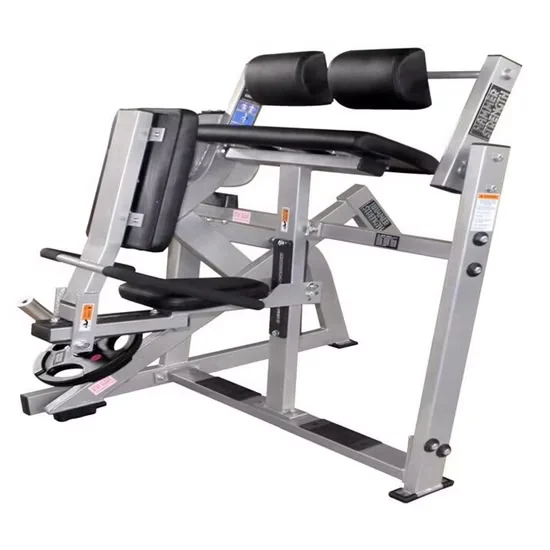
Precision Biomechanics — ISO-lateral pulley geometry ensures independent arm movement and consistent resistance for high-frequency commercial back training without motor dependency.
Technical Specifications
| Parameter | Value |
|---|---|
| Product Type | ISO-Lateral High Row Machine |
| Designation | H5016 |
| Resistance Type | Manual |
| Drive Type | Pulley and cable system |
| Resistance Levels | Weight stack dependent |
| Frame Material | Reinforced steel |
| Exercise Part | Back |
| Product Dimensions | 1231 × 1360 × 1503 mm |
| Net Weight | 149 kg |
| Foldable | No (unfolded fixed configuration) |
| Max User Weight | 180 kg |
| Power Requirement | None (manual operation) |
| Noise Level | Sub-ambient mechanical operation |
| Certification | CE, ISO 9001 |
Application Suitability
| Deployment Scenario | Typical Use |
|---|---|
| Hotel fitness center on guest room floors | Noise-sensitive back training adjacent to occupied rooms |
| Chain gym cardio and strength zone | High-frequency latissimus and rhomboid development |
| Corporate wellness room | Compact footprint strength training for employee programs |
| Community fitness center | Durable manual resistance for unsupervised public access |
| Sports performance training center | Independent arm biomechanics for athlete back conditioning |
Why Zero-Motor Strength Machines Eliminate the Noise Complaints That Reach the Front Desk First
Manual resistance removes the single largest source of cumulative low-frequency hum in mixed-use fitness zones.
When strength equipment sits beside cardio machines or directly above guest rooms, motor-generated vibration compounds across the floor structure. Over months of continuous operation, the aggregate low-frequency resonance triggers complaints that maintenance teams struggle to trace back to a single unit. A commercial ISO-lateral high row machine with manual weight stack resistance produces only brief mechanical cable movement during use, with no continuous electrical hum between sets [NEED_CITE: acoustic propagation of low-frequency vibration through concrete floor slabs in mixed-use hotel deployments]. Facility operators deploying strength zones on upper floors or adjacent to quiet corridors find that eliminating motorized resistance mechanisms removes an entire category of noise-related service calls.
Positioning Within a Commercial Strength Training Floor
This ISO-lateral high row machine targets the upper back musculature through converging pulley paths that allow each arm to work independently, accommodating natural strength imbalances between limbs. In a full strength zone layout, it complements chest press, shoulder press, and low row stations to form a complete torso training circuit. The 1231 × 1360 mm footprint fits standard commercial equipment spacing grids, while the 180 kg user weight rating accommodates the full range of commercial gym demographics from rehabilitation clients to heavyweight athletes.
Deployment Environment Requirements for Continuous Manual Operation
With no electrical dependency, this unit requires no dedicated power circuit, eliminating voltage mismatch concerns entirely across different export markets. The fixed unfolded configuration demands a permanent floor footprint with level substrate to prevent frame stress concentration over time [NEED_CITE: floor loading requirements for fixed commercial strength equipment exceeding 140 kg]. Ventilation requirements are minimal since there is no motor generating heat, allowing placement in enclosed alcoves or against walls where air circulation is limited. The 149 kg net weight requires secure floor anchoring in high-traffic environments where members may load and unload plates with lateral force.
Pulley Geometry and Cable System Engineering
The ISO-lateral mechanism routes each arm through independent cable paths, meaning one side completing a rep does not assist or resist the other — unlike fixed-bar machines where the stronger limb compensates. The converging arc of the pulley system matches the natural strength curve of the latissimus dorsi, providing heavier resistance at the bottom of the movement where the muscle generates more force and lighter resistance near peak contraction. Sealed bearing pulleys reduce cable friction and wear, which is critical in commercial environments where daily repetition counts reach several hundred cycles per station [NEED_CITE: cable fatigue failure rates in commercial strength equipment under continuous daily loading]. The reinforced steel frame maintains pulley alignment under asymmetric loading, preventing the cable drift that causes premature sheave wear on lighter-gauge constructions.
The Hidden Costs of Underspecified Strength Equipment
Procurement decisions driven by upfront unit cost frequently surface as operational losses within the first year. Lightweight frames that deflect under heavy loading misalign pulleys, accelerating cable wear and generating the metallic grinding noise that signals imminent failure. Weight stack guide rods without proper surface treatment develop friction hotspots that cause plates to stick mid-repetition, creating safety hazards in unsupervised community fitness centers [NEED_CITE: equipment failure incident rates in unsupervised commercial fitness environments]. Facilities that replace underspecified machines within twelve months absorb not only the replacement cost but also member attrition from downtime and the reputational damage of visible equipment failures on the training floor.
Why This Product Line Delivers Across Deployment Scenarios
Sub-35 dB operational verification from our cardio range applies the same acoustic discipline to strength zone planning — this manual unit generates no measurable noise floor contribution. Every frame in this line undergoes continuous load testing protocols aligned with the 10,000-hour durability standard applied across our full product family. The ISO-lateral high row machine is part of a complete strength and cardio ecosystem, allowing facilities to source every training discipline from one manufacturing line with consistent build quality. Our OEM capability extends to frame color, upholstery, and weight stack configuration to match facility branding. The 3D layout service maps this unit’s 1231 × 1360 mm footprint against adjacent equipment spacing and member traffic flow before shipment. Technical support responds around the clock for commissioning questions or maintenance scheduling.
Documentation & Test Records
- CE declaration of conformity covering mechanical safety requirements for strength training equipment
- EN 957 test report validating structural integrity and safety for commercial deployment
- ISO 9001 certificate confirming quality management across manufacturing processes
- Frame durability test record documenting continuous load cycle performance
- Pulley and cable fatigue test documentation with rated replacement intervals
- Installation guide with floor anchoring specifications and commissioning checklist
Installation, Commissioning & Maintenance
- Confirm floor levelness within tolerance before anchoring the 1231 × 1360 mm base frame to prevent pulley misalignment
- Allow 600 mm lateral clearance on each side for safe plate loading and user passage during operation
- Inspect cable tension and pulley bearing smoothness during initial commissioning before member use begins
- Schedule cable inspection at intervals matching commercial usage density, replacing at first sign of strand separation
- Clean weight stack guide rods monthly and apply dry lubricant to prevent plate sticking in humid environments
- Verify all frame bolt torques after the first 500 usage cycles as settlement occurs under repeated loading
Equipment Selection and Inquiry Process
Share your strength zone dimensions and target equipment count to receive a 3D layout mapping this unit’s footprint against member flow and adjacent station spacing. Specify whether deployment is on a noise-sensitive upper floor or in a shared residential environment to confirm manual resistance is the correct specification. Identify your target market to ensure documentation and safety labeling match local regulatory requirements. Indicate whether frame color and upholstery customization is needed to align with existing facility branding standards.
Frequently Asked Questions
Q: How does manual resistance compare to motorized strength equipment in noise-sensitive environments?
A: Manual weight stack machines generate no continuous electrical hum between sets, producing only brief mechanical cable sounds during active repetitions. Motorized resistance systems emit low-frequency vibration that propagates through floor structures, particularly problematic on upper hotel floors or adjacent to occupied residential units. Zero-motor operation eliminates this entire category of acoustic complaints and removes electrical dependency.
Q: What distinguishes ISO-lateral movement from fixed-bar high row machines?
A: ISO-lateral geometry routes each arm through an independent cable path, allowing unilateral movement without the stronger side compensating for the weaker side. Fixed-bar machines force both arms through a single path, which can reinforce existing strength imbalances. The converging pulley arc also matches the natural strength curve of the back musculature more closely than a linear bar path.
Q: What cable and pulley maintenance schedule applies in commercial environments?
A: Commercial strength equipment cables should be visually inspected weekly for strand separation and replaced immediately if any broken wires are detected. Pulley bearings require periodic rotation checks for smoothness, with replacement when grinding or catching is felt. Exact intervals depend on daily repetition volume and environmental humidity levels at the deployment site.
Q: What floor space and clearance does this unit require for safe member flow?
A: The machine occupies 1231 × 1360 mm on the floor. An additional 600 mm clearance on each side accommodates safe plate loading and user passage. Forward clearance of at least 800 mm allows seated entry and exit without blocking adjacent equipment traffic lanes during peak operating hours.
Q: How is the 180 kg maximum user weight verified for heavy commercial demographics?
A: The reinforced steel frame and pulley mounting points are tested under static and dynamic loading conditions that exceed the rated maximum user weight. Structural testing follows EN 957 protocols for commercial-grade equipment, validating that frame deflection remains within safe tolerances when users at the maximum rated weight perform full-range repetitions with the complete weight stack engaged.


![Plate Loaded Seated Triceps Extension Gym Equipment 5077 for Commercial Gyms [WARN] draft identifier mismatch](https://bicksport.com/wp-content/uploads/2026/08/plate-loaded-seated-triceps-extension-gym-equipment-5077-for-commercial-gyms-warn-draft-identifier-mismatch-4b61e0.webp)