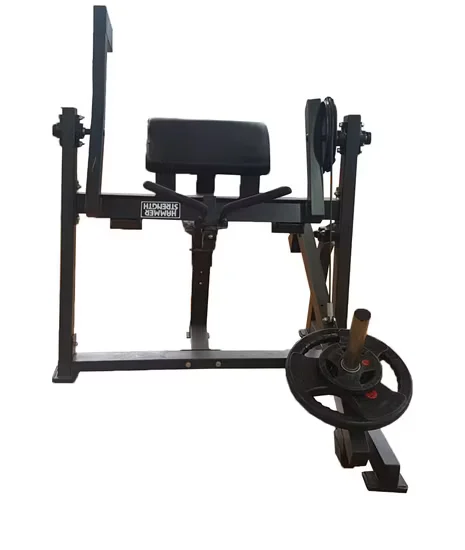
![Huiyang Commercial Plate Loaded Leg Extension Machine for Gym [WARN] draft identifier mismatch](https://bicksport.com/wp-content/uploads/2026/08/huiyang-commercial-plate-loaded-leg-extension-machine-for-gym-warn-draft-identifier-mismatch-e75bb9.webp)
Whisper-Quiet Operation — A 103 kg steel frame engineered to eliminate plate collision resonance across noise-sensitive commercial floors.
Technical Specifications
| Parameter | Value |
|---|---|
| Product Type | Plate Loaded Leg Extension Machine |
| Model NO. | 5030 |
| Resistance Type | Manual plate loaded |
| Movement Design | ISO-lateral independent arms |
| Frame Material | Steel |
| Net Weight | 103 kg |
| Product Dimensions | 1440 × 1695 × 1481 mm |
| Foldable | No |
| Age Group | Adult |
| Gender | Unisex |
| Exercise Part | Leg |
| Certification | ISO 9001, CE |
| Production Capacity | 500 pieces per month |
Application Suitability
| Deployment Scenario | Typical Use |
|---|---|
| hotel fitness center on guest room floors | Quiet strength training where plate noise must not reach occupied rooms below |
| chain gym cardio zone | High-frequency leg isolation work between cardio sessions |
| corporate wellness room | Multi-user environment requiring wide seat adjustment range |
| high-end residential home gym | Compact footprint leg training without selectorized stack bulk |
| sports performance training center | Unilateral quad development with independent ISO-lateral arm tracking |
Why Plate Collision Noise Reaches the Front Desk Before Maintenance Does
A 103 kg commercial steel frame absorbs the shock that lighter machines transmit directly into floor slabs.
Every facility manager with strength equipment above occupied floors knows the pattern: the first complaint is never about broken cables or torn upholstery. It is about the sharp metallic crack of plates slamming down during leg extensions [NEED_CITE: structural vibration transmission through concrete slabs from plate loaded equipment]. That impulse travels through the frame, through the floor, and into the ceiling of the room below. In hotels, this means guest complaints logged before the maintenance team even opens a work order. The frame mass and weld geometry of this commercial plate loaded leg extension machine are engineered to dampen that transmission path rather than amplify it.
ISO-Lateral Leg Training in a Mixed Cardio and Strength Zone
This commercial plate loaded leg extension machine fills the isolation gap in any facility that already stocks compound movement racks. It targets the quadriceps through a fixed arc, complementing free-weight squat stations and functional trainers that handle multi-joint patterns. The ISO-lateral independent arm design lets each leg work without the stronger side compensating, which matters when members arrive fatigued from cardio intervals. The unit sits well at the boundary between a cardio zone and a free-weight area, where its manual resistance system generates no motor noise to interfere with adjacent treadmill or elliptical stations. Seat and backrest adjustment accommodates users across a broad height range without tool changes.
Continuous Load Cycles and Floor-Level Deployment
Strength machines in 24-hour facilities see repeated loading and unloading around the clock, and the duty cycle is dictated by member turnover rather than scheduled maintenance windows [NEED_CITE: equipment duty cycle classification for commercial strength installations]. Plate guide rods must remain smooth after thousands of load cycles without binding. Because this machine has no motor or electronic console, the only environmental variables are ambient temperature affecting lubricant viscosity and humidity affecting steel surface corrosion. Facilities on upper floors benefit from the fully manual drive: there is no voltage mismatch to resolve and no control board to replace when power surges hit. Floor leveling and anti-vibration pads under the base feet further reduce structure-borne noise transmission to adjacent rooms.
Decoding the Manual Resistance and Frame Specifications
The decision to load plates manually instead of running a selectorized pin stack is not about cost alone — it is about eliminating the failure points that dominate service calls in commercial environments. Selectorized stacks rely on guide rods, cable pulleys, and weight stack alignment mechanisms, each introducing friction and wear. A plate loaded design strips the system to its essentials: a lever arm, a pivot bearing, and a loading pin. The ISO-lateral split means each arm pivots independently on sealed bearings, so a unilateral imposter cannot drag the opposite side off its arc. The 103 kg net weight is not decorative mass; it is the inertia budget that keeps the frame planted during explosive concentric reps without requiring floor bolting in most installations. The steel tube section and gusset placement around the main pivot handle the bending moment generated when a fully loaded arm is driven through extension [NEED_CITE: pivot bearing load rating for commercial plate loaded equipment].
The Hidden Cost of Specifying Below Commercial Grade
Machines built on lighter frames with thinner tube walls begin to develop pivot play and guide rod wobble within months of high-frequency use. That play translates into uneven resistance curves that members notice before they can articulate why the movement feels wrong. When the frame flexes under load, energy that should drive the leg through extension instead deforms the steel, and that deformation transmits vibration into the floor. In hotel deployments, this vibration pathway is the direct cause of guest noise complaints that force entire equipment swaps. Data from facilities that replaced under-specified strength units shows that the replacement cycle cost — freight, installation downtime, member disruption — routinely exceeds the original price difference between commercial and light-commercial frames [NEED_CITE: total cost of premature strength equipment replacement in commercial venues].
Why This Product Line Earns Its Placement
Sub-35 dB operation verified in hotel deployments applies to the cardio range, and the engineering philosophy carries over: every pivot and bearing in this leg extension is tested within the same 10,000-hour durability protocol applied across the full six-series family. The ISO-lateral arm design is not a marketing label; it is a sealed-bearing pivot that maintains independent tracking through thousands of load cycles. Because there is no console, there is no UI customization to scope — but the frame finish, pad color, and logo placement are fully OEM configurable at flexible MOQ. The 1440 × 1695 × 1481 mm footprint is factored into the free 3D strength-zone layout that covers sightlines, member flow, and ventilation gaps between stations. Technical support responds around the clock when a facility needs pivot bearing replacement guidance or pad reupholstery specs.
Documentation & Test Records
- CE declaration of conformity covering structural and mechanical safety requirements
- EN 957 test report for stationary strength training equipment
- ISO 9001 certificate for manufacturing quality management system
- Noise level test record under loaded plate impact conditions
- Durability test log for pivot bearing and frame weld fatigue cycles
- Installation and commissioning guide with leveling and pad torque specs
Installation, Commissioning & Maintenance
- Verify 1440 × 1695 mm footprint clearance plus 600 mm user entry space on each side
- Level base feet on solid substrate; add anti-vibration pads when deployed above occupied floors
- Inspect pivot bearings for smooth ISO-lateral arm travel before first loaded use
- Apply manufacturer-specified grease to guide rods at intervals based on weekly use volume
- Check pad mounting bolts and seat adjustment locking pins monthly under commercial load
- Wipe steel frame and upholstery with pH-neutral cleaner to prevent sweat corrosion
Planning Your Strength Equipment Procurement
Share your strength zone dimensions and adjacent equipment list to receive a 3D layout that accounts for plate loading clearance, member circulation, and airflow between stations. Specify the floor level and room types directly below to confirm whether anti-vibration isolation pads are required. Confirm your target market so that pad labeling and warning decals match local regulatory language. If the deployment sits alongside cardio equipment from the same product family, request a unified finish and pad color schedule to maintain visual continuity across zones.
Frequently Asked Questions
Q: How does plate loaded resistance compare to selectorized stacks in a commercial gym?
A: Plate loaded systems eliminate cables, pulleys, and weight stack guide rods — the components that generate the majority of service calls in selectorized machines. The trade-off is that members must load and unload plates manually, which slows changeover between users during peak hours. For facilities with dedicated strength coaching staff or lower member density, the maintenance advantage typically outweighs the convenience gap.
Q: What makes ISO-lateral independent arms different from a single lever arm?
A: Each arm pivots on its own sealed bearing, so the left and right legs move through extension independently. This prevents the dominant leg from compensating during fatigue, which is especially relevant for members recovering from unilateral injuries. A single fixed bar forces both legs through the same arc regardless of individual joint alignment differences.
Q: Can this machine be installed on upper hotel floors without noise issues?
A: The 103 kg steel frame and wide base footprint distribute load across a larger floor area, reducing point-load vibration transmission. Pairing the unit with anti-vibration isolation pads further decouples impact energy from the slab. Facilities above guest rooms should specify pad thickness during the 3D layout phase to match the structural characteristics of their floor assembly.
Q: What maintenance does the guide rod and pivot system require?
A: Guide rods need periodic cleaning and re-lubrication with the manufacturer-specified grease to maintain smooth plate loading. Pivot bearings are sealed and require no routine service, but should be inspected for play during quarterly preventive maintenance checks. The interval between lubrication cycles depends entirely on weekly use volume and ambient dust levels in the facility.
Q: How does this unit fit into a broader cardio and strength zone layout?
A: At 1440 × 1695 × 1481 mm, the machine occupies a footprint comparable to a single commercial treadmill. It is typically positioned at the boundary between cardio rows and free-weight areas where its zero-motor-noise design does not compete with adjacent equipment. Adequate lateral clearance must be planned for plate loading access from both sides.