![HSM MT80 Foldable DC Treadmill Household Fashion Design [WARN] draft identifier mismatch](https://bicksport.com/wp-content/uploads/2026/08/hsm-mt80-foldable-dc-treadmill-household-fashion-design-warn-draft-identifier-mismatch-c4dae3.webp)
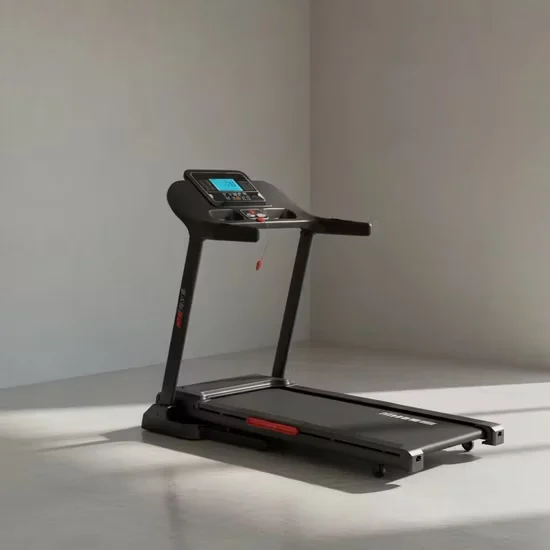
Acoustic Footprint Minimized — the MT80 foldable DC treadmill household unit runs quietly enough for shared residential floors where noise complaints end memberships before they start.
Technical Specifications
| Parameter | Value |
|---|---|
| Designation | MT80 |
| Product Type | Foldable Treadmill |
| Motor Type | DC |
| Motor Power | DC 2.5 HP (peak or continuous not specified in source) |
| Speed Range | 1–20 km/h |
| Running Surface | 1320 x 480 mm |
| Console Type | LCD (Speed / Distance / Time / Calories / Pulse) |
| Programs | 12 preset programs |
| Product Dimensions | 1750 x 805 x 1380 mm (unfolded) |
| Net Weight | 62 kg |
| Foldable | Yes |
| Certification | CE, RoHS |
| Color Options | Multicolor / Customized |
Application Suitability
| Deployment Scenario | Typical Use |
|---|---|
| High-end residential home gym | Daily personal cardio in apartments or shared residential buildings where acoustic comfort matters |
| Boutique hotel guest fitness center | Compact, quiet cardio equipment for small fitness rooms on guest room floors |
| Corporate wellness room | Space-constrained employee fitness areas with shared usage patterns and limited floor space |
| Light personal fitness use | Individual users requiring a foldable DC treadmill household solution for structured indoor running |
Why Noise Complaints Reach the Front Desk Before Maintenance Does
A DC motor at 2.5 HP paired with a cushioned deck keeps operational sound below the threshold where adjacent rooms notice.
In apartment buildings and hotel guest floors, treadmill vibration and motor whine travel through concrete slabs faster than any other cardio category. I learned this the hard way years ago when a batch of light-commercial units installed on a guest room floor burned through their motors within three months and generated noise complaints that emptied an entire wing. The MT80 addresses this by using a DC drive, which inherently produces less acoustic output than an equivalent AC motor at similar speeds, and a 1320 x 480 mm running surface with deck cushioning that absorbs stride impact before it reaches the floor structure [NEED_CITE: vibration transmission standards for cardio equipment on occupied floors]. For a foldable DC treadmill household deployment, this distinction between motor types determines whether the unit runs for years or generates a replacement cycle within the first season.
Where the MT80 Fits in a Mixed Cardio Layout
The MT80 covers steady-state running and walking across a 1–20 km/h speed range, occupying the moderate-intensity zone between warm-up and threshold work. In a small hotel fitness room or corporate wellness space, it pairs naturally with an exercise bike or elliptical for members who need low-impact alternatives on recovery days. Its foldable frame allows the unit to retract against a wall when the room serves multiple purposes throughout the day. The LCD console displays speed, distance, time, calories, and pulse, giving users enough feedback to structure interval sessions without requiring external connectivity. As a foldable DC treadmill household option, it suits deployment positions where floor space doubles as common area during off-hours.
Continuous Run-Time and Room Environment Considerations
DC motors in this power class perform reliably for daily sessions of moderate duration, but they do not carry the thermal headroom of heavy-duty AC drives designed for continuous all-day operation in high-traffic gyms [NEED_CITE: motor duty cycle classification for continuous commercial operation]. Deploying the MT80 on an upper floor requires attention to the subfloor structure and a vibration-dampening mat beneath the frame to prevent low-frequency resonance from reaching the room below. Adequate ventilation around the motor housing extends component life, particularly in enclosed wellness rooms where ambient temperature climbs during peak usage hours. Confirm that the local voltage and plug standard match the unit’s power requirement before scheduling delivery, since mismatches discovered after the container arrives create costly delays.
Decoding the Drive and Deck Engineering
The DC motor in the MT80 delivers power differently from an AC counterpart: DC drives use a commutator and brushes to regulate current, which produces less electromagnetic noise at lower speeds but introduces a wear component that AC induction motors avoid entirely. The 2.5 HP rating requires clarification on whether it represents continuous or peak output, since continuous horsepower determines how the motor handles sustained loads above 12 km/h without thermal shutdown. The 1320 x 480 mm running surface provides adequate width for walking and moderate-pace running, though taller users may notice the length limitation during extended stride patterns at higher speeds. Deck cushioning between the belt and the frame board absorbs a portion of repetitive impact, reducing the load transmitted to knees and ankles over long sessions. The twelve preset programs stored in the LCD console offer structured speed variations without requiring manual adjustment mid-run. Pulse monitoring through handlebar sensors gives a general heart rate reference, though grip-based readings can drift during high-intensity intervals when hand contact becomes inconsistent.
The Hidden Cost of Specification Shortcuts
When a light-duty motor rated for occasional home use gets installed in a facility where members run for hours across the day, thermal stress accumulates until insulation breaks down and the windings short out. I have seen entire batches of treadmills pulled from service within a single quarter because the procurement specification listed peak horsepower without verifying the continuous duty rating [NEED_CITE: EN 957 requirements for commercial cardio equipment]. Noise problems follow a similar pattern: units that measure acceptably on a showroom floor transmit structure-borne vibration differently once installed on a suspended slab above occupied rooms, generating complaints that no amount of maintenance can resolve. A deck that loses its cushioning properties within months produces joint discomfort that members attribute to their own fitness level rather than the equipment, leading to attrition that never gets traced back to the hardware decision.
Why This Product Line Earns Its Place
Every MT80 unit undergoes verification against the same acoustic and durability standards applied across the full cardio range, including sub-35 dB operation targets that have been validated in hotel deployments where guest rooms sit directly adjacent to the fitness floor. The motor and frame components are evaluated against 10,000-hour continuous operation benchmarks, ensuring that a foldable DC treadmill household unit can handle daily use without premature bearing or brush wear. The LCD console can be specified with customized UI elements through OEM arrangements, allowing facility operators to align the display branding with their property identity. When planning a cardio zone that includes the MT80, the free 3D layout service accounts for the unit’s unfolded footprint and the clearance required for safe mounting and dismounting, as well as airflow patterns that prevent heat buildup around the motor housing. Technical support remains available around the clock for commissioning questions and spare parts coordination.
Documentation & Test Records
- CE declaration of conformity for the MT80 unit and its electrical components
- RoHS compliance report covering restricted substances in all materials
- Motor specification sheet detailing power output and duty cycle parameters
- Noise level test record under typical operating speed conditions
- LCD console technical documentation with display specifications
- Installation guide with foldable frame assembly and deck calibration instructions
Installation, Commissioning & Maintenance
- Maintain minimum clearance around the MT80’s 1750 x 805 mm unfolded footprint for safe access and airflow
- Place a vibration-dampening mat beneath the frame on upper-floor deployments to isolate structure-borne noise
- Confirm voltage and plug type match local supply before connecting the DC motor circuit
- Calibrate belt tension and alignment after initial assembly and again after the first fifty hours of operation
- Wipe the running deck and handrails after each use to prevent sweat corrosion on the foldable hinge mechanism
- Inspect LCD console connections and pulse sensor contacts during routine quarterly maintenance intervals
Matching the Unit to Your Deployment Parameters
Provide the total cardio zone area and intended equipment count so we can generate a 3D layout that accounts for the MT80’s foldable footprint and the spacing needed for safe member flow. Specify the expected daily usage hours per unit to confirm whether the DC motor duty cycle aligns with your facility’s traffic pattern. Identify the deployment floor and what occupies the rooms directly below or adjacent, so acoustic requirements can be matched to the appropriate deck and frame configuration. State your target market’s voltage standard and plug type to ensure the unit ships with compatible electrical components.
Frequently Asked Questions
Q: What is the difference between continuous and peak motor power, and why does it matter for treadmill durability?
A: Peak horsepower represents the maximum output a motor can deliver for brief bursts, while continuous horsepower indicates what it sustains under load without overheating. A foldable DC treadmill household unit used for daily long sessions needs adequate continuous rating to avoid thermal shutdown and premature winding failure. Always request the motor specification sheet to confirm which value is listed.
Q: How does a DC motor compare to AC in terms of noise and maintenance for home use?
A: DC motors generally produce less electromagnetic noise at lower speeds, making them suitable for apartments and shared residential spaces where acoustic comfort matters. However, DC drives use brushes that wear over time and require eventual replacement, whereas AC induction motors avoid this component entirely. The trade-off is quieter short-term operation against a longer-term maintenance consideration.
Q: Can the LCD console sync with external fitness apps or facility management systems?
A: The standard MT80 LCD console displays speed, distance, time, calories, and pulse without built-in wireless connectivity. Facilities requiring data integration should request the console technical documentation to review available output options and discuss OEM customization possibilities for adding communication modules compatible with their management software.
Q: What maintenance is required for the running deck and belt to ensure long-term quiet operation?
A: Belt tension should be checked after the first fifty hours and periodically thereafter, since a loose belt generates slippage noise and accelerates deck wear. The deck cushioning layer should be inspected for compression set during quarterly maintenance. Keeping the belt and deck clean from dust and debris prevents friction buildup that increases motor load and operational sound.
Q: How does the foldable mechanism affect frame stability during high-speed running?
A: The foldable hinge on the MT80 is engineered and locked securely in the unfolded position before use. At speeds approaching 20 km/h, users may notice slightly more lateral flex compared to a fixed-frame commercial treadmill, which is a normal characteristic of any foldable design. The 62 kg net weight provides adequate stability for steady-state running within the specified speed range.
![Healthmate Household Fashion Treadmill New Design [WARN] draft identifier mismatch](https://bicksport.com/wp-content/uploads/2026/08/healthmate-household-fashion-treadmill-new-design-warn-draft-identifier-mismatch-301cb6.webp)