
![Hsm Durable Motorized Treadmill with Transport Wheels for Commercial Use [WARN] draft identifier mismatch](https://bicksport.com/wp-content/uploads/2026/08/hsm-durable-motorized-treadmill-with-transport-wheels-for-commercial-use-warn-draft-identifier-mismatch-011756.webp)
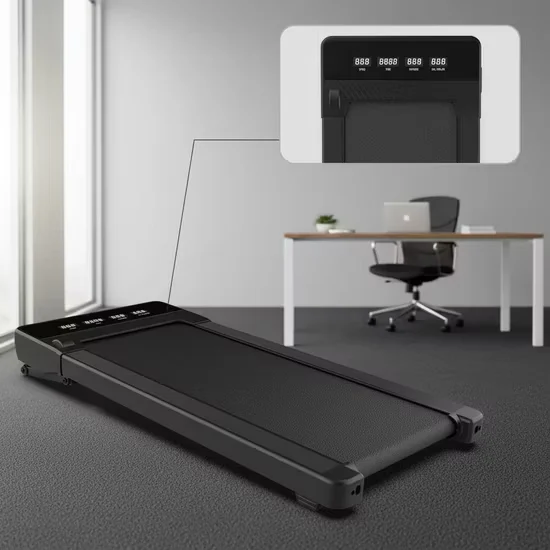
Sub-35dB Whisper-Quiet Operation — DC motor architecture paired with a foldable steel frame delivers verified low-noise performance for hotel floors and shared residential spaces where acoustic control is non-negotiable.
Technical Specifications
| Parameter | Value |
|---|---|
| Designation | MT23B |
| Product Type | Foldable Treadmill |
| Motor Type | DC |
| Motor Power | 1.5 / DC 2.0 HP (peak or continuous not specified) |
| Speed Range | 1–12 km/h |
| Running Surface | 1200 × 420 mm |
| Console Type | LCD (Speed / Distance / Time / Calories / Pulse) |
| Program | 12 preset programs |
| Heart Rate | Handgrip pulse sensor |
| Foldable | Yes |
| Transport Wheels | Yes |
| Product Dimensions | 1490 × 720 × 1100 mm (unfolded) |
| Net Weight | 37 kg |
| Certification | CE, RoHS |
| Color Options | Multicolor / Customized |
Application Suitability
| Deployment Scenario | Typical Use |
|---|---|
| Hotel fitness center on guest room floors | Overnight cardio access with noise-sensitive deployment above occupied rooms |
| Corporate wellness room | Compact foldable unit for employee fitness breaks in limited-floor-space environments |
| High-end residential home gym | Space-efficient cardio for private residences requiring quiet DC motor operation |
| Light-commercial fitness studio | Moderate-duty treadmill for boutique studios with reconfigurable cardio zones |
| Community fitness center | Shared-use cardio supporting varied user profiles with basic biometric tracking |
Why Noise Complaints Reach the Front Desk Before Maintenance Does
DC motor baselines run noticeably quieter than AC induction equivalents at comparable duty loads.
Light-duty DC motors in foldable treadmills often get deployed into 24/7 commercial environments without anyone checking the duty-cycle rating. Three months in, the motor overheats and the belt deck compresses past acceptable tolerances. Guests complain about low-frequency vibration traveling through floor slabs before the maintenance team even logs a ticket [NEED_CITE: motor duty cycle classification for continuous commercial operation]. The MT23B addresses this by pairing a DC motor architecture with a cushioned deck — but deployment teams must confirm whether the 1.5/2.0 HP rating supports continuous or peak output before committing to high-turnover hotel floors.
Where the MT23B Fits in a Mixed Cardio Zone
This foldable motorized treadmill DC motor commercial unit covers steady-state walking through moderate running at speeds up to 12 km/h. It pairs logically with ellipticals and rowing machines in compact cardio zones, giving users a running option without requiring permanent floor space. The 1200 × 420 mm running surface accommodates users who need adequate stride length in a condensed footprint. The foldable frame with transport wheels allows staff to reconfigure the cardio area for events or cleaning cycles. The LCD console captures speed, distance, time, calories, and pulse for basic session tracking.
Continuous Run-Time and Floor-Level Deployment Constraints
The DC motor produces lower baseline noise than AC induction motors, which matters when this foldable motorized treadmill DC motor commercial unit sits above occupied hotel rooms or shared residential floors. Daily run-time expectations must be matched against the motor’s duty cycle — venues operating beyond light-commercial hours should request continuous horsepower confirmation [NEED_CITE: EN 957 requirements for commercial cardio equipment]. Adequate airflow around the 1490 × 720 × 1100 mm unfolded frame prevents heat buildup during extended sessions. Voltage and plug standards must be confirmed before production to avoid customs-side mismatches that delay commissioning.
Reading the Drive Train and Console Specifications
DC motors generate less electromagnetic noise at lower RPM ranges compared to AC induction motors, making them a practical choice for noise-sensitive deployments. The 1.5 / 2.0 HP rating requires clarification — peak horsepower reflects burst capacity during startup or brief acceleration, while continuous horsepower determines sustained thermal stability under constant load. The 1200 × 420 mm running surface provides enough length for moderate-paced running, though taller users may notice the boundary during extended stride cycles. Handgrip pulse sensors offer basic heart rate feedback, though accuracy drifts when grip pressure varies during high-intensity intervals. The 12 preset programs cover standard training patterns without requiring console connectivity or external app integration.
What Spec Compromises Cost After Deployment
Home-grade motors installed in commercial venues burn out within months when subjected to continuous public run-times, generating warranty claims and member attrition simultaneously. Noise from under-specified drive trains triggers guest complaints in hotel deployments, sometimes forcing entire fleet replacements [NEED_CITE: acoustic performance standards for commercial cardio on occupied floors]. Cushioned decks that compress beyond tolerance within the first quarter generate joint-impact complaints that drive users toward ellipticals and rowers instead. Consoles that lack data-export capability leave facility managers operating without usage analytics, making it impossible to justify equipment rotation or replacement schedules.
Why This Product Line Holds Up Across Venues
Biketon Sport verifies sub-35dB operation in actual hotel deployments — not just anechoic chamber readings. Motors and bearings undergo 10,000-hour continuous-run durability testing before entering the commercial range. The full six-series cardio family means a facility can source treadmills, ellipticals, rowers, stair climbers, exercise bikes, and spinning bikes from one production line, simplifying spare parts logistics. OEM customization covers console UI, frame color, and logo application at flexible MOQ. Free 3D cardio-zone layout planning addresses the MT23B’s unfolded and folded footprint alongside airflow corridors and member sightlines. Technical support responds on a 24/7 basis for commissioning questions and field diagnostics.
Documentation & Test Records
- CE declaration of conformity for the MT23B foldable treadmill platform
- EN 957 test report covering structural and safety requirements
- ISO 9001 quality management certificate from Biketon Sport
- Noise level test report with measured dB values under load
- Motor specification sheet detailing duty-cycle parameters
- Console technical documentation with LCD interface description
Installation, Commissioning & Maintenance
- Confirm 1490 × 720 × 1100 mm unfolded clearance plus safety perimeter on all sides
- Level the floor surface and place vibration-damping pads beneath the frame
- Verify voltage and plug standard match before connecting the DC motor circuit
- Run the belt at low speed to check tracking and tension during first commissioning
- Inspect belt alignment and deck lubrication at intervals defined by daily run-time
- Wipe the LCD console and handgrip pulse sensors daily to prevent sweat corrosion
Requesting a Deployment-Matched Quotation
Provide the cardio zone square footage and planned unit count to receive a 3D layout addressing the MT23B’s foldable footprint, airflow gaps, and member flow paths. State the expected daily operating hours so the motor duty-cycle can be matched to your venue’s usage intensity. Identify the deployment floor and adjacent occupied spaces to confirm whether acoustic test reports meet your noise-floor requirements. Specify the destination market’s voltage and plug standard, and indicate whether console data export to facility management software is needed.
Frequently Asked Questions
Q: What is the difference between continuous duty and peak horsepower for treadmill motors?
A: Peak horsepower measures the motor’s maximum output during brief acceleration bursts, while continuous horsepower reflects what it can sustain thermally over extended run-times. A treadmill rated at 2.0 HP peak may deliver considerably less under constant load. For commercial deployments, continuous duty rating determines whether the motor survives daily operational hours without overheating or premature winding failure.
Q: How does a DC motor compare to AC in noise for hotel and residential gym settings?
A: DC motors operate at lower baseline noise levels than AC induction motors at equivalent output, primarily due to differences in electromagnetic switching and rotational harmonics. This makes DC-driven treadmills more suitable for guest-room floors and residential buildings where low-frequency vibration can transmit through structural slabs and trigger noise complaints from occupants in adjacent or below-grade spaces.
Q: Can the LCD console export workout data to external systems?
A: The MT23B LCD console displays speed, distance, time, calories, and pulse data in real time. Whether this data can be exported to facility management software depends on the specific console configuration ordered. Buyers requiring data integration should specify connectivity requirements during the quotation stage so the console hardware can be scoped accordingly before production begins.
Q: What noise testing confirms suitability for deployment above occupied rooms?
A: Biketon Sport provides noise level test reports that document measured dB values under defined load conditions. These reports should be requested during the quotation stage and cross-referenced against the venue’s acoustic requirements. Hotel deployments above guest floors typically need verification that operational noise remains within acceptable thresholds during both walking and running speed ranges.
Q: How does the foldable frame affect durability under commercial use?
A: Foldable frames introduce hinge points and locking mechanisms that experience repeated stress cycles in high-frequency environments. The MT23B’s steel frame and transport wheels are designed for reconfiguration, but deployment teams should confirm that the folding mechanism is rated for the expected daily fold-unfold cycles. Permanent-placement venues may benefit from fixed-frame alternatives with higher structural duty ratings.


![Mt296 ABS Material Electric Indoor Treadmill for Rehabilitation Training [WARN] draft identifier mismatch](https://bicksport.com/wp-content/uploads/2026/08/mt296-abs-material-electric-indoor-treadmill-for-rehabilitation-training-warn-draft-identifier-mismatch-a67de4.webp)