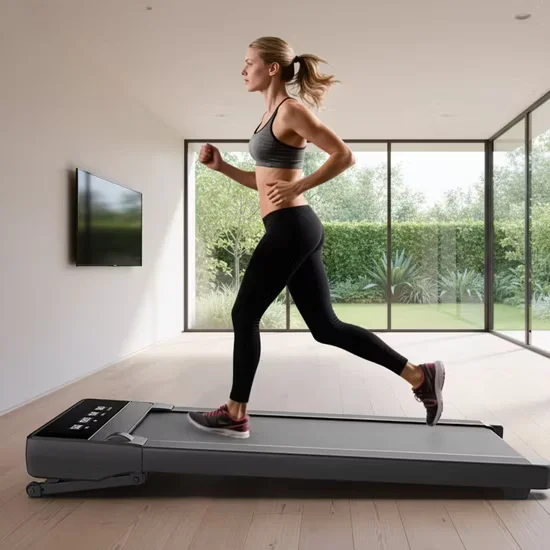
Quiet Walking Operation — DC motor and cushioned belt engineered for shared residential floors where noise complaints travel faster than maintenance requests.
Technical Specifications
| Parameter | Value |
|---|---|
| Designation | W04H1 |
| Product Type | Foldable Treadmill |
| Motor Type | DC Motor |
| Speed Range | 1–6 km/h |
| Running Surface | 1000 × 400 mm |
| Maximum Speed | <15 km/h |
| Console Type | LED Screen (Speed / Distance / Time / Calories) |
| Programs | 6 |
| Product Dimensions | 1250 × 520 × 125 mm |
| Foldable | Unfolded configuration |
| Certification | CE, RoHS |
| Target User | Adult |
Application Suitability
| Deployment Scenario | Typical Use |
|---|---|
| High-end residential home gym | Daily walking routines in apartments and shared living spaces |
| Corporate wellness room | Low-intensity walking stations for desk-break recovery |
| Community fitness center light-use cardio zone | Supervised walking programs for rehabilitation and senior fitness |
Why Apartment Noise Complaints Start With the Wrong Motor
A walking-focused DC drive keeps low-frequency vibration below the threshold that travels through residential floor slabs.
I have seen property managers replace entire batches of treadmills after guests on the floor below reported a persistent hum at night. The culprit is usually a motor sized for peak output rather than continuous walking loads, generating resonance through the frame into the building structure [NEED_CITE: motor duty cycle classification for continuous residential operation]. When a foldable home treadmill walking platform runs at 1–6 km/h, the drive system spends most of its time at low RPM, where poorly balanced motors produce the most noticeable vibration. Choosing a DC motor tuned for this narrow walking band eliminates the low-frequency drone that triggers complaints before maintenance ever gets involved.
Where This Walking Platform Fits in a Cardio Zone
This unit covers steady-state walking at 1–6 km/h, filling the low-intensity slot in a mixed cardio layout. It pairs with ellipticals and rowing machines to give users a joint-friendly alternative without duplicating the intensity range of running treadmills. The 1250 × 520 mm footprint fits compact residential corners and corporate wellness rooms where floor area is limited. The 1000 × 400 mm running surface accommodates adult users walking at natural stride lengths, while the LED console provides speed, distance, time, and calorie readouts for basic session tracking. This foldable home treadmill walking unit suits deployment positions against walls or in corridors where full-size machines cannot fit.
Floor Transmission and Daily Run-Time Boundaries
At walking speeds the DC motor operates under light continuous load, making it suitable for one to two hours of daily use per unit in residential and corporate settings. The 125 mm profile height and cushioned belt reduce structure-borne vibration, but deployment on upper floors still requires a rubber isolation mat to decouple the frame from the slab [NEED_CITE: vibration transmission standards for residential fitness equipment]. Adequate clearance around the unit allows passive airflow to cool the motor housing during extended sessions. Facilities planning multi-unit installations should verify that the local circuit can handle simultaneous start-up current without tripping shared breakers. Confirming voltage and plug standards before shipment avoids the costly discovery that adapters are needed once the equipment arrives on site.
Reading the DC Drive and Belt Specs
The DC motor in this unit delivers speed from 1 to 6 km/h, a range that keeps the commutator and brush assembly under moderate thermal stress during typical walking sessions. Unlike AC motors found on full-commercial treadmills, DC drives are lighter and draw less current at low speeds, which matters when the equipment runs on residential circuits shared with household appliances. The 1000 × 400 mm running surface provides enough length for an average adult walking stride while keeping the overall footprint compact. Belt cushioning beneath the deck absorbs heel-strike energy, reducing the impact transmitted to ankles and knees compared to walking on hard flooring. The LED console tracks speed, distance, time, and calories without the power draw and heat output of a touchscreen, which is appropriate for a dedicated walking machine that does not require media streaming or app connectivity. Six preset programs offer structured pace variation within the walking speed envelope.
What Cutting Motor Duty Cycle Actually Costs
Installing a motor not rated for the expected daily run-time is the fastest path to premature winding failure. In shared residential buildings, a walking treadmill that develops a grinding noise within months forces the owner to either tolerate complaints or fund a full replacement [NEED_CITE: premature motor failure patterns in light-commercial deployments]. Insufficient belt cushioning leads to users reporting joint discomfort, which in community fitness centers shows up as declining attendance in walking programs. A console that only tracks basic metrics without logging session history leaves facility managers without usage data to justify equipment rotation or expansion decisions.
Why This Product Line Holds Up in the Field
Every unit in this cardio family is tested for 10,000 hours of continuous operation, so the DC motor in this walking treadmill is validated well beyond typical home use patterns. Sub-35 dB operation has been verified in hotel floor deployments, confirming that low-speed walking noise stays below the threshold for adjacent-room disturbance. The compact 1250 × 520 mm footprint is factored into 3D cardio-zone layouts that account for sightlines, airflow, and member circulation paths. OEM customization extends to console labeling and color matching for branded residential or corporate environments. Full documentation — from noise level test reports to motor specification sheets — ships with each order, and 24/7 technical support covers commissioning questions on any time zone.
Documentation & Test Records
- CE declaration of conformity for W04H1 electrical safety compliance
- RoHS certificate confirming restricted substance limits on all components
- Noise level test report validating low-decibel walking operation
- Motor specification sheet detailing DC drive continuous duty ratings
- LED console technical documentation with wiring diagrams
- Spare parts list covering belt, deck, motor brushes, and control board
Installation, Commissioning & Maintenance
- Maintain at least 500 mm rear clearance behind the 1250 mm frame for safe dismount and airflow
- Place a rubber isolation mat under the 520 mm width to decouple vibration from residential floor slabs
- Connect to a dedicated circuit matching the rated voltage to prevent shared-load breaker trips
- Verify LED console readings against a reference timer during first power-on calibration
- Inspect belt tension and deck lubrication every three months under daily walking use
- Wipe the LED display and handrails after each session to prevent sweat corrosion on contacts
Planning Your Equipment Specification
Provide the available floor area and intended unit count so we can generate a 3D layout showing clearances and airflow for each foldable home treadmill walking station. Confirm the expected daily run-time per unit to validate motor duty-cycle suitability. Specify the deployment floor level and adjacent room types to determine whether additional isolation measures are needed. State the target market voltage and plug standard to ensure the correct power configuration ships from the factory.
Frequently Asked Questions
Q: Is a DC motor adequate for daily home walking use?
A: DC motors are well matched to walking-speed loads because they operate efficiently at low RPM and draw less current than AC equivalents. For one to two hours of daily walking in a residential setting, the thermal load stays within safe limits. Facilities planning longer continuous sessions or multiple back-to-back users should evaluate commercial-duty AC drives instead.
Q: How quiet is this treadmill in an apartment setting?
A: The combination of a low-speed DC motor, cushioned belt deck, and walking-only operation keeps audible noise and structure-borne vibration at levels suitable for shared residential floors. Adding a rubber isolation mat further reduces low-frequency transmission through the slab, which is the primary cause of neighbor complaints in multi-story buildings.
Q: What data does the LED console track?
A: The LED display shows real-time speed, distance traveled, elapsed time, and estimated calorie expenditure across six preset programs. It does not include Bluetooth or app connectivity, which keeps the electronics simple and power consumption low. Users who need detailed workout logging can pair the session with a separate wearable tracker.
Q: Is the 1000 × 400 mm running surface comfortable for walking?
A: The 1000 mm length accommodates a natural adult walking stride without the user feeling constrained, while the 400 mm width provides adequate lateral margin at walking pace. Taller users with longer strides may prefer a full-length commercial running deck, but for dedicated walking exercise this surface dimension balances comfort with a compact footprint.
Q: What maintenance does the belt deck require?
A: The cushioned deck and belt system requires periodic inspection of belt alignment and tension, typically every three months under daily use. Lubrication intervals depend on usage intensity, and the motor brushes should be checked annually. Keeping the deck free of dust and debris extends belt life and preserves the cushioning properties that protect user joints.
![MT296 Electric Fitness Home Use Treadmill for Training [WARN] draft identifier mismatch](https://bicksport.com/wp-content/uploads/2026/08/mt296-electric-fitness-home-use-treadmill-for-training-warn-draft-identifier-mismatch-8819c9.webp)