Zero-Noise Mechanical Design — Manual power architecture eliminates motor dependency for silent operation across noise-sensitive facilities.
Technical Specifications
| Parameter | Value |
|---|---|
| Product Type | Back Extension Machine |
| Exercise Part | Back |
| Power Source | Manual |
| Material | Steel |
| Net Weight | 42kg |
| Product Dimensions | 1552×771×876mm |
| Foldable | Yes |
| Main Frame Color | Customizable |
| Cushion Color | Customizable |
| OEM/ODM | Acceptable |
| Age Group | Adult |
| Gender | Unisex |
| Certification | ISO 9001, CE |
Application Suitability
| Deployment Scenario | Typical Use |
|---|---|
| Community fitness center | Multi-user shared access with minimal maintenance overhead |
| Professional gym and club | High-frequency strength training in dedicated weight areas |
| Corporate wellness room | Space-efficient back strengthening with foldable storage |
| Hotel fitness center on guest room floors | Silent deployment above occupied rooms without acoustic complaints |
| High-end residential home gym | Dedicated spinal extension work without motor noise intrusion |
Why the Loudest Machines on the Strength Floor Are Often the Simplest Ones to Fix
Pure mechanical structure removes every electrical failure point from the maintenance queue.
When facility operators call me about equipment downtime, it almost always traces back to electronics — control boards that short out, motors that burn under continuous load, or belt drives that snap at peak hours. I have watched entire rows of cardio machines sit idle for weeks waiting on replacement PCBs shipped from overseas. A manual commercial back extension machine strength equipment unit has none of those failure modes. There is no motor to overheat, no electronic console to reboot, and no software to update. [NEED_CITE: failure rate comparison between mechanical and motorized gym equipment in commercial settings]
The silence matters just as much as the reliability. In a five-star hotel fitness center above sleeping guests, or in a residential building where the gym shares a wall with apartments, every decibel generated by a machine travels through the structure. Manual resistance means zero motor hum, zero cooling fan noise, and zero electromagnetic interference with nearby audio systems.
Where Back Extension Fits in a Complete Strength Training Layout
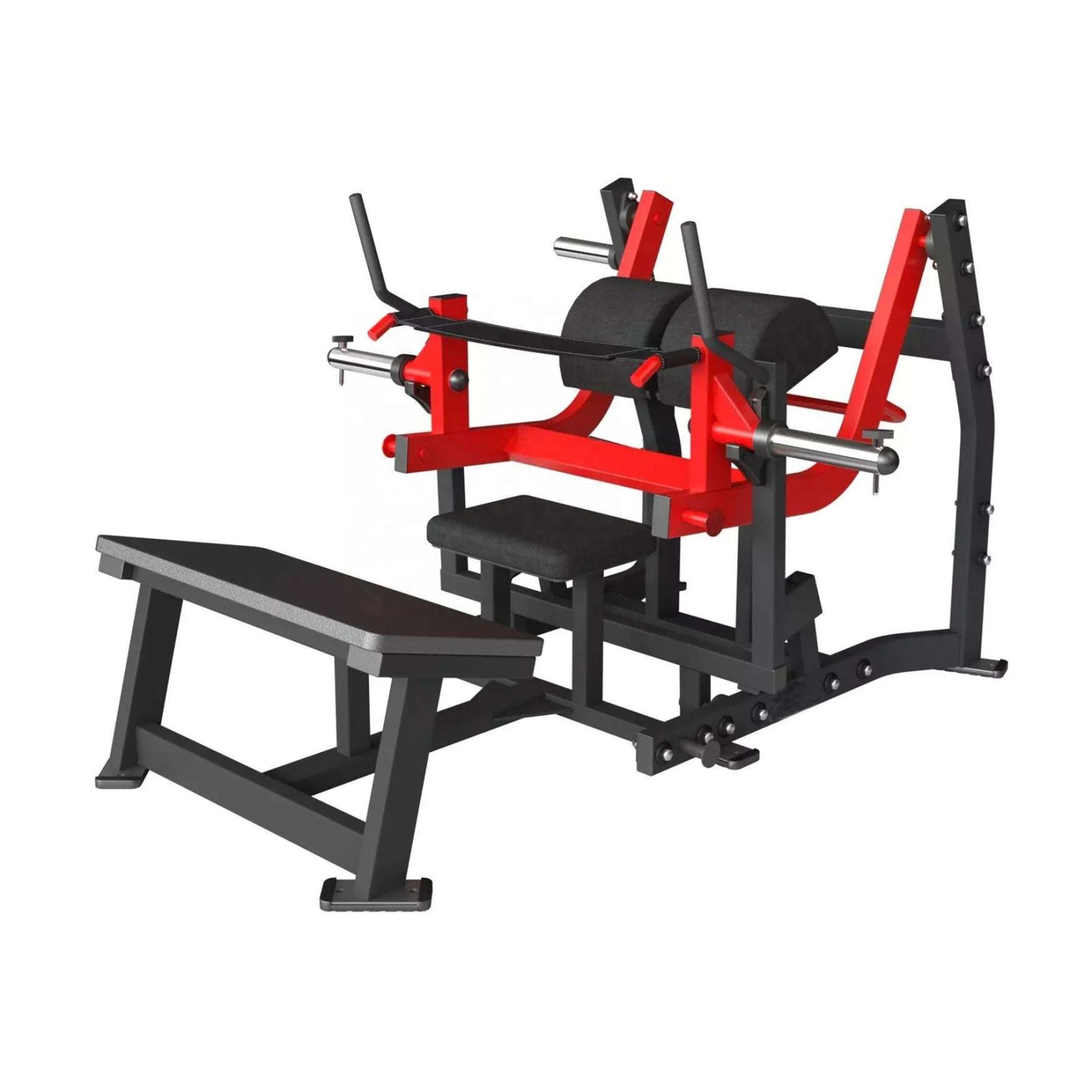
This commercial back extension machine strength equipment targets the erector spinae, glutes, and hamstrings through controlled hip extension movements. In a commercial floor plan, it typically occupies a position along the perimeter of the free weight zone, complementing plate-loaded machines and dumbbell racks. The 1552×771mm footprint allows placement between larger units without disrupting member traffic flow. Foldable design means staff can reclaim floor space during off-peak hours or group class setups. The steel frame accommodates adult users across a wide weight range, making it suitable for mixed-ability facility populations.
Noise Transmission and Floor-Level Deployment Considerations
The manual power source delivers a structural advantage that goes beyond the machine itself. Without a motor generating vibration through the frame, the only sound produced is the cushion contact and the user’s movement — levels that remain negligible even during high-rep sets. This matters for second-floor or above-ground installations where impact noise transmits through concrete slabs to rooms below. The 42kg net weight provides stability during use while remaining light enough for two staff members to reposition when the layout needs adjustment. [NEED_CITE: acoustic impact of mechanical versus motorized equipment on multi-story facility floors] No dedicated electrical circuit is required, and no voltage compatibility issues arise when shipping across markets with different power standards. Ground leveling and anti-vibration pads under the base feet remain recommended for long-term frame alignment.
Manual Resistance Mechanics and Frame Engineering Explained
The manual power source operates on a gravity-based principle where the user’s own body weight provides the resistance load. This eliminates wear components found in motorized alternatives — no carbon brushes to replace, no drive belts to tension, and no cooling fans to clog with dust. The steel frame construction distributes load across welded joints designed for repeated cycling under varying user weights. Foldable hinges add a mechanical element that requires periodic lubrication but introduces no electrical dependency. Cushion padding density directly affects comfort during extended sets; high-density foam maintains shape over thousands of compression cycles, whereas low-grade padding compresses permanently and exposes the underlying frame to user contact. [NEED_CITE: commercial grade cushion density standards for high-frequency gym equipment] The customizable frame and cushion color options allow facility branding alignment without aftermarket modifications that could void structural warranties.
The Hidden Cost of Specifying Consumer-Grade Equipment for Commercial Floors
I once visited a community gym where three out of four back extension benches had cracked frames within eight months of installation. The manufacturer had used thinner gauge steel and spot welding to keep the unit price down. Consumer-grade cushions compressed flat within weeks, causing users to bruise their hip bones and abandon the exercise entirely. [NEED_CITE: structural fatigue patterns in light-commercial versus commercial-grade strength equipment] Foldable mechanisms on cheaper units develop play and wobble that makes the equipment feel unstable, leading members to avoid it and operators to remove it from the floor. These compounding failures turn a small initial saving into a replacement cycle that costs more than specifying proper commercial equipment from the start.
What Sets This Product Line Apart for Facility Operators
Every unit undergoes frame load testing before leaving the production line, and the 10,000-hour durability protocol applies across the entire product range. The sub-35dB operational standard verified in hotel deployments extends naturally to a zero-motor design that produces virtually no ambient noise. The commercial back extension machine strength equipment fits into a complete six-series cardio and strength family, letting facilities source multiple disciplines from a single manufacturing partner. OEM customization covers frame color, cushion color, and branding — all processed within standard production cycles. The free 3D layout service maps this unit’s footprint against adjacent equipment spacing and member flow patterns. Technical support operates around the clock for commissioning questions and spare parts coordination.
Documentation & Test Records
- CE declaration of conformity covering structural safety requirements
- EN 957 test report validating commercial strength equipment standards
- ISO 9001 certificate confirming quality management system compliance
- Noise level test report documenting sub-ambient acoustic output
- Durability test record covering frame and foldable hinge fatigue cycles
- Installation and commissioning guide with spare parts list
Installation, Commissioning & Maintenance
- Verify 1552×771mm footprint clearance with minimum 600mm safety perimeter on all sides
- Level base feet on even flooring and apply anti-vibration pads for upper-floor installations
- No electrical circuit required; manual power source eliminates all wiring and voltage concerns
- Inspect foldable hinge tension and apply lubricant at initial commissioning and quarterly thereafter
- Wipe down steel frame and cushion surfaces daily with non-corrosive disinfectant to prevent sweat damage
Equipment Selection and Facility Planning Inquiry
Provide your strength zone square footage and existing equipment list to receive a customized 3D layout with equipment spacing and member flow analysis. Specify your deployment floor level and adjacent room types so we can confirm acoustic compatibility. Indicate your target market and any OEM branding requirements for frame and cushion color matching. Share your expected daily user volume to help determine optimal placement within the facility floor plan.
Frequently Asked Questions
Q: How does manual resistance compare to motorized alternatives for commercial deployment?
A: Manual resistance eliminates motor maintenance, electronic failures, and electrical consumption entirely. The user’s body weight provides the load, creating a zero-dependency design that reduces long-term servicing to basic hinge lubrication and cushion inspection. For facilities prioritizing uptime and minimal maintenance overhead, mechanical designs consistently outperform motorized equivalents in reliability metrics.
Q: How is maximum user weight capacity determined for this frame?
A: Frame load capacity is established through static and dynamic testing per EN 957 standards. The steel construction and welded joint geometry distribute user weight across multiple contact points. Facility operators should verify the rated capacity against their member population and request the manufacturer’s structural test report before finalizing procurement decisions.
Q: Does the foldable mechanism compromise structural rigidity during use?
A: The folding hinge is engineered with a positive locking mechanism that engages fully when the frame is in the deployed position. This eliminates lateral play and ensures the same rigidity as a fixed-frame unit during exercise. The locking pins undergo fatigue testing to confirm long-term engagement reliability under continuous deployment cycles.
Q: What cushion material specifications support high-frequency cleaning protocols?
A: Commercial-grade vinyl covers with high-density foam cores withstand repeated disinfectant application without cracking or delamination. The sealed surface prevents moisture penetration into the foam layer, maintaining padding density and hygiene standards across thousands of daily use cycles. Request material data sheets to verify chemical resistance compatibility with your facility’s cleaning agents.