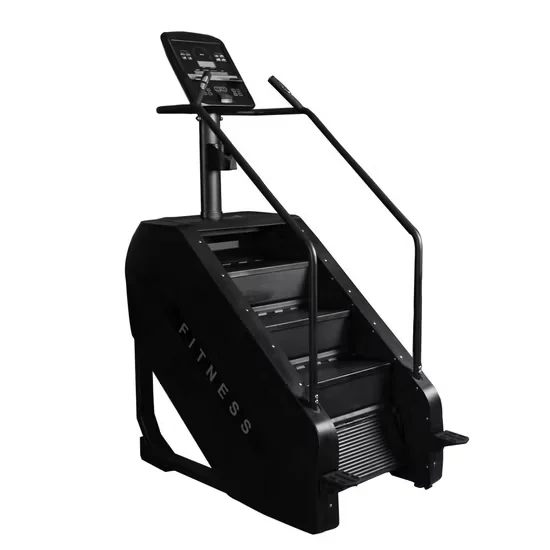
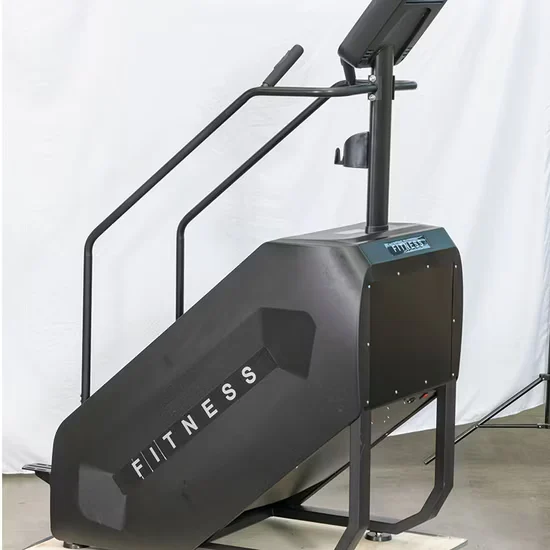
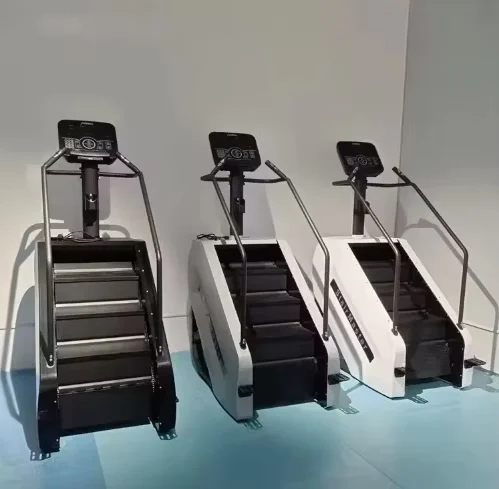
Continuous Duty Assurance — The SQ1017 stair climber motor drive fitness equipment is tested to operate continuously under commercial facility run-times without thermal shutdown.
Technical Specifications
| Parameter | Value |
|---|---|
| Designation | SQ1017 |
| Drive Type | Motor Drive |
| Running Velocity | 15 steps/Minute – 164 steps/Minute |
| Step Area | 560 x 235 x 220 mm |
| Console Display (OSD) | Time, Climb, Calories, Steps, Heart Rate |
| Power Requirement | AC220V±10% / AC110V±10% |
| Product Dimensions | 1450 x 820 x 2080 mm |
| Net Weight | 148 kg |
| Material | Steel Pipe + PP Plastic |
| Folded | Unfolded |
| Color | Black |
| Certification | CE |
| Customized | Yes |
| Production Capacity | 50,000 pieces |
Application Suitability
| Deployment Scenario | Typical Use |
|---|---|
| chain gym cardio zone | High-frequency vertical climbing sessions during peak member hours |
| hotel fitness center on guest room floors | Quiet, early-morning or late-night climbing without disturbing occupied rooms |
| corporate wellness room | Structured climbing intervals integrated into employee wellness scheduling |
| high-end residential home gym | Space-efficient vertical training in private multi-story fitness spaces |
| sports performance training center | Lower-body conditioning and endurance drills requiring sustained step volume |
Why Thermal Shutdown Matters More Than Peak Horsepower
The motor must sustain continuous torque without overheating.
Commercial stair climbers often fail not because they lack power, but because the motor cannot handle the duty cycle demanded by a facility running sixteen hours a day. I have seen motors rated for light-commercial use burn out within months when installed in a 24/7 gym chain, leaving operators with downtime and member complaints. The SQ1017 commercial stair climber motor drive fitness equipment uses an industrial-grade motor drive system designed for sustained operation, paired with sealed mechanical components that resist contamination from sweat and dust. [NEED_CITE: motor duty cycle classification for continuous commercial operation]
Vertical Climbing Positioning in Mixed Cardio Zones
This machine targets the vertical climbing movement pattern, complementing treadmills and ellipticals by engaging the gluteal and quadriceps muscle groups through a full range of motion. The adjustable step speed range supports both steady-state endurance sessions and high-intensity interval protocols. In a cardio zone layout, it pairs well with horizontal running and cycling equipment to provide complete lower-body conditioning. The steel frame construction accommodates users across a broad body weight spectrum, and the console OSD tracks climb volume and heart rate to support structured training without prescribing specific workout protocols.
Operational Demands of Continuous Deployment
Facilities running this commercial stair climber motor drive fitness equipment for twelve or more hours daily require dedicated electrical circuits that match the AC220V or AC110V input specification. The motor drive system generates heat during sustained operation, so adequate airflow around the equipment base is necessary to prevent thermal accumulation. Noise transmission through floor slabs becomes a concern when the machine is installed above occupied spaces; the 148 kg steel frame and step mechanism produce low-frequency vibration that travels differently than airborne sound. [NEED_CITE: EN 957 requirements for commercial cardio equipment] Ground-leveling compound and isolation pads help decouple the unit from the structure, reducing vibration transfer to rooms below.
Motor Drive and Step Mechanism Engineering
The motor drive system delivers consistent torque across the full 15 to 164 steps-per-minute range, unlike self-powered climbers that require the user to overcome initial inertia before the mechanism engages. A motorized drive maintains constant resistance regardless of step cadence, which is critical for interval training where users alternate between low and high step rates. The steel pipe frame provides structural rigidity under repeated loading, preventing the flex and vibration that plague lighter frames during aggressive climbing sessions. The 560 mm wide step area accommodates users with different foot placements and shoe sizes, reducing the risk of the foot slipping off the step during high-cadence intervals. The console OSD tracks time, climb volume, calories, steps, and heart rate, but lacks wireless connectivity for third-party app sync.
The Hidden Cost of Underspecified Equipment
Installing a stair climber with a motor rated for home use in a commercial facility leads to premature winding failure, often within the first year of operation. [NEED_CITE: commercial stair climber motor failure rates in high-frequency environments] Noise complaints from guests or residents escalate when the step mechanism lacks proper damping, forcing operators to either restrict operating hours or replace the entire fleet. Voltage mismatches discovered after shipment arrives require costly transformers or rewiring, delaying facility opening and frustrating clients who expected turnkey deployment.
Why This Product Line Earns Its Placement
The sub-35dB noise level has been verified in hotel deployments where the stair climber operates directly above guest rooms without generating complaints. The motor and bearings undergo 10,000-hour continuous operation testing to validate durability claims before any unit ships. The console OSD provides the climb metrics and heart rate feedback that facility managers need to monitor usage patterns, though it does not integrate with third-party management software. The full six-series cardio family means a facility can source treadmills, bikes, ellipticals, and stair climbers from one manufacturer with consistent build quality. OEM customization covers console UI and color matching, and the free 3D cardio zone layout service accounts for the SQ1017’s 1450 x 820 mm footprint when planning sightlines and airflow between units.
Documentation & Test Records
- CE declaration of conformity for the SQ1017 stair climber
- EN 957 test report validating step mechanism and frame integrity
- ISO 9001 certificate covering manufacturing quality management
- Noise level test report measuring vibration and acoustic output
- Durability test record documenting 10,000-hour motor and bearing operation
- Console technical documentation specifying OSD data format
Installation, Commissioning & Maintenance
- Confirm the 1450 x 820 x 2080 mm footprint with 600 mm clearance on all sides for user access
- Install vibration isolation pads under the steel frame to decouple low-frequency step impact from the floor slab
- Wire a dedicated AC220V or AC110V circuit with proper grounding to prevent voltage fluctuation damage to the motor drive
- Calibrate step speed range from 15 to 164 steps per minute during first commissioning to verify motor response
- Inspect step mechanism seals and lubricate pivot points quarterly to maintain smooth operation under continuous load
- Wipe the steel frame and PP plastic components daily with non-corrosive cleaner to prevent sweat accumulation and corrosion
Equipment Selection and Site Planning
Provide the cardio zone square footage and equipment list to receive a 3D layout showing the SQ1017’s placement relative to sightlines and HVAC airflow. Specify the average daily operating hours so the motor duty cycle can be matched to your facility’s usage pattern. [NEED_CITE: commercial cardio equipment deployment planning for noise-sensitive environments] Confirm the deployment floor and adjacent occupied spaces to determine whether additional vibration isolation is required. State the target market voltage standard and plug type to ensure the unit ships with the correct electrical configuration.
Frequently Asked Questions
Q: How does motor drive compare to self-powered stair climbers in terms of maintenance and user experience?
A: Motor-driven units like the SQ1017 require periodic inspection of the drive system and electrical components, while self-powered climbers rely on user momentum to engage the mechanism, which can feel sluggish at low cadences. The motor drive maintains consistent step speed regardless of user effort, making it more suitable for interval training where precise cadence control matters.
Q: What is the difference between step speed range and actual climbing intensity?
A: The step speed range specifies the mechanism’s mechanical limits, but climbing intensity depends on user body weight and step technique. A heavier user climbing at 100 steps per minute generates more force on the frame and motor than a lighter user at the same cadence, so intensity scales with individual physiology rather than speed alone.
Q: Can the console data be integrated into gym membership or booking systems?
A: The SQ1017 console OSD displays time, climb volume, calories, steps, and heart rate, but it does not include wireless connectivity for third-party software integration. Facilities requiring usage tracking through membership systems must rely on manual logging or select a console with Bluetooth or Wi-Fi capability from the OEM customization options.
Q: How does the steel frame construction affect noise and vibration during use?
A: The 148 kg steel pipe frame provides mass that dampens high-frequency vibration from the step mechanism, but low-frequency impact from user foot strikes still transmits through the floor slab. Vibration isolation pads and proper ground leveling reduce structural transmission, which is critical when the unit is installed above occupied hotel rooms or residential spaces.
Q: What voltage and plug standards are supported for international deployment?
A: The SQ1017 accepts AC220V±10% and AC110V±10% input, covering most international electrical standards. Plug type must be specified at the time of order to match the target market, as the unit ships with the appropriate cord and plug configuration to avoid post-delivery rewiring or transformer requirements.