
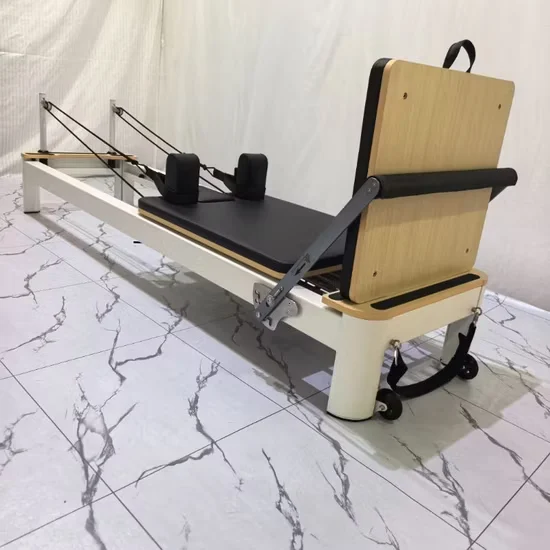
Acoustic-Grade Aluminium Frame — Precision rail glide mechanics keep carriage noise below ambient room levels for shared-wall studio deployments.
Technical Specifications
| Parameter | Value |
|---|---|
| Product Type | Pilates Reformer |
| Designation | SRY-12 |
| Frame Material | Aluminium |
| Product Dimensions | 2570 × 730 × 270 mm |
| Net Weight | 90 kg |
| Carriage System | Precision rail glide |
| Included Accessories | Long Box, Jump Board, Platform |
| Target User | Adult, Unisex |
| Logo | Customized Is Allowed |
| Warranty | 3 Years |
| Production Capacity | 80 Pieces/Month |
Application Suitability
| Deployment Scenario | Typical Use |
|---|---|
| Boutique Pilates studio | Daily group reformer classes with high-frequency accessory swaps |
| High-end residential wellness suite | Private sessions requiring quiet operation near living areas |
| Hotel guest fitness center | Shared-wall adjacency on guest room floors with 24-hour access |
| Rehabilitation and physiotherapy clinic | Low-impact movement therapy with stable platform positioning |
| Corporate wellness room | Midday sessions requiring rapid reconfiguration between users |
Why Carriage Noise Reaches the Studio Owner Before the Maintenance Team Does
Aluminium construction and precision rail alignment eliminate the friction rattle that triggers complaints in shared-wall spaces.
I once walked into a boutique studio built into a residential tower where the owner was fielding weekly noise complaints from the unit directly below. The carriage on their previous reformers rattled on every transitional movement — not because the equipment was defective, but because the rail tolerance and frame resonance amplified every direction change into the floor slab. Pilates studios deployed above or beside occupied spaces need equipment where the carriage glide stays sub-ambient, not just when new but after thousands of spring-loading cycles. A white aluminium Pilates reformer commercial deployment like this one addresses that structural-acoustic gap [NEED_CITE: acoustic transmission requirements for fitness equipment on suspended floor slabs].
Where This Reformer Sits in a Mixed-Modality Studio Floor Plan
This unit covers the full reformer repertoire — footwork, strap work, long box series, and jump board plyometrics — from a single footprint. In a studio mixing mat-based and apparatus work, the SRY-12 pairs with tower or chair units to rotate members through stations without dead time. The 2570 × 730 mm footprint fits standard studio bay spacing, and the aluminium frame keeps weight manageable for periodic reconfiguration. It accommodates adult users across a broad size range, and the modular accessory ecosystem means instructors program full sessions without pulling additional equipment into the lane. The white aluminium Pilates reformer commercial configuration suits franchise studios that need a consistent visual identity across locations.
Continuous Session Scheduling and Deployment Environment Requirements
A studio running back-to-back group classes six days a week subjects the carriage rail and spring anchors to repetitive loading cycles that residential-grade equipment cannot absorb. The aluminium frame resists torsional flex under sustained spring tension, but deployment still demands a level subfloor with vibration-damping pads to prevent structure-borne transmission into the slab below. In hotel wellness floors, the unit must clear adjacent corridor walls by enough margin that carriage end-stops do not transmit impact through partition framing. Power is not a concern here — this is a purely mechanical system — but overhead lighting and HVAC airflow should avoid casting instructor shadows across the carriage path [NEED_CITE: commercial studio spatial planning standards for reformer clearance and airflow]. Facilities operating in humid coastal markets should verify that the aluminium grade resists oxidation without requiring protective coating cycles.
Aluminium Frame Dynamics and Accessory Load Path Explained
The choice of aluminium over steel for the frame is a deliberate trade-off: reduced mass for easier reconfiguration, with sufficient torsional rigidity to resist flex under maximum spring tension. Steel frames absorb vibration differently and weigh more, making them stable but difficult to reposition during studio layout changes. The precision rail system governs how the carriage glides through transitional movements — any misalignment surfaces as audible friction or lateral play that instructors feel before they hear it. The long box, jump board, and platform attach via dedicated mounting points rather than universal clamps, which means attachment interfaces must be inspected for wear at intervals matching class volume. Spring tension selection determines resistance character across the exercise library, and the aluminium rail must maintain dimensional tolerance across seasonal temperature swings without binding. The three-year warranty covers structural and rail components under normal commercial use [NEED_CITE: EN 957 structural fatigue requirements for spring-loaded exercise apparatus].
What Cutting Corners on Frame and Rail Specifications Costs Later
Deploying a reformer with a frame that flexes under repetitive spring loading generates carriage drift that worsens over months, not years. Studios that sourced lighter-gauge frames to save on initial outlay reported rail realignment needs within the first quarter of operation, pulling equipment off the schedule and frustrating members who booked specific class slots. Noise from poorly toleranced rails compounds — what sounds like minor friction in an empty studio becomes a complaint trigger when the room fills and ambient noise drops during focused work. Venues in multi-tenant buildings have faced lease-level disputes when equipment vibration propagated through floor assemblies. A unit that requires frequent rail lubrication or spring replacement also increases the maintenance burden on studio staff who are already managing class scheduling and member experience [NEED_CITE: commercial equipment maintenance scheduling impact on studio revenue].
Why the Senrui Cardio and Apparatus Line Supports This Deployment
The engineering team tests carriage rail glide noise under standard spring tension before units ship, catching friction anomalies that surface only under load. The aluminium frame and accessory mounting interfaces are validated through repetitive attachment-and-release cycles to ensure long-term interchangeability. For studios sourcing multiple apparatus types, the broader Senrui lineup covers complementary equipment so a single supplier relationship handles the full floor build-out. OEM customization extends to logo placement, color matching, and accessory bundling so franchise networks deploy a consistent brand environment. The free 3D studio layout service accounts for reformer lane spacing, instructor sightlines, and airflow paths — not just equipment footprint but how the room functions during a live class. Technical support responds around the clock for facilities operating across time zones, and spare parts logistics keep replacement springs and rail components in circulation without extended downtime.
Documentation & Test Records
- CE declaration of conformity covering structural and mechanical safety requirements
- EN 957 test report validating frame and rail load-bearing performance
- ISO 9001 certificate for manufacturing quality management processes
- Frame material certification with aluminium alloy grade specification
- Carriage rail glide noise measurement record under standard spring tension
- Accessory attachment mechanism durability test documentation
Installation, Commissioning & Maintenance
- Maintain minimum 600 mm clearance on all sides of the 2570 × 730 mm footprint for safe carriage travel and instructor access
- Install vibration-damping pads under all frame contact points to isolate structure-borne noise from the subfloor
- Level the aluminium frame on deployment surface using integrated adjustable feet before spring tension calibration
- Inspect carriage rail alignment and lubrication intervals monthly under daily class scheduling
- Verify long box, jump board, and platform mounting interfaces for wear every 500 attachment cycles
- Clean aluminium frame surfaces with non-corrosive agents to prevent sweat residue buildup in high-humidity environments
Planning Your Studio Build-Out or Equipment Refresh
Provide the studio floor dimensions and intended class capacity to receive a 3D layout showing reformer lane spacing, instructor positioning, and airflow paths. Specify whether the deployment sits on a suspended slab or ground floor to determine vibration isolation requirements. Confirm whether the venue operates near occupied residential or hotel spaces so noise performance targets can be matched. Indicate any OEM customization needs — logo placement, frame color, or accessory bundle — along with target delivery timelines for the rollout.
Frequently Asked Questions
Q: How does the aluminium frame compare to steel in long-term fatigue performance?
A: Aluminium offers a favorable strength-to-weight ratio that reduces frame mass for studio reconfiguration while maintaining torsional rigidity under repetitive spring loading. Steel frames weigh more and absorb vibration differently but are harder to reposition. The aluminium grade used in this reformer is selected for fatigue resistance across thousands of high-tension cycles, and the three-year warranty covers structural integrity under commercial use.
Q: What maintenance does the carriage rail system require in a busy studio?
A: The precision rail system requires periodic lubrication and alignment checks at intervals determined by class volume. Studios running daily group sessions should inspect rail glide smoothness monthly and address any lateral play or friction noise immediately. Environmental factors like humidity and temperature swings can affect rail tolerance. Replacement rail components are available through the spare parts supply chain to minimize equipment downtime.
Q: How quickly can accessories be swapped between classes?
A: The long box, jump board, and platform use dedicated mounting points designed for rapid interchange without tools. Instructors can reconfigure the reformer between class segments in under a minute, keeping group sessions on schedule. The attachment mechanisms are tested for repeated engagement cycles, and any wear in the interface points surfaces as looseness that staff can detect during routine inspection before it affects class quality.
Q: Is this reformer suitable for hotel fitness centers with shared walls?
A: Yes — the aluminium frame and precision rail system produce minimal carriage noise during transitional movements, making the unit appropriate for hotel guest floors and residential-adjacent wellness spaces. Vibration-damping pads under the frame contact points further reduce structure-borne transmission. The 3D layout service can plan reformer placement to avoid impact transmission through partition walls, and the quiet operation has been validated in hotel deployments with 24-hour guest access.
Q: What is the lead time for OEM customization on branded studio rollouts?
A: Logo placement, frame color matching, and accessory bundle configuration are available as OEM options with flexible minimum order quantities suitable for franchise network expansions. Lead time depends on customization scope and order volume, so early confirmation during the quotation phase ensures production scheduling aligns with studio opening or refresh timelines. The OEM process covers visual branding without affecting structural or mechanical specifications.
![Pilates Reformer Machine Spine Corrector Oak Ladder Barrel for Studio [WARN] draft identifier mismatch](https://bicksport.com/wp-content/uploads/2026/08/pilates-reformer-machine-spine-corrector-oak-ladder-barrel-for-studio-warn-draft-identifier-mismatch-f15d91.webp)
![Maple Wood Pilates Reformer Portable Folding Gym Fitness Equipment [WARN] draft identifier mismatch](https://bicksport.com/wp-content/uploads/2026/08/maple-wood-pilates-reformer-portable-folding-gym-fitness-equipment-warn-draft-identifier-mismatch-dd0561.webp)
![High Quality Aluminum Pilates Reformer Bed for Home and Studio Use [WARN] draft identifier mismatch](https://bicksport.com/wp-content/uploads/2026/08/high-quality-aluminum-pilates-reformer-bed-for-home-and-studio-use-warn-draft-identifier-mismatch-8fd5a8.webp)
