
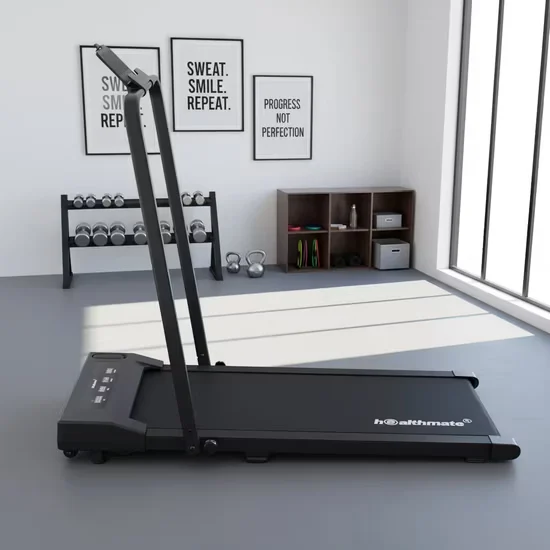
Acoustic Engineering for Compact Spaces — W04D8H delivers motorized cardio performance optimized for environments where spatial constraints and operational noise demand precision engineering.
Technical Specifications
| Parameter | Value |
|---|---|
| Designation | W04D8H |
| Product Type | Foldable Treadmill |
| Motor Type | Motorized Drive System |
| Speed Range | 1-12 km/h |
| Maximum Speed | <15 km/h |
| Running Surface | 1000 x 400 mm |
| Console Type | LED Screen (Speed/Distance/Time/Calories) |
| Programs | 6 |
| Product Dimensions | 1250 x 590 x 1080 mm |
| Folded Design | Yes |
| User Weight Range | 100-160 kg |
| Certification | CE, RoHS |
| Customization | Available (Logo, Packaging) |
| Production Capacity | 3000 units/month |
Application Suitability
| Deployment Scenario | Typical Use |
|---|---|
| High-end residential home gym | Space-efficient cardio for daily walking and light jogging routines |
| Corporate wellness room | Compact motorized option for employee fitness breaks |
| Apartment fitness room | Shared facility cardio accommodating varied user preferences |
| Small fitness studio | Versatile equipment with storage flexibility between sessions |
What Peak Horsepower Hides About Continuous Duty in Compact Foldable Motorized Treadmill W04D8H Deployments
Motorized drive consistency matters more than peak ratings suggest.
When I first started auditing cardio zones for hotel properties, I watched maintenance logs show motor burnout patterns that traced directly back to spec sheet misinterpretation. Operators would see peak horsepower numbers and assume continuous operation was safe, only to find motors overheating within months under sustained guest usage. The W04D8H’s motorized system is engineered for the 1-12 km/h range with thermal management suited to its deployment class. For facilities running equipment across extended daily windows, understanding the gap between peak output and continuous duty cycle prevents premature failures and emergency replacements [NEED_CITE: motor duty cycle classification for continuous commercial operation]. The foldable motorized treadmill W04D8H addresses compact space requirements while maintaining drive system integrity across its speed spectrum.
Cardio Zone Positioning for Walking and Light Jogging Intensities
The foldable motorized treadmill W04D8H covers walking through light jogging modes across its 1-12 km/h range, filling the steady-state cardio slot in mixed-equipment layouts. In a corporate wellness room or apartment fitness space, it pairs with resistance machines or free weight stations to round out training options. The 1000 x 400 mm running surface accommodates users within the 100-160 kg range during moderate-intensity sessions. LED console feedback on speed, distance, time, and calorie estimates supports self-directed workout tracking without requiring external app integration.
Continuous Operation Windows and Spatial Deployment Constraints
Daily runtime expectations for this foldable motorized treadmill W04D8H class should align with motorized drive thermal limits—facilities anticipating back-to-back user sessions across eight or more hours need to verify continuous duty specifications before deployment. Noise transmission through floor assemblies becomes a factor when units sit above occupied spaces; the motorized drive system operates within acoustic ranges suitable for residential and hospitality environments, though vibration isolation pads help manage structure-borne transmission [NEED_CITE: acoustic transmission standards for cardio equipment in multi-story buildings]. The 1250 x 590 mm footprint requires level flooring with adequate clearance for the folding mechanism’s full range of motion. Standard single-phase power supplies the motorized system without requiring dedicated three-phase circuits.
Motorized Drive and LED Console Architecture Explained
The motorized drive system in the W04D8H delivers speed regulation across the 1-12 km/h band through electronic control that adjusts power delivery based on user weight and belt load. DC motor architectures in this class typically prioritize compact form factor and cost efficiency, trading some continuous-duty thermal headroom for size reduction—appropriate for deployment scenarios where daily runtime stays within moderate windows. The LED console provides real-time speed, distance, time, and calorie readouts through segment displays rather than touchscreen interfaces, which reduces electronic complexity and potential failure points. Six preset programs offer structured session options without requiring users to manually adjust speed mid-workout. The folding mechanism introduces a mechanical hinge point that must maintain structural rigidity during operation; safety locks prevent unintended collapse while the unit is in use.
The Hidden Costs of Underspecified Drive Systems
I’ve seen apartment fitness rooms replace entire cardio fleets after residents filed noise complaints that traced back to motorized drives vibrating through floor slabs during early morning use. Units spec’d for light residential duty cycles fail prematurely when deployed in shared facilities with continuous user turnover. The W04D8H’s foldable design and motorized system target environments where space constraints justify the form factor, but operators must match expected daily runtime to the drive system’s thermal capacity [NEED_CITE: EN 957 requirements for commercial cardio equipment durability testing]. LED consoles without data export capabilities create information silos—facility managers cannot track usage patterns or identify underutilized equipment without manual observation.
Why This Product Line Addresses Compact Cardio Requirements
Biketon Sport’s acoustic engineering focus means the W04D8H’s motorized drive system undergoes noise validation during development rather than as an afterthought. The 10,000-hour durability testing protocol covers motorized components under continuous load, providing deployment confidence beyond spec sheet claims. Six complete cardio series from one manufacturer means facilities sourcing the foldable motorized treadmill W04D8H can standardize console interfaces and maintenance procedures across equipment categories. OEM customization extends to logo and packaging, while 3D layout planning accounts for the unit’s folded storage footprint and operational clearance requirements. Technical support availability addresses commissioning questions without requiring on-site service visits for routine setup issues.
Documentation & Test Records
- CE conformity declaration confirming European market compliance for W04D8H motorized systems
- EN 957 test report validating structural and operational safety standards
- ISO 9001 certificate covering manufacturing quality management processes
- RoHS compliance documentation for electronic component material restrictions
- Motor specification sheet detailing continuous and peak duty parameters
- LED console technical documentation with program descriptions and display functions
Installation, Commissioning & Maintenance
- Position W04D8H on level flooring with 500mm clearance behind for folding mechanism travel
- Install vibration isolation pads under the 1250 x 590 mm footprint to reduce structure-borne noise
- Connect to standard single-phase outlet; avoid shared circuits with high-draw equipment
- Verify folding safety locks engage before first user session after transport
- Inspect motorized drive belt tension and alignment quarterly under moderate-use conditions
- Clean LED console surface with non-abrasive solutions to maintain display legibility
Equipment Selection and Deployment Planning
Provide your cardio zone square footage and adjacent equipment list to receive 3D layout recommendations accounting for the W04D8H’s operational footprint and folded storage position. Specify anticipated daily runtime hours to confirm motorized drive duty cycle alignment with your facility’s usage patterns. Identify deployment floor level and adjacent occupied spaces to validate acoustic suitability for your environment.
Frequently Asked Questions
Q: What is the difference between continuous and peak motor power for treadmills?
A: Peak power represents maximum output during brief acceleration or heavy-load moments, while continuous power reflects sustained thermal capacity during extended operation. Selecting equipment based solely on peak ratings risks motor overheating under real-world usage patterns where sessions run consecutively without cool-down intervals between users.
Q: How does the folding mechanism impact treadmill stability during use?
A: Folding designs introduce hinge points that must maintain rigidity under dynamic loading. Safety locks prevent unintended collapse, and structural testing validates that the running surface remains stable across the full speed range without deflection or vibration that would affect user comfort or gait consistency.
Q: What maintenance is required for the motorized drive system?
A: Motorized systems require periodic belt tension checks, alignment verification, and lubrication per manufacturer intervals. Electronic components benefit from dust-free environments and stable voltage supply. Facilities should establish maintenance schedules based on actual usage hours rather than calendar dates to match service intervals to operational wear.
Q: What is the maximum user weight capacity for this foldable model?
A: The W04D8H accommodates users within the 100-160 kg range as specified. Weight capacity reflects both structural frame limits and motorized drive capability to maintain speed regulation under load—exceeding rated capacity accelerates component wear and compromises speed consistency during sessions.

![Hsm W04H1 Remote Control Walking Treadmill with Transport Wheels for Commercial Use [WARN] draft identifier mismatch](https://bicksport.com/wp-content/uploads/2026/08/hsm-w04h1-remote-control-walking-treadmill-with-transport-wheels-for-commercial-use-warn-draft-identifier-mismatch-8bc95e.webp)

![Hsm Fashion Design Walking Treadmill with Auto-Incline Function [WARN] draft identifier mismatch](https://bicksport.com/wp-content/uploads/2026/08/hsm-fashion-design-walking-treadmill-with-auto-incline-function-warn-draft-identifier-mismatch-4d04f6.webp)