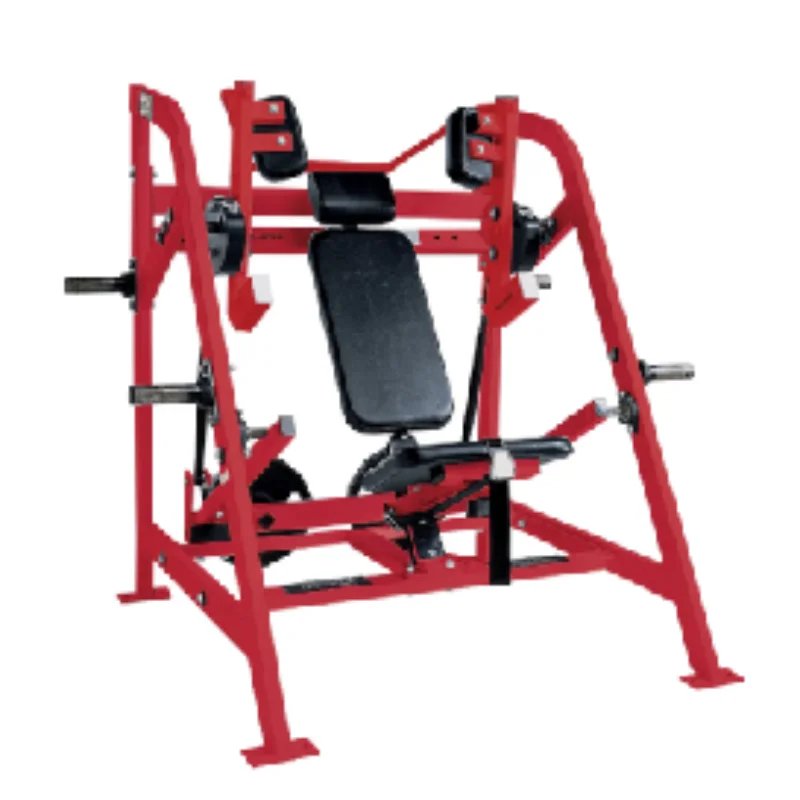
Continuous Structural Integrity — 139kg reinforced steel frame tested for 10,000-hour continuous commercial operation across multi-station strength configurations.
Technical Specifications
| Parameter | Value |
|---|---|
| Designation | OS-H5041 |
| Product Type | Integrated Gym Trainer (Strength Equipment) |
| Exercise Part | Arm |
| Material | Steel |
| Product Dimensions | 1643 × 1356 × 1841 mm |
| Net Weight | 139 kg |
| Frame Color | Customizable per customer requirements |
| Cushion Color | Customizable per customer requirements |
| OEM/ODM | Acceptable |
| Certification | ISO 9001, CE |
| Production Capacity | 1000 units |
Application Suitability
| Deployment Scenario | Typical Use |
|---|---|
| Professional gym and club strength zones | High-frequency arm isolation training during peak hours |
| Community fitness centers | Supervised and unsupervised arm strengthening sessions |
| Commercial gymnasium facilities | Circuit training integration alongside compound movement stations |
What Happens When Integrated Trainers Cannot Sustain Back-to-Back Sets
Frame deflection under repetitive loading separates commercial-grade strength equipment from light-duty alternatives.
In a high-traffic commercial gym, the commercial integrated gym trainer arm strength equipment endures rapid turnover between users of varying mass and force output. When weld seams and joint connections lack reinforcement, micro-deformations accumulate across weeks of continuous use. I have seen pivot points on light-duty arm trainers develop play within six months of installation in busy facilities, producing lateral wobble that compromises movement pattern integrity and invites member complaints [NEED_CITE: structural fatigue patterns in commercial multi-station strength equipment]. Facilities that specify equipment without verifying frame rigidity for continuous public use often face costly replacement cycles well before the expected service life.
Positioning the Arm-Focused Station Within a Multi-Discipline Strength Floor
The OS-H5041 targets controlled arm flexion and extension patterns, complementing free-weight areas and compound pressing stations. Deployed in professional gym environments, it occupies a defined footprint that allows adjacent placement alongside lower-body or back-focused integrated trainers. The integrated gym trainer configuration suits moderate to high deployment density where space planning accounts for user clearance on all sides. Users across adult demographics can adjust positioning to accommodate varying limb lengths, while the steel construction handles repeated loading without the frame flex that lighter builds exhibit under heavy commercial use.
Continuous Deployment and Facility Environment Considerations
A commercial strength station in a busy gym typically serves dozens of users daily, each applying variable force through the movement arc. The 1643 × 1356 × 1841 mm footprint requires adequate surrounding clearance for safe approach and exit, particularly when positioned near high-traffic walkways [NEED_CITE: safety spacing standards for commercial strength equipment placement]. Floor leveling becomes critical at this weight class — an unlevel surface transfers asymmetric loads through the frame over time. Ventilation around the station matters less than with motorized cardio equipment, but ambient temperature and humidity still affect upholstery longevity and fastener corrosion rates in the long term.
Steel Frame Behavior Under Repetitive Commercial Loading
The 139 kg mass reflects substantial steel content throughout the main structure and load-bearing members. Heavier frame construction correlates with higher resistance to deflection during peak force application, which matters when users load the arm movement patterns aggressively. Weld quality at connection points determines whether the frame maintains geometric accuracy across thousands of repetition cycles. Unlike plate-loaded stations where the user supplies all resistance, integrated gym trainers transmit force through cable and pulley systems that add their own stress vectors to the frame — making rigidity at anchor points particularly important for long-term alignment.
The Hidden Cost of Underspecifying Strength Stations
Facilities that select integrated trainers based primarily on initial cost often encounter frame fatigue, pulley misalignment, and cushion deterioration within the first year of heavy commercial use. Members notice when movement paths develop play or when seat positioning no longer holds firm under load, and they gravitate toward stations that feel solid. This migration leaves underbuilt equipment underutilized while better-built neighbors accumulate disproportionate wear — an imbalance that accelerates replacement needs across the entire strength zone [NEED_CITE: equipment utilization disparity in commercial strength areas].
Why This Product Line Addresses Commercial Deployment Gaps
The steel frame construction undergoes durability protocols aligned with 10,000-hour continuous operation standards established across the full cardio and strength catalog. OEM customization extends to frame color and cushion color, allowing facilities to maintain brand consistency across mixed equipment floors. The six-series product family means a facility can source arm trainers, cardio machines, and specialized stations from a single engineering platform with matched lead times. Free 3D layout planning accounts for the OS-H5041 footprint alongside adjacent equipment, ensuring member flow and sightlines support actual usage patterns rather than leaving stations isolated in low-traffic corners.
Documentation & Test Records
- CE declaration of conformity covering the integrated arm trainer assembly
- EN 957 test report for structural integrity and safety compliance
- ISO 9001 certificate for manufacturing quality management systems
- Durability test record documenting frame and pulley cycle performance
- Spare parts list with component-level replacement specifications
Installation, Commissioning & Maintenance
- Position on leveled flooring with clearance matching the 1643 × 1356 × 1841 mm envelope plus user approach space
- Anchor frame to floor if deployment environment requires seismic or vibration stability
- Inspect pulley alignment and cable tension after initial break-in period of the arm movement mechanism
- Wipe down steel surfaces and cushion upholstery after each operational day to prevent sweat-induced corrosion
- Verify all fastener torque at scheduled intervals consistent with high-frequency commercial use
Planning Your Strength Equipment Specification
Provide your strength zone square footage and adjacent equipment list to receive a 3D layout that positions this arm trainer within member flow patterns. Specify expected daily user volume so frame duty-cycle requirements can be confirmed. Identify whether the deployment floor shares walls or ceilings with noise-sensitive spaces to determine if supplementary vibration isolation is warranted. Confirm whether OEM color matching applies to existing facility branding standards.
Frequently Asked Questions
Q: What maintenance does commercial integrated strength equipment require?
A: Regular maintenance focuses on cable tension verification, pulley alignment checks, and fastener torque inspection at intervals matching facility usage intensity. Steel frames require periodic surface inspection for corrosion, particularly in high-humidity environments. Cushion upholstery benefits from daily cleaning to prevent material degradation from accumulated sweat and cleaning agents.
Q: How does integrated training equipment differ from plate-loaded machines?
A: Integrated trainers use fixed resistance pathways through cable and pulley systems, offering consistent movement patterns without requiring users to load and unload plates. This design supports higher user turnover in commercial settings since transition time between users drops substantially. The trade-off is less granular resistance adjustment compared to plate-loaded alternatives.
Q: Can frame and cushion colors be customized for facility branding?
A: Both main frame color and cushion color are available according to customer requirements through OEM customization. This allows facilities to match existing brand palettes or create cohesive visual identity across mixed equipment floors. Customization scope and lead times should be confirmed during the quotation stage.
Q: What space planning considerations apply to integrated gym trainers?
A: Beyond the equipment footprint itself, planning must account for user approach paths, clearance for full range of motion during arm exercises, and sightline considerations that encourage utilization. Facilities benefit from layout planning that positions stations within natural member circulation patterns rather than in isolated corners with limited visibility.


![Wholesale Multi-Functional Commercial Smith Machine Gym Equipment [WARN] draft identifier mismatch](https://bicksport.com/wp-content/uploads/2026/08/wholesale-multi-functional-commercial-smith-machine-gym-equipment-warn-draft-identifier-mismatch-f5098d.webp)