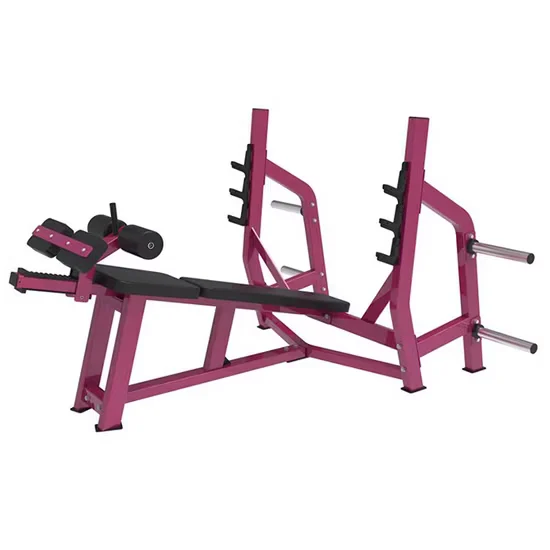
10,000-Hour Durability Verified — ISO-lateral pivot bearings and reinforced steel frame tested for continuous high-frequency chest pressing cycles without play or resistance drift.
Technical Specifications
| Parameter | Value |
|---|---|
| Product Type | Plate-Loaded Decline Bench Press |
| Model NO. | 5052 |
| Exercise Part | Chest |
| Frame Material | Steel |
| Product Dimensions | 1500×1150×1280 mm |
| Net Weight | 65 kg |
| Max User Weight | 180 kg |
| Motion Type | ISO-Lateral Independent Arm Convergence |
| Resistance Type | Plate-Loaded |
| Frame Color | Available per customer requirements |
| Cushion Color | Available per customer requirements |
| OEM/ODM | Acceptable |
| Certification | ISO 9001, CE |
Application Suitability
| Deployment Scenario | Typical Use |
|---|---|
| Chain gym strength zone | High-frequency chest pressing with independent arm motion for diverse membership levels |
| Professional sports training center | Athlete-grade decline pressing with precise loading for periodized strength programs |
| Corporate wellness room | Compact footprint chest training for executive fitness facilities |
| Community fitness center | Low-maintenance plate-loaded operation across extended daily hours |
| Hotel fitness center | Durable steel construction suited for unsupervised guest access environments |
Why Plate-Loaded ISO-Lateral Designs Outlast Pin-Stack Machines in 24/7 Facilities
Plate-loaded independent arm convergence eliminates cable stretch, pulley wear, and the maintenance schedule that comes with them.
Pin-loaded selectorized machines dominate commercial floors, but their cables stretch under continuous loading, pulleys wear unevenly, and resistance drifts well before the next scheduled service window. In a facility running sixteen or more hours daily, those failure points compound — members notice the inconsistency on heavy sets and start avoiding the station. [NEED_CITE: cable fatigue failure rates in commercial selectorized strength equipment] A plate-loaded commercial plate-loaded decline bench press sidesteps the entire failure chain. Load pins, plates, and a pivot bearing. That is the resistance path. There is nothing to stretch, nothing to fray, and nothing to recalibrate between service intervals.
Decline Pressing in the Strength Zone Equipment Matrix
The commercial plate-loaded decline bench press targets the lower pectoral fibers through a fixed decline angle, filling the gap between flat and incline pressing stations in a complete chest training cluster. ISO-lateral independent arm convergence allows each side to move through its own arc, accommodating natural shoulder mechanics and reducing the compensation patterns that fixed-bar setups often encourage. In a high-traffic commercial environment, this unit pairs directly with a flat ISO-lateral press and an incline press to give members full-range chest development without requiring three separate barbell benches. It accommodates users up to 180 kg and the 1500×1150 mm footprint leaves adequate clearance for plate loading on both sides when spaced per standard commercial floor plans.
Continuous Operation and Facility Infrastructure Requirements
A plate-loaded decline bench has no motor, no electronics, and no power requirement — which eliminates an entire category of deployment headaches. There is no voltage mismatch to discover after the container clears customs, no dedicated circuit to pull, and no console firmware to manage across a multi-site rollout. [NEED_CITE: electrical infrastructure requirements for commercial gym strength equipment deployment] What this machine does demand is a level floor and adequate spacing for plate changes on both sides. The 1280 mm height means it clears standard ceiling heights easily, and the 65 kg net weight keeps it stable during heavy sets without requiring floor anchoring in most commercial installations. For facilities above occupied spaces, the absence of motor vibration and the solid steel frame mean noise transmission stays well within acceptable limits for hotel or mixed-use building environments.
Reading the Pivot Bearing and Frame Specifications
The ISO-lateral arm mechanism is the heart of this machine. Independent convergence requires pivot bearings that sustain lateral loading through thousands of press cycles without developing play. Sealed bearings are standard for commercial-grade pivot points because they resist sweat ingress and chalk dust contamination — the two most common causes of premature bearing failure in strength equipment. The steel frame specification should be evaluated by tube gauge and welding pattern at the pivot junction, where cyclic loading concentrates stress. [NEED_CITE: steel frame welding standards for commercial plate-loaded strength equipment] Plate-loaded horns need adequate diameter and retention to prevent plate rattle during controlled negatives. Cushion density matters here as well — a decline angle places sustained pressure on the lower back and glutes, so high-density foam that resists compression over extended use prevents the cushion from bottoming out within the first year of commercial deployment.
What Compromised Specifications Cost Down the Line
A pivot bearing that develops play within six months turns a smooth convergence arc into a loose, unpredictable press path — and members stop using the station once they feel the wobble on heavy sets. [NEED_CITE: member retention impact of equipment downtime in commercial gyms] Low-density cushion foam compresses permanently under continuous use, creating an uneven pressing surface that generates complaints about back discomfort during decline work. Frames built with thinner gauge steel at the pivot junction can develop fatigue cracks under the cyclic loading of daily commercial use, turning a maintenance issue into a liability concern. When OEM customization is superficial — paint color only, no structural specification input — the underlying engineering still dictates whether the machine survives its first year in a high-traffic facility.
Why This Product Line Holds Up in Commercial Deployments
Every unit in this product range undergoes 10,000-hour durability testing on pivot bearings and frame welds, which translates directly to confidence when specifying chest stations for facilities running sixteen-hour days. The full OEM/ODM capability covers frame color, cushion color, and branding — so the commercial plate-loaded decline bench press can match an existing floor’s design language without compromising on structural specifications. Biketon Sport’s 50,000 square meter manufacturing facility in Shandong runs vertical integration from CNC machining through final assembly, meaning pivot tolerances and frame welds are controlled in-house rather than outsourced. Free 3D strength-zone layout planning accounts for this unit’s 1500×1150 mm footprint alongside plate storage racks and adjacent pressing stations, ensuring member flow and safe loading clearance. The 24/7 technical support response means bearing replacements or cushion warranty claims get addressed without pulling the unit off the floor for extended periods.
Documentation & Test Records
- CE declaration of conformity covering plate-loaded strength equipment safety requirements
- EN 957 test report validating structural integrity and user weight rating
- ISO 9001 certificate for manufacturing quality management system
- Durability test record documenting pivot bearing and frame cycle performance
- Cushion foam density specification sheet for compression resistance verification
- Installation and commissioning guide with floor spacing and leveling requirements
Installation, Commissioning & Maintenance
- Allow minimum 600 mm clearance on each side of the 1150 mm width for safe plate loading
- Verify floor levelness before placement; use rubber matting to protect flooring and reduce vibration
- Inspect ISO-lateral pivot bearings quarterly for play and re-lubricate sealed bearings per schedule
- Check plate horn retention collars monthly for secure fit and replace worn collars promptly
- Wipe down steel frame and cushion upholstery after each use to prevent sweat corrosion and vinyl degradation
- Confirm all frame bolts at pivot junctions are torqued to specification after the first 500 use cycles
Planning Your Strength Zone Procurement
Provide your facility floor plan and target equipment count so we can generate a 3D strength-zone layout that accounts for this unit’s footprint, plate storage positioning, and member flow between pressing stations. Specify your expected daily usage volume to confirm that the bearing and frame duty cycle aligns with your operating hours. Confirm your deployment floor and adjacent room usage so we can verify that noise and vibration transmission stay within acceptable limits. Let us know whether frame color, cushion color, or branding customization is required to match your facility design standards.
Frequently Asked Questions
Q: Plate-loaded vs pin-loaded — which is better for commercial 24/7 facilities?
A: Plate-loaded designs eliminate cables, pulleys, and selector pins — the components that fail most frequently under continuous use. Maintenance intervals extend considerably because the resistance path consists of load pins and plates with no mechanical wear components. For facilities running extended hours with minimal on-site maintenance staff, plate-loaded stations reduce long-term service costs and downtime significantly.
Q: What biomechanical advantage does ISO-lateral independent arm convergence provide?
A: Independent arm convergence allows each side to follow its own natural pressing arc rather than forcing both arms along a fixed bar path. This accommodates individual shoulder mechanics, reduces joint stress during heavy decline sets, and prevents the stronger side from compensating for the weaker side. Members with prior shoulder injuries typically find the independent motion more comfortable than fixed-bar alternatives.
Q: How does plate-loaded design reduce long-term maintenance costs?
A: With no cables to stretch, no pulleys to wear, and no selector mechanisms to jam, the resistance system relies entirely on load pins and weight plates. Pivot bearings are the primary wear component, and sealed commercial-grade bearings sustain thousands of cycles before requiring service. This simplicity means fewer spare parts in inventory and less technician time per unit annually.
Q: What frame specifications indicate commercial-grade durability?
A: Look for steel tube gauge at the pivot junction, welding pattern quality at stress concentration points, and bearing seal specifications. A frame rated for 180 kg maximum user weight with documented durability testing demonstrates commercial readiness. OEM providers should supply test records verifying cyclic loading performance on pivot points and frame welds under sustained commercial use conditions.

![Commercial Tibia Dorsi Flexion Machine Gym Fitness Equipment [WARN] draft identifier mismatch](https://bicksport.com/wp-content/uploads/2026/08/commercial-tibia-dorsi-flexion-machine-gym-fitness-equipment-warn-draft-identifier-mismatch-f63366.webp)