
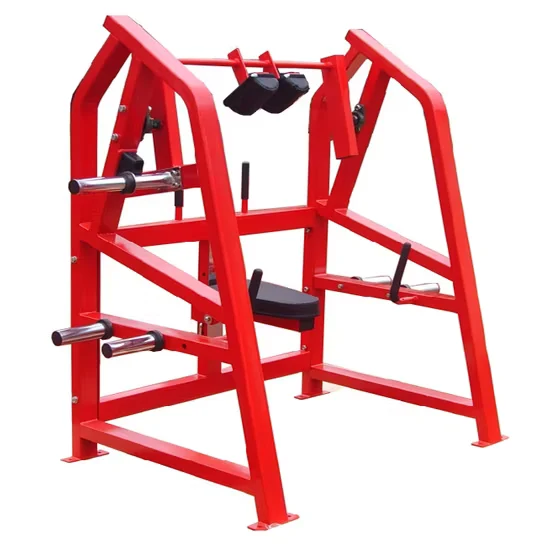
Heavy-Duty Neck Training — 130kg steel frame construction verified for high-frequency professional gym deployments requiring absolute stability during multi-directional resistance exercises.
Technical Specifications
| Parameter | Value |
|---|---|
| Designation | 5021 |
| Product Type | 4-Way Neck Machine |
| Resistance Type | Selectorized (Weight Stack) |
| Frame Material | Steel |
| Exercise Part | Neck (Flexion, Extension, Lateral Flexion, Rotation) |
| Product Dimensions | 90014001600mm |
| Net Weight | 130kg |
| Fit Area | Professional Gym and Club, Community, Gymnasium |
| Age Group | Adult |
| Gender | Unisex |
| Certification | ISO 9001, CE |
| OEM/ODM | Available |
| Warranty | Contact for commercial warranty terms |
Application Suitability
| Deployment Scenario | Typical Use |
|---|---|
| Professional gym strength zone | Daily multi-user neck conditioning for general membership |
| Sports performance training center | Athlete-specific neck strengthening for contact sports (football, rugby, combat sports) |
| Corporate wellness facility | Ergonomic neck rehabilitation and postural correction programs |
| Community fitness center | Accessible neck training for adult members seeking injury prevention |
| High-end residential home gym | Personalized neck and upper back conditioning for dedicated users |
Why Commercial Facilities Need Dedicated Neck Training Architecture
Precision-engineered movement paths eliminate the dangerous guesswork that plagues improvised neck training methods.
Many strength zones treat neck training as an afterthought, leaving athletes to improvise with manual resistance or unstable harness systems. This approach introduces uncontrolled loading vectors that risk cervical injury. A dedicated commercial 4-way neck machine provides biomechanically sound resistance curves across all four anatomical planes. Facilities that ignore this equipment category often see members attempting dangerous alternatives or leaving to train at specialized sports performance centers [NEED_CITE: biomechanical loading requirements for cervical spine training].
Positioning the 4-Way Neck Machine Within Professional Strength Zones
This equipment occupies a specialized niche in professional athletic training environments where cervical strength directly impacts performance and injury resilience. It complements compound movement stations by targeting stabilizer muscles that heavy squats, deadlifts, and Olympic lifts cannot adequately develop. The 900*1400mm footprint requires dedicated floor space with adequate clearance for users to mount and dismount safely. Deployment typically occurs in functional training zones or dedicated athlete preparation areas rather than general fitness floors. The 130kg mass provides inherent stability without requiring floor anchoring in most installations.
Continuous Operation and Facility Infrastructure Considerations
Unlike cardio equipment rated for continuous duty cycles, this commercial 4-way neck machine experiences intermittent loading patterns with peak stress during set transitions and weight stack adjustments. The steel frame and selectorized mechanism demand minimal maintenance compared to cable-driven systems, but pivot points and guide rods require periodic lubrication to maintain smooth resistance curves [NEED_CITE: selectorized equipment maintenance intervals in commercial environments]. Deployment in humid environments or facilities with poor climate control accelerates corrosion on exposed metal components. Standard commercial electrical supply is unnecessary since the system operates purely mechanically. Floor leveling becomes critical—the 130kg static load concentrates on four contact points, and uneven surfaces create lateral instability during lateral flexion exercises.
Selectorized Resistance and Mechanical Transmission Analysis
The 130kg total mass indicates substantial steel gauge thickness in the frame, providing the rigidity necessary to prevent flex during maximal resistance efforts. Selectorized weight stacks offer discrete resistance increments that allow precise progressive overload tracking—a critical factor when training cervical musculature where small load increases significantly impact adaptation. The four-direction capability requires either a rotating seat mechanism or adjustable resistance arm positioning; both approaches introduce mechanical complexity that must withstand repeated adjustment cycles. Guide rod diameter and bushing material determine whether the weight stack travels smoothly or binds under load. Commercial-grade units employ linear bearings or high-density polymer bushings rather than simple sleeve bearings that degrade within months of heavy use.
The Hidden Costs of Compromising on Neck Training Equipment Specifications
Facilities that purchase light-commercial or home-grade neck trainers for professional environments typically face premature failure at pivot points and selectorized mechanisms. Thin-gauge steel frames develop play in adjustment mechanisms, creating unpredictable resistance paths that compromise training safety. Inadequate padding density compresses permanently within weeks, exposing users to uncomfortable pressure points during loaded neck movements. Weight stacks with insufficient guide rod support generate noise and binding that frustrates users and drives them toward improvised training methods [NEED_CITE: failure modes in light-commercial strength equipment deployed in professional settings].
Why This Product Line Delivers for Demanding Facilities
The 130kg frame mass reflects material choices prioritizing structural integrity over shipping cost optimization. Full OEM/ODM capability allows facilities to match existing equipment aesthetics through custom color, logo, and upholstery specifications. The ISO 9001 and CE certification framework ensures manufacturing consistency across production batches. Free 3D strength zone layout planning addresses the spatial requirements specific to neck training equipment, including safe mounting zones and sightlines for trainer supervision. The six-series product family means facilities can source all strength and cardio disciplines from one manufacturing partner, simplifying procurement and warranty management. 24/7 technical support ensures rapid resolution of mechanical issues that could otherwise sideline specialized training equipment.
Documentation & Test Records
- CE declaration of conformity confirming European market compliance
- EN 957 test report validating safety requirements for stationary training equipment
- ISO 9001 certificate demonstrating quality management system implementation
- Structural load testing records for frame and pivot point verification
- Selectorized mechanism cycle testing documentation
- Upholstery and padding durability assessment reports
Installation, Commissioning & Maintenance
- Verify floor levelness before positioning; 130kg mass concentrates load on four feet requiring stable substrate
- Maintain minimum 600mm clearance on all sides for safe user mounting and emergency exit
- Lubricate weight stack guide rods with manufacturer-specified grease at quarterly intervals
- Inspect selectorized pin engagement and cable attachment points monthly for wear
- Clean upholstery with pH-neutral disinfectant after each use session to prevent material degradation
- Check pivot point bushings semi-annually for play and replace before looseness affects movement path accuracy
Equipment Selection and Deployment Consultation
Provide your strength zone dimensions and existing equipment inventory to receive a 3D layout incorporating the commercial 4-way neck machine with proper spacing for adjacent stations. Specify your facility’s daily user volume to determine whether single-unit deployment suffices or multiple machines prevent training bottlenecks during peak hours. Identify whether the machine will serve general membership or specialized athletic populations to guide resistance range configuration. Detail your target market’s voltage and plug standards if integrating electronic consoles for repetition counting or data logging in future upgrades.
Frequently Asked Questions
Q: How does the four-direction movement path maintain precision and user safety?
A: The mechanical design constrains resistance vectors to anatomically appropriate planes, preventing dangerous off-axis loading. Selectorized weight stacks provide consistent resistance curves without the variability inherent in manual resistance or elastic band systems. Properly engineered pivot points align with cervical spine rotation centers, minimizing shear forces. Regular maintenance of guide rods and bushings ensures the movement path remains true throughout the equipment’s operational lifespan.
Q: What structural indicators should commercial buyers prioritize when selecting neck training equipment?
A: Frame mass serves as a proxy for steel gauge thickness—units under 100kg typically indicate cost-cutting that compromises stability. Examine pivot point construction; commercial-grade equipment uses sealed bearings or replaceable bushings rather than simple bolt-through designs. Selectorized mechanisms should employ hardened guide rods with precision-fitted bushings. Upholstery attachment methods matter; bolted pads allow replacement without full disassembly.
Q: How does the 130kg equipment weight impact facility floor loading and installation requirements?
A: The concentrated static load requires verification that floor structures can support point loads at each foot position. Most commercial concrete slabs accommodate this without issue, but suspended floors or raised access flooring systems need engineering review. The mass eliminates the need for floor anchoring in typical installations, allowing repositioning during facility reconfigurations. Leveling feet compensate for minor substrate irregularities.
Q: What customization options are available through OEM/ODM programs?
A: Customization covers frame powder-coating colors, upholstery materials and colors, logo placement on frame and pads, and weight stack plate labeling. Some programs accommodate modified resistance ranges or alternative selectorized mechanisms. Console integration for data logging remains available for facilities implementing member tracking systems. Custom packaging and documentation support private-label deployments for equipment distributors.
Q: How should facilities position neck training equipment within strength zone layouts?
A: Locate the machine away from high-traffic circulation paths where distracted members might collide with users performing loaded movements. Ensure adequate lighting so trainers can observe form from multiple angles. Position near other specialized equipment rather than between major compound movement stations where congestion occurs. Provide clear signage explaining proper usage to prevent unsupervised experimentation by untrained members.

![Commercial Weight Storage Bench 5049 Gym Equipment Plate Organizer [WARN] draft identifier mismatch](https://bicksport.com/wp-content/uploads/2026/08/commercial-weight-storage-bench-5049-gym-equipment-plate-organizer-warn-draft-identifier-mismatch-272146.webp)

![Body Building Gym Equipment Commercial Leg Extension Machine 5030 [WARN] draft identifier mismatch](https://bicksport.com/wp-content/uploads/2026/08/body-building-gym-equipment-commercial-leg-extension-machine-5030-warn-draft-identifier-mismatch-528359.webp)