
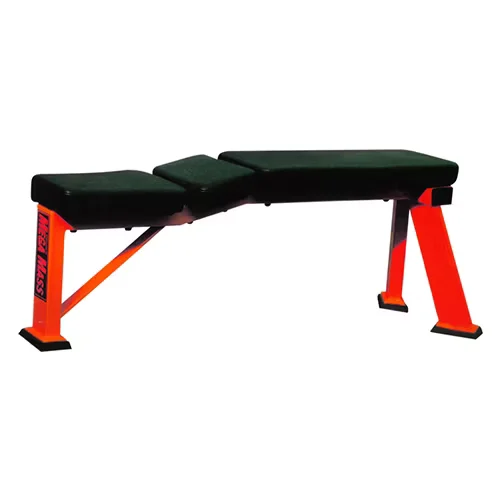
Reinforced Frame Design — Steel flat bench engineered for high-frequency professional gym use with welded joints tested under continuous load.
Technical Specifications
| Parameter | Value |
|---|---|
| Designation | H048 |
| Product Type | Flat Bench / Integrated Gym Trainer |
| Exercise Part | Whole Body |
| Material | Steel |
| Product Dimensions | 1353595532mm |
| Net Weight | 32kg |
| Max User Weight | 180kg |
| Age Group | Adult |
| Gender | Unisex |
| Main Frame Color | Customizable according to customer requirements |
| Cushion Color | Customizable according to customer requirements |
| Certification | ISO 9001, CE |
| Production Capacity | 1000 PCS/Month |
Application Suitability
| Deployment Scenario | Typical Use |
|---|---|
| Professional gym and health club | Full-body resistance training stations in free weight zones |
| Community fitness center | Durable flat bench for multi-user daily training routines |
| Commercial gymnasium | High-frequency weight training support across group and solo sessions |
| Corporate wellness room | Compact integrated trainer for space-conscious employee fitness facilities |
Why Steel Frame Fatigue Ends Up Costing More Than the Bench Itself
Heavy-duty welded steel prevents the cracking and wobbling that forces premature replacement in high-traffic free weight zones.
When a flat bench develops frame play or visible weld stress after months of daily loading, the problem extends beyond the unit itself — members notice instability, adjust their form to compensate, and eventually avoid that station entirely [NEED_CITE: structural fatigue patterns in commercial free weight equipment]. Gym operators often replace benches in batches because lighter-gauge frames fail on similar timelines. The H048 commercial flat bench gym equipment addresses this with reinforced steel construction and joint welding designed to withstand continuous commercial loading cycles without developing lateral movement or surface deformation.
Positioning Within the Free Weight Training Zone
This flat bench covers foundational pressing, rowing, and core training movements that form the base of most resistance programs. In a professional gym layout, it pairs with adjustable benches and squat racks to create a complete free weight cluster, occupying a compact footprint while supporting whole-body exercise variety. The 1353595532mm dimensions allow placement in high-density training areas where floor space is allocated per station. The commercial flat bench gym equipment accommodates users across a wide body weight range up to 180kg, making it suitable for general membership populations without requiring separate heavy-duty units.
Floor Loading, Spacing, and Daily Use Environment
A flat bench in a busy free weight zone sees repeated loading and unloading throughout operating hours, requiring stable footing on commercial rubber flooring or sealed concrete [NEED_CITE: floor loading standards for commercial gym free weight areas]. Adequate clearance on all sides ensures safe dumbbell handling and member passage between stations. The 32kg net weight provides inherent stability during use without anchoring, though rubber pads underneath prevent surface scratching and reduce vibration transfer to adjacent floors. Facilities deploying multiple units should plan spacing that accounts for dumbbell arc clearance and member movement patterns.
Steel Gauge, Welding Integrity, and Foam Density Under Load
The steel frame material provides the structural backbone, with welded joints bearing concentrated forces during heavy pressing and rowing movements. Frame thickness directly influences resistance to bending under repeated load cycles, and reinforced welding at stress points prevents the micro-cracks that propagate into visible failure. Cushion foam density determines whether the pad compresses unevenly after months of use — high-density foam retains its profile and prevents the user from feeling the steel frame beneath during exercises. Customizable frame and cushion colors allow facility operators to maintain visual consistency across equipment sets while selecting the commercial flat bench gym equipment that meets structural requirements.
The Hidden Cost of Specifying Below Commercial Grade
Benches built with lighter-gauge steel and thinner cushion pads may pass initial inspection but reveal their limitations within the first year of commercial deployment. Frame wobble develops at welded connections, cushion surfaces crack from repeated compression, and the unit becomes a maintenance ticket rather than a training asset [NEED_CITE: equipment replacement frequency in commercial gym environments]. Operators who selected based on initial cost often find that batch replacement and member complaints about unstable equipment exceed what a commercial-grade specification would have required. The integrated gym trainer design of this unit prioritizes structural longevity over cosmetic features that degrade quickly under daily use.
Why This Product Line Fits Professional Facility Standards
Every unit in the cardio and strength range undergoes 10,000-hour continuous operation testing on frames and load-bearing components, ensuring that the steel construction holds up under real deployment conditions. The OEM and ODM capability covers frame color, cushion color, and specification adjustments to match facility branding requirements. Free 3D layout planning accounts for the footprint and spacing needs of this flat bench within the broader equipment configuration, considering member flow between stations. The full product family allows sourcing complementary equipment from one production line, maintaining consistent quality and finish across the training floor. Technical support responds around the clock for installation guidance and operational questions.
Documentation & Test Records
- CE declaration of conformity for commercial gym equipment deployment
- EN 957 test report covering structural load and stability requirements
- ISO 9001 certificate validating production quality management processes
- Steel frame material specification and welding quality inspection record
- Cushion foam density and durability compression test documentation
- Installation guide with spacing and floor preparation requirements
Installation, Commissioning & Maintenance
- Maintain clearance around the 1353595532mm footprint for safe dumbbell handling and member passage
- Place on level commercial flooring with rubber pads to prevent surface damage and vibration transfer
- Inspect welded joints and frame connections upon delivery before positioning in the training zone
- Verify cushion foam firmness and surface integrity after the first month of high-frequency use
- Clean cushion surfaces daily with appropriate commercial gym disinfectant to prevent material degradation
- Check frame stability and foot pad condition quarterly to maintain consistent bench performance
Equipment Selection and Inquiry Guidance
Share your free weight zone dimensions and planned station count to receive a 3D layout that positions this flat bench within your equipment flow. Specify whether frame and cushion colors need to match existing facility branding for OEM customization scoping. Indicate your target market and deployment environment to confirm that the steel specification aligns with your expected daily usage intensity. Clarify any certification or documentation requirements for your procurement process early to streamline the quotation stage.
Frequently Asked Questions
Q: What steel grade is used for the H048 flat bench frame?
A: The frame is constructed from commercial-grade steel selected for structural integrity under repeated loading. The specific gauge and material specification are documented in the frame material sheet provided with each order. Welded joints at stress points are reinforced to handle continuous use in professional gym environments. Buyers can request the detailed material test report during the inquiry stage for engineering review.
Q: How do I customize frame and cushion colors to match my facility?
A: Both main frame color and cushion color are fully customizable according to your facility branding requirements. During the OEM scoping phase, you provide color references or Pantone codes, and production matches accordingly. This applies to both frame powder coating and cushion upholstery material. Customization lead time and minimum order quantities are confirmed during the quotation stage based on your specific color selections.
Q: What is the weight capacity of this bench for commercial use?
A: The flat bench is rated to support users up to 180kg, covering the broad range of body types encountered in professional gym environments. This capacity is validated through structural load testing per EN 957 standards. The reinforced steel frame and welded joint design maintain stability at maximum load without frame flex or lateral movement. Weight capacity documentation is included in the test records package.
Q: How does the OEM and ODM customization process work?
A: OEM and ODM customization covers frame color, cushion color, and specification adjustments based on your requirements. The process begins with scoping during the inquiry stage, where customization options are confirmed alongside quantity and lead time. Production accommodates branding adjustments including logo placement where applicable. All customization specifications are documented on the proforma invoice before production commences to ensure accuracy.
Q: What certifications does this flat bench hold?
A: The equipment holds ISO 9001 certification for production quality management and CE marking for market compliance. EN 957 test reports cover structural load and stability requirements specific to commercial gym equipment. All certification documents and test records are provided as part of the documentation package with each shipment. Additional testing documentation can be supplied upon request during the procurement process.
![New Design Strength Gym Equipment Total Leg Press Machine for Commercial Gyms [WARN] draft identifier mismatch](https://bicksport.com/wp-content/uploads/2026/08/new-design-strength-gym-equipment-total-leg-press-machine-for-commercial-gyms-warn-draft-identifier-mismatch-864355.webp)

![Commercial Adductor Machine Inner Thigh Fitness Equipment H5027 [WARN] draft identifier mismatch](https://bicksport.com/wp-content/uploads/2026/08/commercial-adductor-machine-inner-thigh-fitness-equipment-h5027-warn-draft-identifier-mismatch-d2f896.webp)
