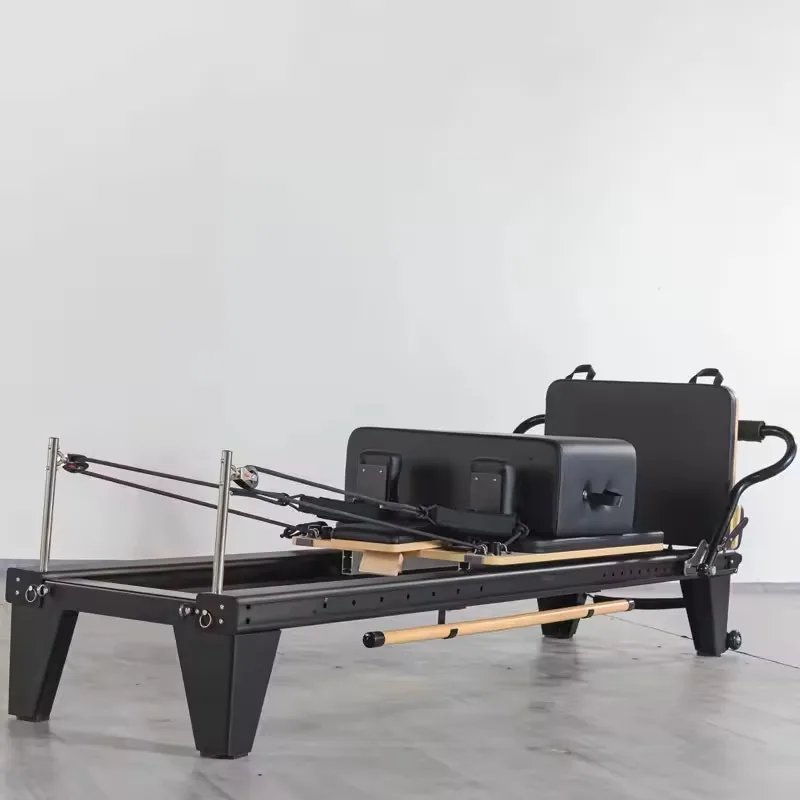
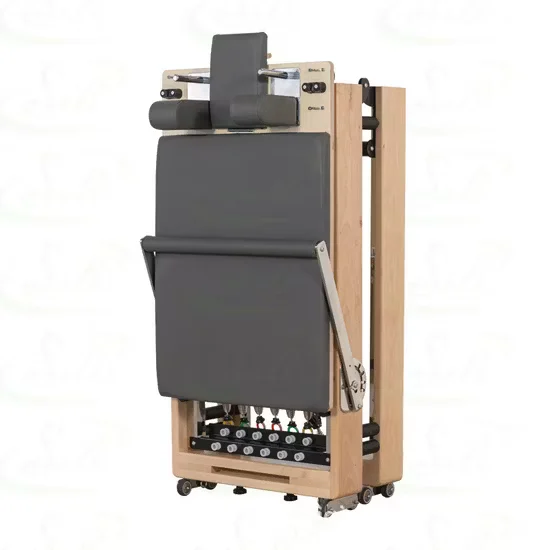
Wood-Frame Silence — Solid wood construction eliminates motor and electronic drive noise entirely, making this reformer suitable for shared-wall studio environments and multi-use fitness facilities where acoustic control is essential.
Technical Specifications
| Parameter | Value |
|---|---|
| Product Type | Pilates Reformer |
| Material | Wood |
| Specification | 2400600350mm |
| Net Weight | 100kgs |
| Foldable | Yes |
| Accessory | Long Box / Jump Board / Platform |
| Logo | Customized Is Allowed |
| Color | Solid Color |
| Age | Adult |
| Gender | Unisex |
| Warranty | 3 Years |
Application Suitability
| Deployment Scenario | Typical Use |
|---|---|
| boutique Pilates studio | group reformer classes requiring silent operation between shared walls |
| commercial fitness center with mind-body zone | dedicated Pilates programming adjacent to high-traffic cardio areas |
| high-end residential wellness facility | multi-use movement space where equipment stores compactly between sessions |
| hotel spa and recovery floor | guest-accessible reformer training with minimal noise transfer to adjacent rooms |
| rehabilitation and physiotherapy center | controlled resistance exercise programming for recovery and mobility work |
Why Acoustic Performance Matters More Than Resistance Range in Studio Deployment
Motor-free wood construction removes the single largest noise complaint trigger in shared-wall fitness environments.
Boutique Pilates studios occupying converted commercial floors or residential-adjacent spaces face acoustic scrutiny from neighbors, building management, and adjacent tenants. Electronic drive systems, magnetic resistance motors, and metal-on-metal carriage tracks generate low-frequency vibration that travels through structural framing. Wood-frame reformers eliminate motor noise entirely and dampen carriage travel through inherent material density [NEED_CITE: acoustic transmission characteristics of wood versus aluminum in fitness equipment frames]. Facility operators who have deployed motor-driven reformers on upper floors or shared-wall configurations report recurring noise complaints that disrupt class scheduling and trigger lease compliance issues.
Reformer Placement Within a Multi-Discipline Studio Layout
This folding Pilates reformer bed commercial wood frame model covers the full reformer exercise repertoire from footwork through advanced pulling strap sequences, accommodating beginner through advanced programming without requiring supplemental equipment. The 2400mm length provides full carriage travel for tall users while the foldable mechanism reduces stored footprint between class sessions, allowing multi-use studios to reconfigure floor space for mat work or group movement classes. The accessory ecosystem—long box, jump board, and platform—expands exercise variety without requiring dedicated secondary stations. Deployment density typically ranges from 6 to 12 units in a dedicated reformer studio, with the wood frame’s acoustic properties enabling tighter spacing without noise accumulation during synchronized group classes.
Continuous Scheduling and Acoustic Environment Requirements
Boutique Pilates studios operating back-to-back group classes from early morning through evening require equipment that maintains consistent carriage smoothness without generating cumulative noise that disturbs adjacent spaces. Wood-frame construction dampens vibration transfer through floor structures, making this reformer suitable for upper-floor deployments above occupied retail, office, or residential spaces [NEED_CITE: commercial lease acoustic compliance standards for fitness equipment]. Facilities operating 12 to 16 hours daily benefit from the absence of motor heat generation, eliminating supplemental ventilation requirements that motor-driven reformers impose in enclosed studio rooms. Floor leveling and vibration isolation pads remain recommended for optimal carriage alignment, though the wood frame’s mass provides inherent stability on standard commercial subfloors.
Material Selection and Carriage Track Engineering
Solid wood construction delivers acoustic dampening that aluminum and steel frames cannot match, as wood’s cellular structure absorbs rather than transmits vibration energy generated during carriage travel. The 100kg frame weight provides stability during dynamic jump board exercises without requiring floor anchoring, while the foldable mechanism incorporates reinforced hinge points rated for repeated deployment cycles. Long box and platform accessories mount to standardized attachment points, maintaining structural integrity during advanced exercise sequences. Wood-frame reformers require periodic rail lubrication and tension adjustment to maintain carriage smoothness over high-frequency commercial use, though they avoid the electronic sensor failures and motor burnout that plague motorized resistance systems in continuous operation [NEED_CITE: maintenance interval comparison between wood and aluminum Pilates reformer frames].
The Hidden Cost of Compromised Frame Construction
Facilities that selected aluminum or lightweight composite reformers to reduce upfront procurement costs report accelerated carriage wear, joint looseness, and noise complaints within the first year of high-frequency deployment. Thin-gauge metal frames transmit vibration through floor structures, triggering acoustic complaints from adjacent tenants and forcing class schedule restrictions. Motor-driven resistance systems in commercial reformers experience premature failure under back-to-back class scheduling, requiring warranty claims and equipment rotation that disrupts studio programming. Wood-frame reformers with reinforced foldable mechanisms maintain structural rigidity through thousands of deployment cycles, though facilities must verify hinge durability testing documentation before committing to foldable models for daily multi-use reconfiguration [NEED_CITE: foldable mechanism durability testing standards for commercial fitness equipment].
Why This Product Line Delivers for Commercial Deployment
Sub-35dB whisper-quiet operation is inherent to wood-frame construction, requiring no motor or electronic component to generate noise that would compromise shared-wall studio environments. The 10,000-hour durability testing protocol applied to our motorized cardio equipment extends to mechanical components on this reformer, including carriage bearings, foldable hinge mechanisms, and spring tension systems. Full OEM customization covers logo placement, solid color finish matching, and branding alignment for facility-specific deployment. The six-series cardio family allows facilities sourcing Pilates equipment to consolidate procurement across reformers, treadmills, ellipticals, and rowing machines from a single manufacturing partner. Free 3D studio layout planning addresses reformer spacing, accessory storage, and airflow requirements for enclosed movement rooms. Technical support availability covers installation commissioning, carriage alignment procedures, and maintenance scheduling for high-frequency studio operations.
Documentation & Test Records
- CE declaration of conformity for commercial Pilates equipment
- EN 957 test report covering structural load and carriage safety
- ISO 9001 certificate for manufacturing quality management
- Foldable mechanism durability cycle test record
- Accessory load rating verification for jump board and long box
- Wood frame material grade and joint construction documentation
Installation, Commissioning & Maintenance
- Allow 2400mm length plus 600mm clearance on each side for safe user movement and accessory deployment
- Level floor surface and deploy vibration isolation pads to maintain carriage alignment and prevent frame stress
- Inspect carriage rail lubrication and spring tension monthly under high-frequency studio scheduling
- Verify foldable hinge mechanism smoothness and locking engagement after every 500 deployment cycles
- Clean wood surfaces with manufacturer-approved products to prevent sweat damage and finish degradation
- Store long box, jump board, and platform accessories in designated rack positions to prevent frame impact
Inquiry Guidance for Equipment Selection
Provide studio square footage and planned reformer count to receive 3D layout planning that addresses spacing, accessory storage, and airflow requirements for enclosed movement rooms. Specify daily operating hours and class scheduling density to confirm that foldable mechanism durability and carriage smoothness align with your facility’s programming demands. Indicate deployment floor level and adjacent occupancy types to verify that wood-frame acoustic properties meet your building’s noise compliance requirements. Confirm OEM customization scope including logo placement, color matching, and branding alignment for facility-consistent visual identity across all equipment deployments.
Frequently Asked Questions
Q: How does wood frame construction compare to aluminum for commercial Pilates reformer noise and durability?
A: Wood frames absorb vibration through their cellular structure rather than transmitting it through floor connections, making them noticeably quieter in shared-wall environments. Aluminum frames offer lighter weight for portable applications but generate more acoustic transfer during carriage travel. Wood construction provides inherent stability for dynamic exercises without floor anchoring, though it requires periodic rail maintenance that aluminum self-lubricating systems avoid.
Q: What storage footprint does the foldable reformer achieve compared to fixed-frame models?
A: The foldable mechanism reduces the reformer’s vertical storage profile, allowing multi-use studios to stack units against walls between class sessions and reclaim floor space for mat work or group movement programming. Fixed-frame models require dedicated floor positions that remain occupied regardless of scheduling. Facilities should verify hinge durability testing documentation to ensure the foldable mechanism withstands daily reconfiguration cycles.
Q: Which reformer exercises require the long box, jump board, or platform accessories?
A: The long box enables seated and supine pulling strap exercises that require extended body support beyond the standard carriage length. The jump board attaches to the carriage end for plyometric jumping sequences that develop lower body power. The platform provides stable standing surface for exercises requiring foot placement outside the carriage travel range. Facilities should confirm accessory load ratings match their client weight distribution.
Q: What customization options are available for facility branding and visual consistency?
A: OEM customization covers logo placement on the wood frame, solid color finish matching to facility brand palettes, and accessory color coordination across multiple unit orders. Customization scope should be confirmed during quotation to ensure brand-consistent deployment across all reformers in a studio environment. Facilities should request sample finish swatches before committing to production runs.
Q: What maintenance does a wood-frame reformer require under high-frequency commercial use?
A: Carriage rail lubrication and spring tension adjustment should occur monthly under daily class scheduling to maintain smooth operation. Wood surfaces require cleaning with approved products to prevent sweat damage and finish degradation over time. Foldable hinge mechanisms need periodic inspection for smooth engagement and locking security. Facilities should establish maintenance logs tied to class scheduling volume.

![Commercial Wood Pilates Reformer Folding Bed for Studio and Home Use [WARN] draft identifier mismatch](https://bicksport.com/wp-content/uploads/2026/08/commercial-wood-pilates-reformer-folding-bed-for-studio-and-home-use-warn-draft-identifier-mismatch-78416d.webp)