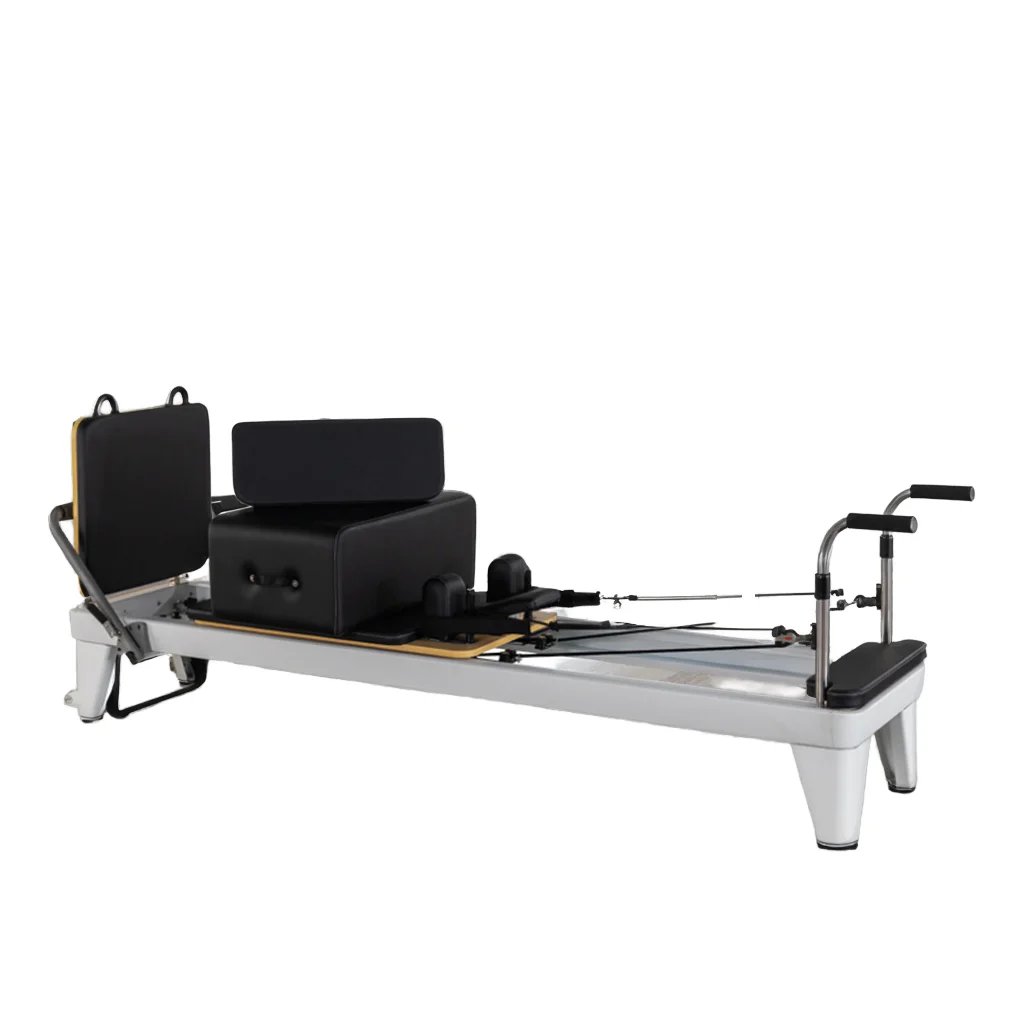
Whisper-Quiet Carriage Glide — Aluminum frame and precision rail system engineered to eliminate joint squeak and wood warping under continuous studio scheduling.
Technical Specifications
| Parameter | Value |
|---|---|
| Product Type | Pilates Reformer |
| Model | SRY-21 |
| Frame Material | Aluminum |
| Foldable | Yes |
| Color | Solid Color (customizable) |
| Accessory Compatibility | Long Box / Jump Board / Platform |
| Product Dimensions | 2550 × 680 × 350 mm |
| Net Weight | 65 kg |
| Age Group | Adult |
| Gender | Unisex |
| Logo | Customized Is Allowed |
| Warranty | 3 Years |
| Certification | ISO 9001, CE |
| Production Capacity | 80 Pieces/Month |
Application Suitability
| Deployment Scenario | Typical Use |
|---|---|
| Boutique Pilates studio | Back-to-back group reformer classes with high-frequency carriage cycling |
| Hotel fitness center on guest room floors | Quiet individual sessions where noise transfer to adjacent rooms is a concern |
| High-end residential home gym | Foldable storage between sessions in multi-purpose wellness rooms |
| Rehabilitation center | Controlled spring-resistance programming for guided recovery movements |
| Corporate wellness room | Compact deployment in space-constrained employee fitness areas |
Why Aluminum Frames Outlast Wood in Studio Environments
Carriage alignment and noise performance remain consistent across thousands of cycles when the frame does not absorb moisture or shift at the joints.
Traditional wooden reformers develop squeaks at the rail-to-frame connection after months of continuous studio scheduling. In humid climates across African and South Asian deployments, I have seen wood frames warp enough to cause carriage drift, forcing technicians to re-shim rails weekly. [NEED_CITE: dimensional stability comparison between aluminum and hardwood frames under humidity cycling] Members notice the noise before studio operators do, and complaints reach the front desk in hotel environments long before maintenance logs a ticket. A folding aluminum Pilates reformer commercial grade unit sidesteps this failure mode entirely by eliminating organic material from the load path.
Where This Reformer Fits in a Studio Equipment Mix
This unit covers the full reformer movement library — footwork, long stretch, coordination, and jump board cardio intervals — making it the anchor piece in a studio floor plan. It pairs with cadillacs and chair units for apparatus-rotation classes, so operators can schedule varied programming without requiring members to switch rooms. The 2550 mm footprint and foldable frame suit studios where floor space doubles as mat-work area between apparatus sessions. User weight capacity accommodates the broad adult demographic typical of commercial class rosters. The folding aluminum Pilates reformer commercial platform handles both beginner spring settings and advanced jump board loading.
Continuous Scheduling and Room-Level Deployment Constraints
Studios running four to six back-to-back classes daily subject every rail, spring, and pulley to continuous loading with minimal cooldown between sessions. [NEED_CITE: commercial Pilates equipment duty cycle standards for multi-class scheduling] The aluminum frame does not require climate-controlled storage between uses, unlike wood that needs humidity regulation to prevent seasonal warping. Noise transfer through floor slabs matters when studios operate above occupied hotel rooms or residential units — the carriage glide on this aluminum track generates minimal structure-borne vibration. Ground-floor and basement deployments require a level substrate and vibration isolation pads under each foot to prevent uneven rail loading. Adequate clearance on all sides — particularly the head end — ensures safe carriage travel during jump board sequences.
What the Frame and Spring Specs Actually Mean
Aluminum extrusion maintains dimensional tolerance across temperature and humidity ranges that cause hardwood to swell or contract at the rail interface. The foldable hinge mechanism must preserve carriage track alignment after repeated folding cycles — any deviation introduces lateral play that users feel as wobble during single-leg work. [NEED_CITE: hinge mechanism alignment retention testing for foldable reformer platforms] The spring and pulley system operates under continuous tension-release loading; commercial-grade springs retain calibrated tension across 10,000+ hours of studio scheduling, whereas light-duty springs lose rate consistency and require replacement within months. Multi-accessory compatibility — long box for supine work, jump board for plyometric intervals, platform for standing sequences — means a single unit supports the complete class curriculum without additional apparatus.
The Hidden Cost of Spec Compromises
Operators who select wooden *ulative maintenance cost that exceeds the aluminum price differential within the first year. Squeaking joints generate member complaints in shared residential and hotel environments, sometimes triggering entire equipment replacement rather than individual unit repair. Springs that lose tension calibration force instructors to verbally compensate during class, degrading the member experience and increasing private session cancellations. In markets with high ambient humidity, warped frames cause carriage misalignment that damages wheels and rail surfaces simultaneously — one component failure cascades into three. [NEED_CITE: total cost of ownership comparison for commercial Pilates reformer frame materials]
Why This Product Line for Your Facility
Sub-35dB carriage operation has been verified across hotel deployments where equipment sits adjacent to occupied guest rooms, eliminating the most common noise complaint in shared-floor fitness spaces. The aluminum frame and spring system undergo 10,000-hour continuous-use testing to validate tension retention and structural integrity under commercial scheduling loads. This reformer belongs to a complete cardio and apparatus family, so a facility can source every discipline from aligned design language and warranty terms. OEM customization extends to logo placement and color specification to match studio branding. The free 3D layout and airflow planning service accounts for reformer footprint, head-end clearance, and member circulation paths specific to this unit’s dimensions. Technical support responds around the clock for commissioning questions and spare parts coordination.
Documentation & Test Records
- CE declaration of conformity covering Pilates reformer safety requirements
- EN 957 test report for commercial-grade exercise equipment structural loading
- ISO 9001 certificate for manufacturing quality management systems
- Noise level test report verifying carriage glide acoustic performance
- Spring tension retention record after 10,000-hour continuous cycling
- Foldable hinge mechanism durability and alignment verification report
Installation, Commissioning & Maintenance
- Maintain minimum 600 mm clearance on all sides of the 2550 × 680 mm footprint for safe carriage travel and instructor access
- Install vibration isolation pads under each aluminum foot to decouple rail vibration from floor slabs in upper-floor deployments
- Verify spring tension calibration on first commission and re-check at 500-hour intervals using the provided tension gauge specification
- Inspect foldable hinge mechanism alignment quarterly and tighten pivot hardware to specified torque values
- Clean aluminum rails with non-abrasive solvent weekly to prevent sweat residue buildup that increases carriage friction
- Lubricate pulley bearings per the maintenance schedule in the installation and commissioning guide
Equipment Selection and Inquiry Scope
Provide your studio floor area and intended reformer count to receive a 3D layout with carriage clearance and member circulation paths mapped to this unit’s dimensions. Specify daily class count and average session duration so we can confirm spring system duty-cycle suitability for your scheduling density. Identify the deployment floor and adjacent occupied spaces to validate acoustic requirements against test report data. State your target market so we can scope any OEM customization including logo, color, and accessory bundle.
Frequently Asked Questions
Q: How does an aluminum reformer frame compare to wood in terms of noise and maintenance over time?
A: Aluminum does not absorb moisture or shift at bonded joints, so the rail-to-frame interface maintains its original tolerance without seasonal re-shimming. Wooden frames in humid environments develop squeaks at connection points and can warp enough to cause carriage drift, requiring regular technician visits. The aluminum frame eliminates both failure modes, keeping carriage noise low and reducing scheduled maintenance to basic cleaning and spring inspection.
Q: Does folding the reformer affect carriage track alignment or spring tension?
A: The hinge mechanism is precision-machined to return the frame to exact alignment after each fold-unfold cycle. Carriage track parallelism and spring anchor geometry are verified through repeated folding durability tests. Operators should inspect pivot hardware at scheduled intervals, but normal folding for storage does not degrade glide smoothness or spring calibration under typical studio use conditions.
Q: How do springs maintain consistent resistance in a high-frequency studio schedule?
A: Commercial-grade springs are wound from alloy steel rated for continuous tension-release cycling across 10,000+ hours. Light-duty springs lose rate consistency within months as the metal fatigues, forcing instructors to adjust verbal cues during class. The springs on this reformer are tested for tension retention under sustained studio scheduling, and replacement intervals are documented in the maintenance guide.
Q: Can this reformer support the full class curriculum including jump board work?
A: Yes. The long box, jump board, and platform accessories mount to the same frame, covering supine, standing, and plyometric movement patterns from a single unit. This reduces the total apparatus count a studio needs, freeing floor area for mat work or additional member stations. Each accessory stores separately when not in use.
Q: Is this reformer suitable for deployment on hotel guest room floors?
A: The aluminum frame and carriage rail system produce minimal structure-borne vibration, and noise level testing confirms operation compatible with noise-sensitive environments. Vibration isolation pads under each foot further decouple the unit from floor slabs. Hotel operators should confirm deployment floor and adjacent room proximity during the inquiry stage so acoustic requirements can be matched to test data.

![Wholesale Pilates Reformers Cadillac with Tower for Home Gym [WARN] draft identifier mismatch](https://bicksport.com/wp-content/uploads/2026/08/wholesale-pilates-reformers-cadillac-with-tower-for-home-gym-warn-draft-identifier-mismatch-ea7bd5.webp)