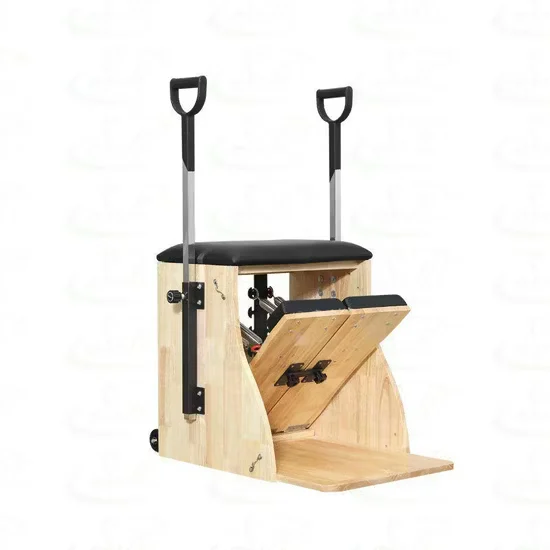
![Foldable Pilates Reformer with Tower for Studio Use [WARN] draft identifier mismatch](https://bicksport.com/wp-content/uploads/2026/08/foldable-pilates-reformer-with-tower-for-studio-use-warn-draft-identifier-mismatch-ca5e25.webp)
Wood-Frame Vibration Damping — Solid wood construction naturally absorbs spring resonance and carriage roll noise, keeping studio floors quiet during back-to-back class blocks.
Technical Specifications
| Parameter | Value |
|---|---|
| Product Type | Foldable Pilates Reformer |
| Designation | SRY-20B |
| Brand | Senrui |
| Frame Material | Solid Wood |
| Product Dimensions | 2400 × 600 × 350 mm |
| Net Weight | 100 kg |
| Foldable | Yes |
| Accessories Included | Long Box, Jump Board, Platform |
| Color Options | Solid Color (customization available) |
| Logo Customization | Available |
| Warranty | 3 Years |
Application Suitability
| Deployment Scenario | Typical Use |
|---|---|
| Boutique Pilates studios running multiple daily class blocks | Reformer group classes with full accessory set per station |
| Multi-discipline fitness centers with shared floor space | Reformer sessions between mat and cardio zones, folded when space is needed |
| High-end residential wellness suites | Quiet home practice with foldable storage after each session |
| Rehabilitation clinics and wellness centers | Controlled spring-loaded resistance for guided recovery programs |
| Hotel spa and wellness floors | Low-noise reformer sessions without disturbing adjacent guest rooms |
Why Spring Resonance Travels Through Shared Floors Before Anyone Notices
Solid wood frames absorb vibration at the source rather than transmitting it through floor slabs.
Metal-frame reformers conduct spring oscillation and carriage impact directly into concrete or timber subfloors, creating low-frequency resonance that reaches rooms below. In multi-tenant wellness buildings and hotel spa floors, this vibration triggers complaints from occupants who never see the equipment itself. Facility managers often discover the problem only after lease disputes or guest compensation requests escalate. The SRY-20B addresses this through wood’s inherent acoustic damping — the frame material itself reduces resonance transmission during spring-loaded transitions and carriage roll. [NEED_CITE: acoustic transmission characteristics of wood vs steel frames in fitness equipment]
Where This Reformer Fits in a Studio Equipment Layout
This foldable Pilates reformer commercial wood unit covers full reformer class programming — from supine footwork through standing platform work — with the included Long Box, Jump Board, and Platform. It pairs alongside mat zones and complements cadillac or chair stations in a comprehensive Pilates studio. The foldable frame allows a single room to transition between reformer classes and open-floor mat or functional movement sessions within the same operating day. The 2400 mm length accommodates users across a wide height range, and the wood frame handles continuous class-cadence use without the joint loosening common in bolted metal assemblies.
Continuous Class Scheduling and Room-Level Requirements
Studios running four to six reformer classes per day subject springs and carriage wheels to sustained cyclic loading. The 3-year warranty reflects tested confidence in wood joint integrity and spring fatigue resistance across that operational tempo. Deployment on upper floors of mixed-use buildings benefits from the wood frame’s vibration absorption, but subfloor flatness remains critical — uneven surfaces introduce lateral carriage drift that accelerates wheel wear. Rooms housing multiple reformers need adequate spacing between units for instructor circulation and safe limb extension during side-lying work. Ambient temperature and humidity control also matter: solid wood responds to moisture swings, so climate-stable environments preserve joint tightness and frame alignment over time. [NEED_CITE: wood dimensional stability requirements for commercial fitness equipment environments]
Spring Resistance, Carriage Mechanics, and Frame Material Behavior
Solid wood frames damp vibration through material porosity — the cellular structure of hardwood absorbs oscillation energy that steel or aluminum would conduct. This matters most during rapid direction changes in jump board work and high-rep footwork sequences where spring snap-back creates resonant frequency. The carriage runs on wheels along the wood frame rail, and the foldable hinge mechanism must maintain lateral rigidity during side-lying and kneeling exercises where off-center loading occurs. Accessories like the Long Box extend the working surface for seated and supine arm work, while the Jump Board converts the reformer for plyometric loading. Spring resistance provides progressive tension that increases with extension — a different loading curve from constant-weight resistance, requiring users to control both concentric and eccentric phases throughout each repetition.
What Spec Compromises Cost in a Studio Environment
Studios that select reformers based on upfront unit price often face compounding costs within the first year. Metal frames with inadequate cross-bracing develop audible rattling that worsens with each class cycle, eventually requiring full bearing and wheel replacement. Springs that lack fatigue-rating documentation lose tension consistency, causing instructors to compensate by adjusting programming rather than relying on equipment calibration. Non-foldable units consume permanent floor space that limits a studio’s ability to reconfigure between class formats, reducing revenue per square meter. Wood frames with poorly executed joinery — dowels instead of mortise-and-tenon or inadequate metal-bracket reinforcement at the hinge — develop play that manifests as carriage wobble during unilateral exercises. [NEED_CITE: fatigue cycle testing standards for Pilates reformer springs in commercial use]
Why This Product Line Earns Studio Deployment
The SRY-20B benefits from the same engineering discipline applied across our commercial cardio range. The wood frame undergoes the same durability verification protocols — continuous cyclic loading tests that simulate years of studio-class cadence. The foldable mechanism is engineered for repeated daily folding without hinge degradation, matching the operational reality of multi-use studio spaces. Our 3D layout planning service covers reformer spacing, instructor circulation paths, and ventilation requirements specific to Pilates environments where breathwork and sustained exertion demand adequate airflow. OEM customization extends to logo placement and wood finish color, allowing studios to maintain visual branding across a full equipment fleet. Documentation packages include assembly guides with torque specifications for wood-frame fasteners, ensuring re-assembly after transport preserves structural integrity.
Documentation & Test Records
- CE declaration of conformity covering Pilates reformer structural and mechanical safety
- Frame and carriage load testing report aligned with EN 957 requirements
- ISO 9001 certificate for manufacturing quality management systems
- Spring fatigue cycle test record documenting resistance consistency over extended use
- Noise and vibration transmission assessment for multi-floor studio deployment
- Assembly and commissioning guide with wood-frame fastener torque specifications
Installation, Commissioning & Maintenance
- Maintain clearance around the 2400 × 600 mm footprint for safe limb extension and instructor access during classes.
- Verify subfloor flatness before placement; uneven surfaces cause lateral carriage drift and accelerate wheel wear on the wood rail.
- Confirm ambient humidity stays within wood-stable range to prevent joint loosening or frame warping over seasonal cycles.
- Inspect spring attachment points and carriage wheels monthly under daily class schedules; replace springs showing visible deformation.
- Lubricate carriage wheel bearings at intervals specified in the commissioning guide to maintain smooth roll along the wood frame.
- Check foldable hinge mechanism bolts quarterly and re-torque to factory specifications to preserve lateral rigidity.
Planning Your Reformer Deployment
Share your studio floor plan and class schedule density so we can map reformer spacing, folding clearance, and airflow requirements in a 3D layout. Specify the target market and deployment floor level so we can confirm whether subfloor vibration isolation is needed for the rooms below. Indicate any branding requirements — logo placement, wood finish shade, or upholstery color — so customization lead times align with your opening or renovation schedule.
Frequently Asked Questions
Q: How does a solid wood frame compare to metal in acoustic performance for shared-floor studios?
A: Wood’s cellular structure absorbs spring resonance and carriage vibration rather than conducting it through floor slabs. Metal frames transmit low-frequency oscillation that reaches rooms below, often triggering complaints. In multi-tenant wellness buildings, the wood frame reduces the need for supplemental vibration isolation mats, though subfloor flatness remains important for carriage tracking and long-term wheel wear.
Q: Does the foldable hinge compromise carriage stability during lateral exercises?
A: The hinge mechanism is engineered to maintain lateral rigidity when the unit is deployed in its operating position. Side-lying and kneeling work generate off-center loads that test frame torsion, and the wood joinery at the fold point is reinforced to handle that stress across thousands of class cycles without developing play or wobble.
Q: What spring resistance range is provided, and can springs be swapped?
A: The included springs cover progressive resistance suitable for both clinical rehabilitation and athletic conditioning within a studio class format. Springs can be exchanged to adjust the tension curve for specific user populations, and the attachment hardware accommodates standard reformer spring replacements without frame modification.
Q: Are the Long Box, Jump Board, and Platform included or sold separately?
A: All three accessories ship with the SRY-20B as standard inclusions. This supports full commercial class programming — from seated arm work on the Long Box through plyometric Jump Board sequences — without requiring additional equipment purchases or compatibility verification.
Q: What customization options are available for facility branding?
A: Logo placement and wood finish color can be tailored to match studio branding. Upholstery color for the carriage pad and accessories is also customizable. Minimum order quantities and lead times vary by customization scope, so specify your requirements during the quotation phase to align production scheduling with your deployment timeline.