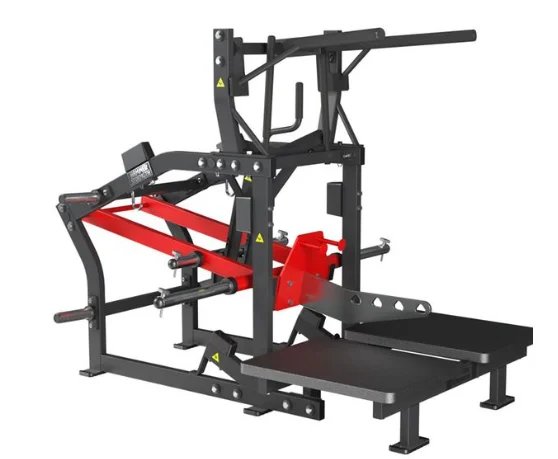
Commercial Steel Frame — reinforced steel construction and sealed bearing system engineered for continuous high-frequency use across professional gym environments.
Technical Specifications
| Parameter | Value |
|---|---|
| Product Type | Strength Equipment |
| Model NO. | 5031 |
| Exercise Part | Leg |
| Frame Material | Steel |
| Movement System | ISO-Lateral Independent Arms |
| Bearing Type | Sealed Bearings |
| Max User Weight | 180kg |
| Product Dimensions | 1989×1771×1545mm |
| Net Weight | 148kg |
| OEM/ODM | Available (logo, color, specification) |
| Certification | ISO 9001, CE |
Application Suitability
| Deployment Scenario | Typical Use |
|---|---|
| Professional gym and health club strength zones | High-frequency leg training across diverse membership base |
| Community fitness center | Daily member access with minimal maintenance requirements |
| Corporate wellness facility | Balanced unilateral training for varied fitness levels |
| Hotel fitness center | Low-maintenance durability for 24/7 guest access |
| Sports performance training center | Athlete-grade bilateral and unilateral leg development |
Why Frame Rigidity Matters More Than Plate Stack Size
ISO-Lateral independent arms paired with a reinforced steel frame deliver balanced resistance through the full range of motion under continuous commercial loading.
When strength equipment enters a high-traffic commercial floor, the frame absorbs repetitive loading cycles that quickly expose thin-gauge steel and inconsistent welds. I have seen leg press units develop lateral sway within months when the pivot bearings and frame joints were not spec’d for the duty cycle of a busy gym [NEED_CITE: structural fatigue testing for commercial strength equipment]. The ISO-Lateral Leg Press Machine commercial gym operators choose must hold its geometry after thousands of reps daily, or the motion path drifts and member complaints follow.
Positioning Within the Strength Zone Layout
The ISO-Lateral Leg Press Machine commercial gym facilities deploy occupies a distinct role in the lower-body training area, complementing hack squat machines, leg extension and curl stations, and free-weight squat racks. Its ISO-Lateral independent arm design allows both bilateral and unilateral pressing, covering strength and hypertrophy intensity ranges without requiring additional dedicated machines. The 1989×1771mm footprint demands adequate clearance on all sides for safe loading and member passage. User accommodation up to 180kg ensures compatibility across a broad membership demographic.
Continuous Use and Deployment Environment Requirements
Professional gym floors running this equipment across 12–16 hour operating windows require attention to floor leveling and vibration isolation beneath the 148kg frame. Sealed bearings reduce scheduled maintenance intervals, but the deployment surface must be flat and load-rated for dynamic forces during heavy pressing cycles [NEED_CITE: floor load requirements for commercial plate-loaded equipment]. Adequate spacing between adjacent machines ensures members can load and unload plates without interference. The unit does not require electrical supply, simplifying placement away from dedicated power circuits.
Sealed Bearings and Independent Arm Mechanics Explained
The ISO-Lateral mechanism decouples left and right pressing arms so each leg works independently against its own resistance path. This eliminates the compensation pattern where a dominant leg absorbs the majority of load during bilateral pressing. Sealed bearings at the pivot points prevent dust and sweat ingress that degrade open-bearing systems on commercial floors, maintaining consistent motion quality over extended service intervals. The steel frame transmits force from the footplate through the carriage without flex, preserving the intended resistance curve throughout the pressing arc. Heavier frame mass at 148kg contributes to stability during explosive or high-load repetitions without anchoring to the floor.
The Hidden Cost of Underspec’d Frame Construction
Light-gauge frames that deflect under load shift the pressing angle and place uneven stress on the carriage bearings, accelerating wear and generating noise that members notice immediately. Facilities that purchased based on price rather than duty cycle frequently replace entire units within the second year [NEED_CITE: replacement frequency of under-specced commercial strength machines]. Bearing failure on a leg press creates a safety concern unlike any cardio unit — a seized pivot during a heavy set puts the member at direct risk. Data from facility maintenance logs consistently shows frame and bearing issues as the primary drivers of strength equipment downtime.
Why This Product Line Holds Up on Commercial Floors
Every frame in our cardio and strength catalog undergoes 10,000-hour continuous load testing before entering production, and the ISO-Lateral Leg Press is no exception. The sealed bearing specification was selected specifically to extend maintenance intervals in high-traffic environments where daily lubrication is unrealistic. OEM customization covers frame color, logo placement, and pad material to align with facility branding. Our 3D layout planning service maps the leg press footprint against adjacent equipment sightlines and member flow paths, ensuring the unit sits where traffic patterns support rather than obstruct usage. Documentation and spare parts availability back every deployment with 24/7 technical support response.
Documentation & Test Records
- CE declaration of conformity for the ISO-Lateral Leg Press platform
- EN 957 structural and safety test report covering frame load capacity
- ISO 9001 quality management certificate for manufacturing facility
- Durability test record documenting 10,000-hour bearing and frame cycling
- Weld inspection and material thickness verification report
- Spare parts list with bearing and pivot assembly specifications
Installation, Commissioning & Maintenance
- Verify floor load rating supports 148kg unit weight plus dynamic user loading across the 1989×1771mm footprint
- Level all four contact points and install vibration pads to prevent frame rock during heavy pressing cycles
- Maintain minimum 600mm clearance on all sides for plate loading and member passage
- Inspect sealed bearing pivot points quarterly for smooth rotation and absence of play
- Wipe down guide rods and carriage surfaces weekly to prevent sweat corrosion on steel components
- Confirm all frame bolts at specified torque intervals during first 30 days and quarterly thereafter
Matching Equipment to Your Facility Requirements
Provide your strength zone square footage and planned equipment list to receive a 3D layout with member flow and sightline analysis. Specify daily operating hours and expected peak membership traffic so we can confirm bearing and frame duty cycle alignment. Indicate whether adjacent spaces require noise mitigation from plate loading impact. Share your target market and any branding customization requirements to scope OEM lead time.
Frequently Asked Questions
Q: How does ISO-Lateral differ from a traditional bilateral leg press?
A: The ISO-Lateral system separates left and right pressing arms so each leg moves independently. This prevents the stronger leg from compensating during the press, delivering more balanced muscle development. In commercial settings, it also allows members recovering from unilateral injuries to train one leg without removing load from the other side, increasing the machine’s utility across a diverse membership.
Q: What frame specifications should buyers verify for commercial durability?
A: Confirm steel gauge thickness at the main uprights and carriage rails, and request weld inspection documentation. Frame weight at 148kg reflects material mass that contributes to stability during heavy use. Ask for cyclic load test records showing the frame tested under repeated pressing cycles, and verify the maximum user weight rating aligns with your membership demographics.
Q: How do sealed bearings affect maintenance scheduling?
A: Sealed bearings prevent dust, chalk, and sweat from entering the race, which extends service intervals compared to open or shielded bearings. On a busy gym floor, this means quarterly inspection rather than monthly repacking. The trade-off is that sealed units are replaced rather than serviced when they reach end of life, so confirming spare parts availability with the supplier is essential for long-term planning.
Q: What OEM customization options are available for this machine?
A: Frame color, logo placement on the shroud or upright, and pad material can all be customized to match facility branding. Minimum order quantities are flexible and depend on the scope of customization requested. Console or digital integration does not apply to this plate-loaded unit, so OEM focus remains on physical appearance and contact surface specifications.
Q: How should the leg press be positioned within the strength zone layout?
A: Place the unit along a wall or perimeter with adequate overhead clearance for full-range carriage travel. Allow sufficient aisle width on the loading side for members handling heavy plates. Sightline positioning matters — members are more likely to use equipment they can see from the entrance, so avoid placing the press behind taller machines where it becomes visually hidden from the main traffic flow.
![Commercial ISO-Lateral Plate Loaded Rowing Machine H5003 [WARN] draft identifier mismatch](https://bicksport.com/wp-content/uploads/2026/08/commercial-iso-lateral-plate-loaded-rowing-machine-h5003-warn-draft-identifier-mismatch-07c8f9.webp)
![Hammer Strength Equipment Leg Extension OS-H5030 [WARN] draft identifier mismatch](https://bicksport.com/wp-content/uploads/2026/08/hammer-strength-equipment-leg-extension-os-h5030-warn-draft-identifier-mismatch-ab35ad.webp)
![Huiyang 5081 Half Rack Power Cage Gym Machine [WARN] draft identifier mismatch](https://bicksport.com/wp-content/uploads/2026/08/huiyang-5081-half-rack-power-cage-gym-machine-warn-draft-identifier-mismatch-004de5.webp)