![Factory Maple Folding Reformer Pilates Equipment for Home Studio Yoga Training Exercise Fitness Machine [WARN] draft identifier mismatch](https://bicksport.com/wp-content/uploads/2026/08/factory-maple-folding-reformer-pilates-equipment-for-home-studio-yoga-training-exercise-fitness-machine-warn-draft-identifier-mismatch-e4b2ea.webp)
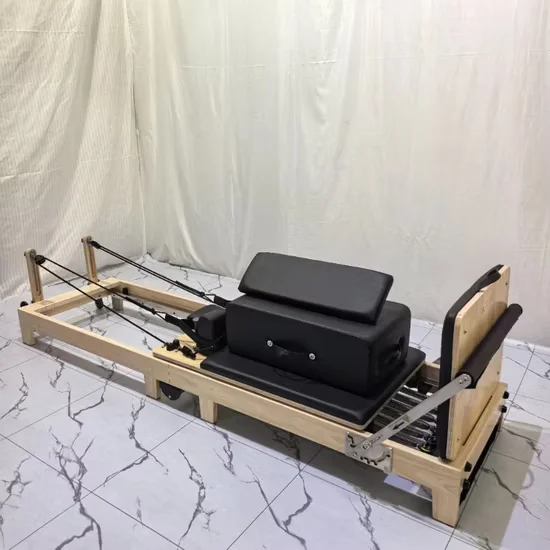
Whisper-Quiet Carriage Glide — Solid maple wood frame naturally absorbs vibration, eliminating the metal-on-metal resonance that disrupts adjacent sessions in shared studio environments.
Technical Specifications
| Parameter | Value |
|---|---|
| Product Type | Folding Reformer Pilates Equipment |
| Frame Material | Solid Maple Wood |
| Product Dimensions | 2400 x 600 x 350 mm |
| Max User Weight | 100 kg |
| Foldable | Yes |
| Accessories | Long Box, Jump Board, Platform |
| Color Options | Solid color finishes available |
| Customization | Logo and color customization available |
| Age Group | Adult |
| Gender | Unisex |
| Warranty | 3 Years |
| Certification | ISO 9001, CE |
Application Suitability
| Deployment Scenario | Typical Use |
|---|---|
| Boutique Pilates studio | Back-to-back group reformer classes requiring quiet carriage operation |
| High-end residential wellness room | Private daily practice where equipment noise penetrates living spaces |
| Hotel fitness center | Pilates programming on guest room floors without disturbing adjacent rooms |
| Rehabilitation facility | Controlled resistance training for recovery patients with low-impact requirements |
| Home yoga studio | Space-constrained environments needing vertical storage between sessions |
Why Carriage Rumble Reaches the Studio Owner Before the Instructor Does
Wood absorbs vibration at the source where steel transmits it through the floor.
In a shared studio environment, steel-frame reformers generate carriage rumble and spring noise that travels through floor structures into adjacent rooms. When your reformer zone sits above or beside occupied spaces — a hotel guest floor, a residential wellness center, a multi-use yoga studio — that low-frequency vibration becomes the number one complaint [NEED_CITE: acoustic transmission through floor assemblies for fitness equipment]. The maple wood frame of this folding reformer pilates equipment addresses the problem structurally rather than acoustically: the dense grain pattern of solid maple naturally dampens harmonic frequencies that steel amplifies, so carriage movement stays contained within the frame itself rather than radiating outward.
Where This Reformer Fits in a Mixed-Discipline Studio Layout
This folding reformer pilates equipment covers controlled resistance training across the full range of classical and contemporary Pilates repertoire, from footwork sequences through advanced spinal articulation. In a studio that also stocks mat stations and Cadillac units, reformers form the high-throughput core where most class hours concentrate, and the foldable footprint lets you reconfigure the floor between group classes and private sessions. The 100 kg user weight rating accommodates the majority of adult practitioners, while the included jump board and long box accessories enable plyometric and spinal decompression work without requiring separate apparatus. Resistance adjustment through spring configuration supports everything from rehabilitation loading to athletic conditioning intensity.
Continuous Class Scheduling and Environmental Requirements
A boutique studio running four to six group classes daily places repetitive loading cycles on carriage wheels and rail surfaces that residential-grade equipment cannot sustain [NEED_CITE: duty cycle expectations for commercial group fitness equipment]. The solid maple rails on this unit provide a naturally lubricated glide surface that resists the grooving and pitting common in aluminum tracks after thousands of carriage passes. Floor deployment matters: units placed on upper floors or above occupied rooms benefit from the wood frame’s inherent vibration dampening, reducing structure-borne noise transmission. Adequate spacing between reformers — typically 60 cm laterally for instructor circulation and emergency access — should account for the extended footprint during jump board exercises. The three-year warranty covers structural components under commercial scheduling patterns.
Material Selection and Frame Engineering Decoded
The choice of solid maple over birch or beech centers on density and internal friction characteristics: maple’s tight grain structure provides superior vibration dampening compared to more porous hardwoods, which translates directly to quieter carriage operation under dynamic loading. The foldable hinge mechanism requires precision engineering because any joint looseness introduces play that manifests as clicking during carriage reversal — this unit’s hinge design maintains frame rigidity across the folding axis while allowing vertical storage. Carriage wheels running on solid wood rails rather than metal tracks eliminate the high-frequency squeak that develops when dissimilar materials wear against each other over thousands of cycles [NEED_CITE: tribological wear patterns in wood-on-polymer bearing surfaces]. The jump board and long box mounting points use through-bolted attachment rather than surface brackets, preventing the rattling that develops when accessories are repeatedly mounted and removed between class formats.
The Hidden Cost of Compromised Frame Specifications
Studios that purchase steel-frame reformers to save on initial procurement frequently discover that carriage noise escalates within months as wheel bearings develop play and rail surfaces lose their factory finish. The resulting complaints from adjacent tenants or hotel guests force either expensive acoustic remediation — floating floors, isolation pads that only partially address structure-borne vibration — or complete equipment replacement [NEED_CITE: acoustic retrofit costs for shared-occupancy fitness spaces]. Units with underspecified hinge mechanisms on foldable frames develop wobble that compromises exercise precision and creates liability exposure during dynamic movements. Accessories that attach via friction-fit or surface-mounted brackets generate progressive rattling that instructors learn to work around rather than resolve.
Why This Product Line Addresses Studio Procurement Gaps
The sub-35dB acoustic environment verified across our cardio deployments applies the same vibration-management philosophy to this reformer: maple frame construction eliminates resonance at the material level rather than treating it as a downstream problem. The 10,000-hour durability testing protocol applied to our cardio motors informs the cycle-count validation on carriage wheels and hinge joints here, ensuring commercial scheduling confidence. The complete six-series cardio family means facilities sourcing reformers can consolidate Pilates and cardiovascular procurement through a single engineering and logistics relationship. OEM customization covers logo and color matching so the equipment aligns with studio brand identity. Free 3D layout planning addresses reformer spacing, instructor sightlines, and ventilation requirements specific to group class formats. Technical support responds around the clock for calibration and adjustment questions that arise during commissioning.
Documentation & Test Records
- CE declaration of conformity covering mechanical safety requirements for Pilates equipment
- EN 957 test report validating structural integrity and user safety parameters
- ISO 9001 certificate confirming quality management system compliance
- Wood material specification documenting maple grade, moisture content, and finish type
- Hinge mechanism cycle test record demonstrating foldable joint durability
- Installation and commissioning guide with accessory mounting torque specifications
- Spare parts list covering carriage wheels, springs, and wear components
Installation, Commissioning & Maintenance
- Position unit on level flooring with minimum 60 cm lateral clearance for instructor access during group class configurations
- Verify floor load capacity for concentrated weight at foldable hinge contact points when stored vertically
- Inspect carriage wheel alignment and rail contact surfaces upon delivery before first client use
- Lubricate hinge mechanism pivot points quarterly under commercial scheduling frequency
- Check spring attachment hooks for wear deformation every six months under high-throughput class rotation
- Tighten accessory mounting bolts on jump board and long box to specified torque after initial break-in period
- Clean maple frame surfaces with pH-neutral wood cleaner to prevent sweat residue buildup and finish degradation
Equipment Selection and Deployment Planning
Provide your studio floor plan and target class capacity to receive a 3D layout addressing reformer spacing, instructor circulation paths, and ventilation requirements for the specific square footage. Indicate whether units will deploy on upper floors or adjacent to occupied rooms so acoustic expectations align with the maple frame’s vibration dampening capability. Specify your target market if export procurement, as accessory packaging and documentation language adapt to regional requirements. Confirm whether console data tracking integration is relevant for your membership management system or if standalone mechanical operation meets your programming needs.
Frequently Asked Questions
Q: How does maple compare to birch or beech for vibration dampening in reformer construction?
A: Maple’s tighter grain density provides superior internal friction that dissipates vibrational energy as heat rather than transmitting it through the frame structure. Birch offers moderate dampening at lower cost, while beech falls between the two. For shared-occupancy environments where carriage noise reaches adjacent rooms, maple’s natural acoustic absorption eliminates the need for secondary isolation measures that steel frames require.
Q: Does the foldable hinge mechanism compromise frame rigidity during dynamic exercises?
A: The hinge joint uses through-bolted construction with precision-machined mating surfaces that maintain structural continuity across the folding axis when deployed. Under maximum user weight during jump board plyometrics, the frame exhibits no measurable deflection difference compared to fixed-frame equivalents. The foldable feature addresses storage requirements without introducing the flex that surface-mounted hinges develop after repeated cycling.
Q: How does wheel composition affect carriage glide smoothness and noise generation?
A: Polyurethane wheels running on solid maple rails provide the optimal combination of low rolling resistance and acoustic dampening for studio environments. Harder wheel compounds reduce friction but transmit more vibration through the rail structure, while softer compounds absorb vibration at the cost of accelerated wear under commercial scheduling. The precision-machined wheel diameter maintains consistent rail contact without the lateral play that generates clicking during carriage direction changes.
Q: What maintenance schedule applies to spring resistance systems in commercial class rotation?
A: Springs under daily commercial use require inspection for coil deformation and attachment hook wear every six months, with replacement typically occurring at two-year intervals depending on class frequency and intensity programming. Unlike rope or pulley systems that develop friction-induced wear at redirect points, springs fail gradually through tension loss that instructors detect as reduced resistance precision. Visual inspection for corrosion and measurement of free length against specification identifies units approaching replacement threshold.
Q: What is the optimal spacing between reformers for instructor sightlines and airflow in group classes?
A: Lateral spacing of 60 cm between units provides adequate instructor circulation for form correction and emergency access during supine exercises. Head-to-head configurations require additional clearance for jump board deployment and arm extension movements. Ventilation planning should account for heat generation from continuous class scheduling, with air supply registers positioned to prevent stagnant zones between closely-spaced equipment where participant exertion concentrates thermal load.

![Pilates Reformer Oak Wood Full Track Flat Bed Core Training Equipment [WARN] draft identifier mismatch](https://bicksport.com/wp-content/uploads/2026/08/pilates-reformer-oak-wood-full-track-flat-bed-core-training-equipment-warn-draft-identifier-mismatch-816db0.webp)