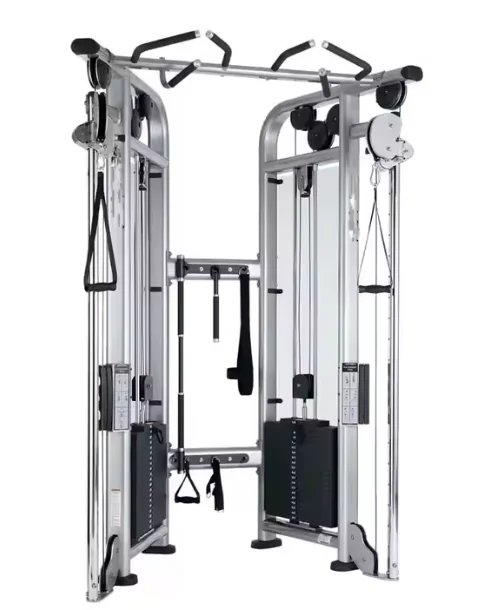
![Dual Pec Fly Power Cage Commercial Gym Strength Training Machine PX-1069 [WARN] draft identifier mismatch](https://bicksport.com/wp-content/uploads/2026/08/dual-pec-fly-power-cage-commercial-gym-strength-training-machine-px-1069-warn-draft-identifier-mismatch-c8a764.webp)
Heavy-Duty Frame Rigidity — 3mm steel tube construction engineered for high-frequency commercial resistance training without structural deflection.
Technical Specifications
| Parameter | Value |
|---|---|
| Designation | PX-1069 |
| Product Type | Dual Pec Fly & Power Cage |
| Material | Steel |
| Tube Thickness | 3mm |
| Product Dimensions | 1300 x 2150 x 2200 mm |
| Age Group | Adult |
| Gender | Unisex |
| Frame Color | Customized (available in Yellow, Black, Orange, Pink, etc.) |
| Cushion Color | Customized (available in Yellow, Black, Orange, Pink, etc.) |
| OEM/ODM | Available |
| Production Capacity | 5000 Pieces/Year |
| Certification | CE |
Application Suitability
| Deployment Scenario | Typical Use |
|---|---|
| Commercial Gym Strength Zone | Primary station for chest isolation and power rack compound movements |
| Community Fitness Center | High-traffic shared resistance training for general adult membership |
| Corporate Wellness Room | Dual-function station maximizing exercise variety in limited square footage |
| Hotel Fitness Center | Heavy-duty combination unit reducing total equipment count for facility operators |
| University Athletic Training Room | Structural strength accommodation for progressive overload programs |
Why Frame Rigidity Dictates Equipment Lifespan in Commercial Zones
3mm steel tubing resists deformation under repeated maximal loading.
When commercial gym members load a pec fly station with heavy plates or perform kipping movements inside a power cage, lateral forces travel through every weld and bolt. Residential-grade frames using thinner tubing begin to wobble within months. That wobble transfers to cable guides and pulley bearings, accelerating wear. I have seen strength machines pulled from gym floors because the frame fatigued long before the moving parts failed [NEED_CITE: structural fatigue cycles in commercial resistance equipment]. The PX-1069 commercial dual pec fly power cage strength training machine addresses this with a reinforced steel structure built for continuous daily loading.
Positioning the Combination Unit Within a Strength Training Floor Plan
This dual-function station merges pectoral isolation with enclosed power rack capability, occupying the footprint of one machine while delivering two distinct training modalities. In a commercial gym strength zone, the PX-1069 pairs logically with leg press and lat pulldown stations to complete a full-body circuit. The unisex adult design accommodates a broad range of user anthropometry, making it suitable for mixed-membership community fitness centers. The unit handles progressive overload protocols from rehabilitation loads through advanced resistance training, with the enclosed cage configuration providing spotter-independent safety for solo lifters.
Continuous Loading Cycles and Facility Environment Requirements
Commercial gym strength equipment endures hundreds of daily repetitions across dozens of users, each loading cycle sending stress waves through the frame and cable system. The 1300 x 2150 mm footprint demands a minimum 600mm clearance on all sides for safe plate loading and user entry. Concrete subfloor installation with rubber matting dampens dropped-weight vibration transmission to adjacent floors. Facility operators in multi-story buildings should verify load-bearing capacity before positioning loaded power cages on upper levels [NEED_CITE: floor loading requirements for commercial plate-loaded equipment]. Adequate overhead clearance must exceed the 2200mm frame height by at least 300mm to accommodate pull-up movements and plate changes.
Engineering Decisions Behind 3mm Tube Construction and Customizable Finishes
The 3mm tube thickness specification addresses the specific failure mode where repeated lateral loading causes frame joints to work loose. Thinner tubing flexes under heavy eccentric loads, creating micro-movements at bolt connections that progressively enlarge mounting holes. Steel tube at this gauge maintains dimensional stability through years of loading cycles, preserving alignment of the pec fly arm pivots and the power cage J-hook positions. Powder-coated frame finishes in customized colors including Yellow, Black, Orange, and Pink allow facility designers to maintain brand consistency across equipment purchases. Cushion upholstery in matching color options extends the visual coordination to user contact points without requiring aftermarket reupholstering.
The Hidden Costs of Underspecifying Frame Thickness
Gym operators who select strength equipment based on price-per-station often encounter structural failures before the second year of operation. Frames built with sub-3mm tubing develop visible flex during heavy compound lifts, generating user complaints about stability and safety perception. The resulting maintenance calls for frame welding and bolt tightening accumulate labor costs that erase initial purchase savings. Equipment pulled from the floor for structural repair creates member frustration and reduces available training stations during peak hours [NEED_CITE: commercial equipment downtime costs in fitness facilities]. Selecting the PX-1069 commercial dual pec fly power cage strength training machine with specified 3mm construction eliminates this failure category.
Why This Product Line Meets Commercial Deployment Requirements
The 10,000-hour durability testing protocol applied across our manufacturing verifies frame and moving component survival under continuous commercial operation. Our 50,000㎡ ISO-certified Shandong facility controls quality from raw tube cutting through final assembly and packaging. OEM and ODM customization extends beyond color selection to include logo application and specification modifications at flexible minimum order quantities. The complete six-series cardio family available from the same manufacturing source allows facility operators to consolidate procurement. Free 3D strength and cardio zone layout planning considers equipment spacing, user flow patterns, and ventilation requirements specific to your floor plan. Technical support responds around the clock for commissioning questions and parts identification.
Documentation & Test Records
- CE declaration of conformity for European market compliance
- EN 957 test report covering static and dynamic loading
- ISO 9001 certificate demonstrating quality management systems
- Frame material specification sheet with steel grade and thickness verification
- Assembly and installation guide with bolt torque specifications
- Spare parts list with component diagrams and ordering codes
Installation, Commissioning & Maintenance
- Verify concrete subfloor levelness before positioning the 1300 x 2150 mm base frame
- Install rubber matting beneath and around the unit for dropped-weight protection and vibration dampening
- Confirm ceiling clearance exceeds 2200mm height plus pull-up movement space
- Inspect all frame bolts after the first 500 loading cycles and retorque to specification
- Apply silicone lubricant to pec fly pivot bearings quarterly to maintain smooth arm movement
- Wipe down steel frame and cushion surfaces daily with non-corrosive cleaner to prevent sweat accumulation
Configuring Your Strength Equipment Inquiry
Provide your facility floor plan dimensions and total equipment count to receive a customized 3D layout showing optimal PX-1069 positioning with safe clearance zones. Specify your target market to confirm applicable certification requirements and documentation standards. Indicate preferred frame and cushion color combinations to align with your brand identity or interior design scheme. State your required delivery timeline to verify production scheduling against current capacity.
Frequently Asked Questions
Q: What frame thickness standard applies to commercial strength training equipment?
A: Commercial gym equipment typically requires steel tube construction at 3mm thickness or greater to withstand repeated heavy loading without structural deformation. This gauge maintains frame rigidity during compound movements and prevents the progressive loosening of bolt connections that occurs with thinner materials. The PX-1069 meets this standard across all primary frame members.
Q: What minimum order quantity applies to custom frame and cushion colors?
A: OEM color customization for frame powder coating and cushion upholstery is available at flexible minimum order quantities that accommodate single-facility purchases. Standard color options including Yellow, Black, Orange, and Pink are maintained in production scheduling. Custom color matching to specific brand guidelines requires sample approval before production commencement.
Q: Does the equipment support OEM brand logo application and custom packaging?
A: Yes, OEM branding extends to logo application on the frame, custom cushion embroidery, and branded packaging materials for dealer distribution. Logo placement options include the main upright and weight stack shroud. Artwork files must meet vector format specifications for clean reproduction at the required scale.
Q: What daily maintenance procedures extend equipment service life in commercial settings?
A: Daily wiping of frame surfaces and cushion upholstery with non-corrosive cleaner prevents sweat salt accumulation that accelerates corrosion. Weekly inspection of cable tension and pulley alignment identifies wear before cable failure occurs. Quarterly lubrication of pivot bearings and monthly bolt torque verification maintain structural integrity under continuous commercial loading.
![Commercial 7 Station Multi Functional Strength Training Gym Equipment [WARN] draft identifier mismatch](https://bicksport.com/wp-content/uploads/2026/08/commercial-7-station-multi-functional-strength-training-gym-equipment-warn-draft-identifier-mismatch-4fa8dc.webp)