
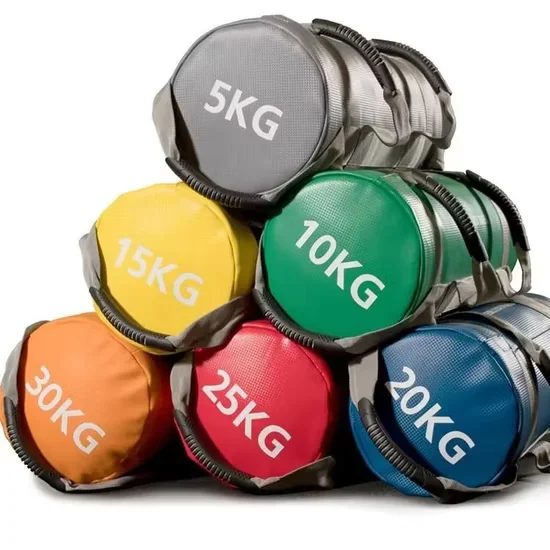
Durability Meets Versatility — High-frequency functional training demands equipment that withstands repeated drops and drags without material fatigue or seam failure.
Technical Specifications
| Parameter | Value |
|---|---|
| Product Type | Power Bag |
| Material | PVC |
| Model NO. | PB-2000 |
| Product Dimensions | 602525cm |
| Color | Customized Color |
| Logo | Customized Logo Available |
| MOQ | 50PCS |
| Application | Outdoor, Indoor |
| HS Code | 9506911900 |
| Production Capacity | 5000/Years |
Application Suitability
| Deployment Scenario | Typical Use |
|---|---|
| Commercial gym functional training zone | Dynamic lifts, carries, and rotational throws during group sessions |
| CrossFit box conditioning area | High-repetition partner drills and obstacle-style movements |
| Outdoor boot camp training ground | Weather-exposed sandbag runs and ground-based resistance work |
| Private studio small-group classes | Controlled strength circuits with varied load progressions |
| Sports performance training center | Sport-specific conditioning and grip endurance development |
Why Material Failures Surface Before the Warranty Expires
PVC tear resistance determines whether a power bag survives its first year of commercial rotation.
I remember a functional training studio that switched to canvas bags to cut costs. Within months, the stitching along the grab handles started unraveling under repeated partner-passing drills. Members noticed the fraying, and the studio ended up replacing the entire batch. When you spec a customizable dynamic power bag PVC weight training tool for a busy facility, the material choice directly controls replacement frequency and member perception [NEED_CITE: material abrasion standards for commercial fitness accessories]. PVC holds up against the grit, sweat, and ground contact that define functional training environments.
Where This Power Bag Fits in a Functional Training Zone
The PB-2000 covers the load-carrying and dynamic-throw movement patterns that barbells and kettlebells cannot replicate. In a well-planned functional zone, it complements sleds, medicine balls, and rig-based accessories by introducing an unstable, shifting load. Facilities deploying this customizable dynamic power bag PVC weight training tool typically position it near open floor space or outdoor turf areas where throws and drags are safe. The 602525cm profile suits users across a broad strength range, from introductory conditioning to advanced athletic programming.
Continuous Use Demands and Environmental Exposure
Functional training accessories do not have motors or electronics, but their material fatigue profile matters just as much in high-throughput facilities. Bags in commercial rotation endure daily drops onto rubber flooring, repeated dragging across turf, and prolonged UV exposure in outdoor boot camp settings. PVC resists moisture absorption and does not degrade under sunlight the way untreated canvas does. Facility operators should establish a rotation schedule so that bags in the highest-traffic class slots get inspected for seam integrity weekly [NEED_CITE: commercial equipment inspection frequency guidelines]. Proper storage away from sharp-edged equipment racks also extends service life considerably.
Reading the Material and Construction Specifications
PVC as a shell material offers inherent water resistance and wipe-clean surfaces, which matters when bags move between indoor and outdoor stations throughout a single session. The 602525cm dimension creates a cylindrical grip profile that distributes load across the forearm during carries and shoulder positions during squats. Reinforced stitching at stress points — particularly around handles and fill ports — determines whether the bag survives repetitive impact. When comparing construction quality, examine the thread gauge and whether seams are single or double-stitched. The PVC thickness itself influences how the bag conforms under load; thicker material maintains shape but reduces the shifting-sand effect that makes unstable-load training effective.
The Hidden Cost of Specifying Below Commercial Grade
Studios that purchase recreational-grade bags for commercial rotation typically face three failure modes. First, handle attachments tear free during partner drills, creating a safety concern and liability exposure. Second, the fill port closures weaken, allowing sand or filler material to leak onto training floors. Third, UV-degraded material becomes brittle in outdoor settings, cracking along fold lines during cold-weather sessions. Each failure mode forces unplanned replacement purchases and disrupts programmed class formats. These costs accumulate quietly until an operator audits annual accessory spend and discovers the pattern [NEED_CITE: total cost of ownership analysis for functional training accessories].
Why This Product Line Addresses Facility-Level Concerns
We test our PVC formulations against repeated abrasion cycles that simulate months of commercial dragging and dropping. The customizable dynamic power bag PVC weight training range supports full color and logo customization, so facilities maintain visual consistency across their accessory inventory without sourcing from multiple vendors. Our MOQ of 50 units aligns with the batch sizes that commercial gyms and CrossFit affiliates typically need to outfit a complete functional zone. OEM customization extends to branding requirements that franchise operators enforce across locations. Our team also provides 3D layout planning for functional training zones, ensuring bag storage racks and open training areas are spaced for safe throwing and carrying distances. Technical support covers material care guidance and replacement scheduling recommendations.
Documentation & Test Records
- CE declaration of conformity for functional training accessories
- Material abrasion and tear resistance test documentation
- ISO 9001 quality management system certificate
- PVC composition and safety compliance report
- Logo adhesion and print durability test record
- Product specification sheet with dimensional tolerances
Installation, Commissioning & Maintenance
- Allocate floor storage racks with adequate spacing to prevent PVC surface abrasion between units
- Inspect fill port closures and seam integrity upon delivery before filling to rated capacity
- Establish weekly rotation logs for high-use bags in group class environments
- Wipe PVC surfaces with non-solvent cleaners to prevent material degradation from harsh chemicals
- Store outdoor-use bags in covered racks to limit unnecessary UV exposure between sessions
Planning Your Functional Zone Equipment Order
Share your functional training area dimensions and intended class formats so we can recommend bag quantities and storage placement within your 3D zone layout. Specify whether bags will operate primarily indoors, outdoors, or in mixed environments so we can confirm PVC formulation suitability. Provide your branding requirements — color codes and logo artwork — to scope the customization production run. Indicate your target delivery timeline to align with our production capacity scheduling.
Frequently Asked Questions
Q: How does PVC compare to nylon or canvas for power bag construction?
A: PVC provides superior water resistance and does not absorb sweat or moisture during outdoor sessions, unlike untreated canvas. It wipes clean quickly between users, supporting hygiene protocols in shared commercial environments. Nylon offers comparable durability but typically at a higher material cost. PVC balances tear resistance, weather tolerance, and cost efficiency for high-throughput facility deployments.
Q: What logo printing methods are available for custom branding?
A: We offer screen printing and heat transfer processes depending on logo complexity and color count. Screen printing works well for bold single-color marks that need abrasion resistance on PVC surfaces. Heat transfer accommodates multi-color graphics with finer detail. Both methods are tested for adhesion durability against repeated handling and cleaning cycles typical in commercial settings.
Q: Can bags ship unfilled, and does filling material affect performance?
A: Unfilled shipping reduces freight weight and allows facilities to select fill material locally. Sand provides the standard shifting-load characteristic for dynamic training. Some operators use rubber mulch for a lighter option suitable for introductory classes. Fill level directly affects bag firmness; leaving partial air space increases the unstable-load effect that challenges stabilizer muscles during carries and throws.
Q: What cleaning and maintenance routine extends PVC power bag lifespan?
A: Wipe surfaces with mild soap solution after exposure to sweat or outdoor dirt. Avoid petroleum-based solvents that degrade PVC plasticizers over time. Inspect seams monthly and rotate bags out of high-frequency class slots if any thread separation appears. Store bags flat or upright on racks rather than stacked under heavy equipment to prevent permanent creasing along fold lines.

![Ergonomic Adjustable Triceps Pull Down Rope OEM Gym Cable Attachment [WARN] draft identifier mismatch](https://bicksport.com/wp-content/uploads/2026/08/ergonomic-adjustable-triceps-pull-down-rope-oem-gym-cable-attachment-warn-draft-identifier-mismatch-0efea7.webp)
![Durable Heavy Punching Bag with Custom Colors for Commercial Gym Use [result]Durable Heavy Punching Bag with Custom Colors for Commercial Gym Use[/result]](https://bicksport.com/wp-content/uploads/2026/08/durable-heavy-punching-bag-with-custom-colors-for-commercial-gym-use-resultdurable-heavy-punching-bag-with-custom-colors-for-commercial-gym-use-result-e2f488.webp)