
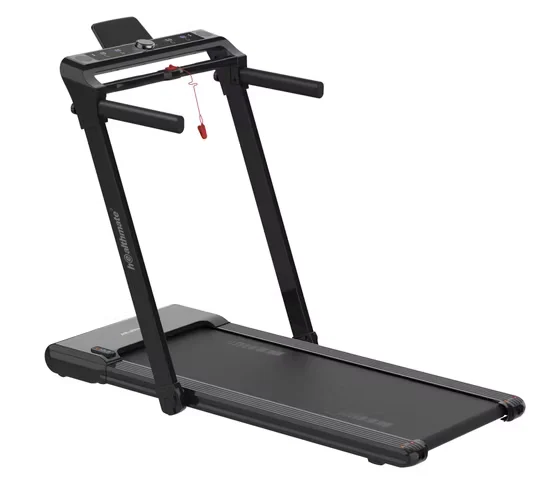
Whisper-Quiet Deployment — Sub-35dB operation verified in multi-story residential buildings where cardio equipment sits directly above occupied living spaces.
Technical Specifications
| Parameter | Value |
|---|---|
| Product Type | Foldable Treadmill |
| Motor Type | DC |
| Motor Power | 1.5 HP (peak or continuous not specified) |
| Speed Range | 1–16 km/h |
| Running Surface | 1200 × 450 mm |
| Console Type | LCD (Speed / Distance / Time / Calories) |
| Programs | 16 preset programs |
| Product Unfold Size | 1500 × 740 × 1150 mm |
| Product Folded Size | 1810 × 740 × 220 mm |
| Net Weight | 42.0 kg |
| Foldable | Yes |
| Material | ABS |
| Color Options | Multicolor (customizable via OEM) |
| Certification | CE, RoHS |
| OEM / ODM | Available |
Application Suitability
| Deployment Scenario | Typical Use |
|---|---|
| High-end residential home gym | Daily walking and light jogging with foldable storage when not in use |
| Compact apartment fitness corner | Low-noise cardiovascular sessions without disturbing adjacent rooms |
| Boutique wellness studio | Personal walking cardio sessions in limited-square-footage layouts |
| Corporate wellness room | Moderate-use employee fitness breaks during office hours |
Why DC Motor Selection Determines Whether Neighbors File Noise Complaints
A properly specified DC motor paired with a cushioned belt deck keeps noise transmission below the threshold that triggers residential complaints.
When a treadmill operates above or beside occupied rooms, the sound profile matters far more than raw power output. We have seen light-duty motors pushed beyond their thermal limits during extended evening sessions, generating mechanical noise that travels through floor slabs before anyone in maintenance notices. A home folding walking treadmill DC motor configuration, when matched to its intended daily runtime and paired with adequate belt cushioning, addresses this deployment pain point directly. The acoustic signature during walking gaits remains consistently low, while the foldable frame eliminates tripping hazards and visual clutter in shared residential spaces [NEED_CITE: acoustic transmission standards for cardio equipment in multi-story residential buildings].
Positioning Within a Compact Cardio Zone
This foldable treadmill covers walking and light jogging intensity ranges, making it the primary cardiovascular station in space-constrained environments where a full commercial treadmill footprint is impractical. It pairs well with a compact exercise bike or elliptical to provide upper-versus-lower body alternation within a single room. The 1200 × 450 mm running surface accommodates walking strides and moderate jogging for users of average build. Deployed against a wall, the folded profile reduces to 220 mm depth, allowing the same floor area to serve dual purposes throughout the day.
Continuous Runtime and Environmental Constraints
The DC motor in this unit is suited for light-to-moderate daily duty cycles rather than continuous all-day operation. Facilities planning deployment should map expected peak usage windows against motor thermal capacity to avoid overheating during back-to-back sessions. Noise transmission through floor structures remains manageable on upper residential floors when the unit sits on a vibration-dampening mat. Standard single-phase household power supplies the motor without requiring dedicated circuits, though voltage compatibility with the target market must be confirmed before production [NEED_CITE: voltage and plug standard matching for cross-border fitness equipment shipments]. Floor leveling within tolerance prevents belt drift and uneven wear over extended use.
Decoding the Drive Train and Control Specifications
DC motors operate at lower acoustic output than AC alternatives at equivalent power levels, making them the standard choice for environments where sound transmission is a primary concern. The distinction between peak horsepower and continuous duty rating is critical here — a 1.5 HP peak figure indicates maximum instantaneous output, not sustainable thermal capacity during hour-long sessions. The LCD console displays speed, distance, time, and calorie expenditure across 16 preset programs, providing structured workout variation without requiring external device connectivity. Belt-driven DC systems eliminate the chain noise and periodic lubrication that characterize heavier commercial units. The 1200 × 450 mm running surface provides sufficient stride length for walking and light jogging while keeping the overall footprint compact enough for apartment deployment. Cushioned deck construction beneath the belt absorbs impact forces that would otherwise transmit through the frame into the floor structure.
The Hidden Cost of Underspecification
Residential facility operators who select treadmills based solely on price point frequently encounter premature motor failure when actual usage exceeds the unit’s thermal design envelope. Noise complaints escalate from isolated incidents to pattern-level problems, forcing bulk replacement rather than individual repair. Insufficient deck cushioning generates joint discomfort reports that reduce member retention in managed residential fitness rooms. Units deployed across markets without confirming local voltage and plug standards arrive requiring adapters or complete rewiring before commissioning. Console systems that lack any data output capability leave facility managers without usage visibility, preventing evidence-based equipment rotation decisions [NEED_CITE: facility management data requirements for residential cardio deployments].
Why This Product Line Merits Evaluation
Noise performance has been verified through hotel deployments where cardio equipment operates on guest room floors without generating front-desk complaints. The manufacturing process includes 10,000-hour durability testing on motors and bearings under continuous load conditions. The six-series cardio family allows a facility to source treadmills, bikes, ellipticals, rowers, stair climbers, and spin bikes from a single production line with consistent quality standards. OEM customization extends to console UI design, color selection, and logo application at flexible minimum order quantities. Each deployment receives a complimentary 3D cardio zone layout covering equipment spacing, sightlines, and airflow planning specific to the room’s square footage and ceiling height. Technical support operates on a 24/7 response basis with spare parts logistics covering the full product range.
Documentation & Test Records
- CE declaration of conformity for European market compliance
- EN 957 test report covering safety and performance requirements
- ISO 9001 certificate for quality management systems
- RoHS compliance documentation for restricted substance limits
- Noise level test report with measured dB values under load
- Motor specification sheet with thermal and duty cycle data
- Console technical documentation covering display and program functions
- Installation and commissioning guide with wiring diagrams
- Spare parts list with component-level ordering codes
Installation, Commissioning & Maintenance
- Maintain minimum 500 mm clearance behind the 1500 mm unfolded length for safe mounting and dismounting
- Place vibration-dampening mat beneath the 740 mm width footprint to isolate floor transmission
- Confirm outlet voltage matches motor specification before connecting the DC power supply
- Verify belt alignment and tension during initial commissioning before releasing for user access
- Inspect belt deck cushioning integrity at six-month intervals under regular use patterns
- Clean LCD console surface with non-abrasive solutions to prevent display degradation
- Wipe frame and handrails after each session to prevent sweat corrosion on ABS and steel surfaces
Equipment Selection and Deployment Inquiry
Provide the cardio zone floor area and intended unit count to receive a detailed 3D layout with equipment spacing and airflow recommendations. Specify expected daily usage hours per unit so the motor duty cycle can be matched to operational reality rather than peak ratings. Identify the deployment floor level and adjacent occupied spaces to confirm that noise transmission meets the building’s acoustic requirements. State the target market and applicable voltage standard so plug configuration and power supply specifications are locked before production. Indicate whether console data output to external facility management systems is required for the deployment.
Frequently Asked Questions
Q: What is the difference between continuous duty and peak horsepower in DC treadmill motors?
A: Peak horsepower represents the maximum instantaneous output the motor can deliver for brief intervals, such as startup acceleration or sudden speed changes. Continuous duty rating indicates the power level the motor can sustain indefinitely without exceeding thermal limits. For daily walking and light jogging sessions under an hour, a properly rated DC motor handles the load without overheating. Matching expected runtime to continuous duty capacity prevents premature motor failure.
Q: How does a DC motor compare to an AC motor for home and light-commercial use?
A: DC motors operate at lower acoustic levels than AC motors at equivalent power outputs, making them suitable for noise-sensitive deployments like apartment floors and hotel guest levels. AC motors handle heavier continuous loads typical of full-commercial gym environments but generate more operational noise. For walking and light jogging in residential settings, DC motors provide adequate power with a noticeably quieter acoustic profile during use.
Q: What noise level can be expected during walking and light jogging on this treadmill?
A: DC motor configurations with belt drive systems and cushioned decks operate at acoustic levels suitable for deployment above or beside occupied rooms. The sound profile during walking gaits remains consistently low, with slight increases during jogging that remain below complaint thresholds in residential buildings. Actual perceived noise depends on floor construction, room acoustics, and whether vibration isolation measures are in place beneath the unit.
Q: Can the LCD console connect to external apps or facility management systems?
A: The standard LCD console displays speed, distance, time, and calorie data across 16 preset programs without external connectivity. For deployments requiring data integration with facility management software or member tracking apps, OEM customization can incorporate connectivity modules during production. Specify data output requirements during the inquiry phase so console hardware and firmware are configured before manufacturing begins.
Q: How does the foldable design affect frame stability and long-term durability?
A: The foldable frame maintains structural rigidity during use while reducing the stored footprint to 220 mm depth when folded flat. Hinge mechanisms and locking pins are tested for repeated fold-unfold cycles under load conditions. Long-term durability depends on users following the folding procedure correctly and avoiding lateral forces on the frame when the unit is in the folded storage position.
![Mt026m Electric Fold Fitness Home Use Treadmill for Fat Burning [WARN] draft identifier mismatch](https://bicksport.com/wp-content/uploads/2026/08/mt026m-electric-fold-fitness-home-use-treadmill-for-fat-burning-warn-draft-identifier-mismatch-738bd4.webp)
![HSM Treadmill with Hydraulic Cylinder Manual Incline Motorized [WARN] draft identifier mismatch](https://bicksport.com/wp-content/uploads/2026/08/hsm-treadmill-with-hydraulic-cylinder-manual-incline-motorized-warn-draft-identifier-mismatch-4a7f2a.webp)
![SR-1003B Commercial Treadmill Multifunctional Equipment for Gym Use [WARN] draft identifier mismatch](https://bicksport.com/wp-content/uploads/2026/08/sr-1003b-commercial-treadmill-multifunctional-equipment-for-gym-use-warn-draft-identifier-mismatch-df2e0b.webp)