
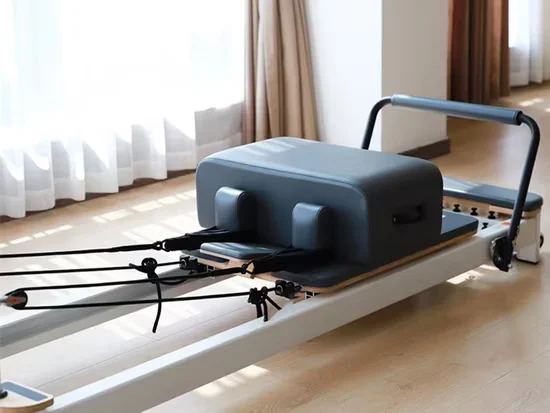
Precision Glide Rail Engineering — Aluminium alloy frame with sealed bearing carriage delivers verified sub-35dB operation across continuous studio sessions.
Technical Specifications
| Parameter | Value |
|---|---|
| Designation | SRY-12 |
| Product Type | Pilates Reformer |
| Frame Material | Aluminium Alloy |
| Color | White |
| Product Dimensions | 2570730270mm |
| Net Weight | 90kgs |
| Max User Weight | 180kg |
| Accessory | Long Box / Jump Board / Platform |
| Certification | CE |
| Warranty | 3 Years |
| Logo | Customized Is Allowed |
Application Suitability
| Deployment Scenario | Typical Use |
|---|---|
| Boutique Pilates Studio | Daily group reformer classes with high-frequency carriage travel |
| Five-Star Hotel Wellness Center | 24-hour guest access on floors adjacent to occupied rooms |
| High-end Residential Fitness Suite | Private daily use with minimal acoustic transfer to neighboring units |
| Rehabilitation Center | Low-impact controlled resistance sessions for joint recovery protocols |
Why Carriage Noise Reaches the Studio Owner Before the Technician Does
Aluminium alloy construction paired with sealed glide bearings keeps carriage travel below the threshold that disturbs adjacent treatment rooms.
Studio operators regularly discover that reformer noise is not a maintenance issue — it is a design issue. Steel weld joints develop micro-creaks after months of repetitive carriage loading, and spring systems lose tension consistency, producing audible snap-back at end range. When reformer rooms share walls with yoga or meditation spaces, these acoustic signatures become member complaints before anyone calls for service [NEED_CITE: acoustic transfer thresholds for fitness equipment on shared commercial floors]. The white aluminium alloy Pilates reformer commercial operators choose for shared-floor deployments must address resonance at the frame level, not just at the carriage surface.
Where the SRY-12 Fits in a Multi-Discipline Studio Layout
This reformer covers controlled resistance training across full-body movement patterns, from supine footwork through standing platform work. In a studio configuring both mat and apparatus zones, it pairs with Cadillac and chair units to complete the classical Pilates apparatus family. Deployment density suits facilities running 6-8 back-to-back group sessions daily. The 180kg user capacity accommodates the full adult body type range without carriage deflection. The white aluminium alloy Pilates reformer commercial studios deploy in high-traffic rooms maintains glide consistency regardless of session frequency or operator load variation.
Continuous Session Scheduling and Studio Environment Requirements
Facilities running reformer classes from early morning through evening place continuous cyclic load on carriage bearings and spring anchor points. The aluminium alloy frame dissipates vibration without the low-frequency resonance that steel frames transmit through hard flooring into rooms below. Adequate lateral clearance around each unit supports member flow during class transitions and allows instructor access for form correction. Standard single-phase power is not required for this purely mechanical system, eliminating voltage mismatch concerns across international deployments [NEED_CITE: commercial Pilates studio electrical and spatial planning guidelines]. Floor leveling within tolerance prevents carriage drift during asymmetric loading exercises.
Aluminium Alloy Frame and Sealed Bearing Glide Mechanics
Traditional steel reformer frames rely on welded joints that develop fatigue micro-movements under cyclic carriage loading, producing the characteristic creak that intensifies over months of studio use. Aluminium alloy eliminates weld-point resonance by distributing load through continuous extruded profiles. Sealed bearings in the glide rail remove the need for periodic lubrication cycles that leave residue attracting dust and degrading glide smoothness. Spring-based resistance provides linear tension curves that remain consistent across the full range of carriage travel, unlike elastic cord systems that exhibit hysteresis and tension drift with temperature fluctuation. The accessory ecosystem — long box for supine work, jump board for plyometric loading, platform for standing exercises — extends exercise variety without requiring separate apparatus units.
The Hidden Cost of Under-Specified Glide Components
Reformers with unsealed carriage bearings require lubrication at intervals that most studio maintenance schedules cannot sustain, leading to metal-on-metal wear that progressively degrades glide smoothness. Members notice the increased friction before operators do, manifesting as joint discomfort during repetitive exercises and eventual class attrition. Spring sets that lack consistent temper specifications lose tension over months, forcing instructors to modify exercise progressions around equipment limitations rather than client capability [NEED_CITE: spring fatigue characteristics in commercial Pilates apparatus under continuous studio duty]. Facilities that purchase on price alone often face complete carriage replacement within the first two years of high-frequency deployment.
Why Studios Source This Line for Multi-Room Deployments
The sub-35dB operation verified in hotel deployments means this reformer runs on guest room floors without generating noise complaints through ceiling assemblies. The 10,000-hour durability protocol on glide bearings and frame joints exceeds the service interval of typical studio class schedules running six days weekly. Full OEM capability allows console-equivalent customization — in this case frame color and logo application — to match studio brand identity across multiple locations. Free 3D studio layout planning accounts for reformer footprint, lateral instructor access corridors, and HVAC airflow patterns that prevent heat buildup in high-density apparatus rooms. 24/7 technical support responds to bearing or spring issues before they force class cancellations.
Documentation & Test Records
- CE declaration of conformity confirming European market safety compliance
- EN 957 test report covering structural load and stability requirements
- Noise level test report verifying sub-35dB carriage travel under loaded operation
- Glide rail durability test record documenting 10,000-hour continuous cycle performance
- Installation and commissioning guide with spare parts specification list
Installation, Commissioning & Maintenance
- Maintain minimum 600mm lateral clearance per unit for instructor access and member flow
- Verify floor level within 3mm across the 2570mm frame length to prevent carriage drift
- Inspect sealed glide bearings quarterly for smooth travel and absence of lateral play
- Check spring anchor points and tension consistency monthly under loaded extension
- Wipe aluminium alloy frame with pH-neutral cleaner to prevent sweat corrosion accumulation
Planning Your Studio Equipment Inquiry
Provide your studio floor area and planned unit count to receive a 3D layout covering equipment spacing, instructor sightlines, and airflow planning. Specify your deployment floor level and adjacent room usage so we can confirm acoustic suitability for your building configuration. Indicate your target market for any applicable certification documentation requirements. State whether you need customized frame color or logo application across your equipment order.
Frequently Asked Questions
Q: How does aluminium alloy frame construction reduce noise compared to traditional steel reformers?
A: Aluminium alloy extruded profiles distribute carriage load continuously without welded joints that develop fatigue micro-movements over time. Steel weld points produce low-frequency resonance under cyclic loading that transmits through flooring into rooms below. The continuous material structure of aluminium alloy eliminates these resonance nodes, keeping carriage travel acoustically contained within the studio space itself.
Q: What is the expected maintenance cycle for sealed bearing glide rails under commercial duty?
A: Sealed bearings eliminate the periodic lubrication requirement that unsealed systems demand every few months in high-frequency studio environments. The sealed design prevents dust and sweat ingress that degrades glide smoothness over time. Facilities typically inspect bearings quarterly for smooth travel and lateral play, with replacement intervals extending well beyond standard commercial warranty periods under normal studio scheduling.
Q: How does carriage glide smoothness affect joint comfort during repetitive reformer exercises?
A: Inconsistent glide resistance forces users to compensate with stabilizing muscles during exercises designed for prime mover engagement. Bearings that develop friction or lateral play create unpredictable carriage movement, particularly during slow controlled repetitions where any irregularity becomes perceptible. Smooth consistent travel allows proper loading patterns through full joint range without compensatory tension that leads to overuse discomfort.
Q: What accessory configurations are available for different studio programming needs?
A: The SRY-12 ships with long box for supine and seated exercises, jump board for plyometric cardiovascular loading, and platform for standing balance work. Studios offering classical Pilates repertoire find this combination covers the majority of apparatus-based exercises. Additional accessory configurations can be discussed during the inquiry stage based on your specific class programming requirements.
![Commercial Aluminum Alloy Half Trapeze Pilates Reformer Machine [WARN] draft identifier mismatch](https://bicksport.com/wp-content/uploads/2026/08/commercial-aluminum-alloy-half-trapeze-pilates-reformer-machine-warn-draft-identifier-mismatch-e689ff.webp)
![Pilates Reformer with Tower Half Trapeze Wood for Studio [WARN] draft identifier mismatch](https://bicksport.com/wp-content/uploads/2026/08/pilates-reformer-with-tower-half-trapeze-wood-for-studio-warn-draft-identifier-mismatch-cf7181.webp)

