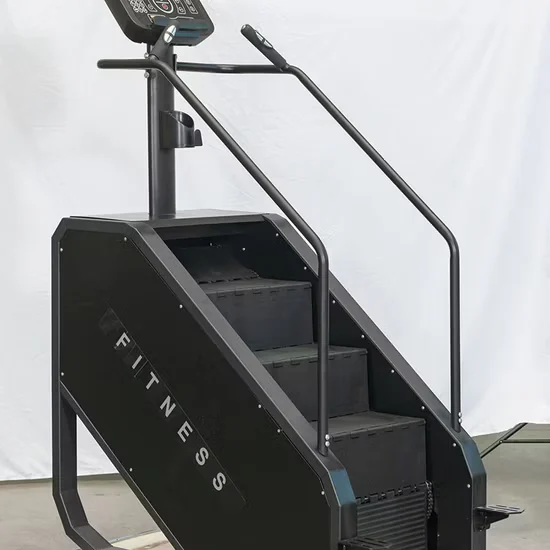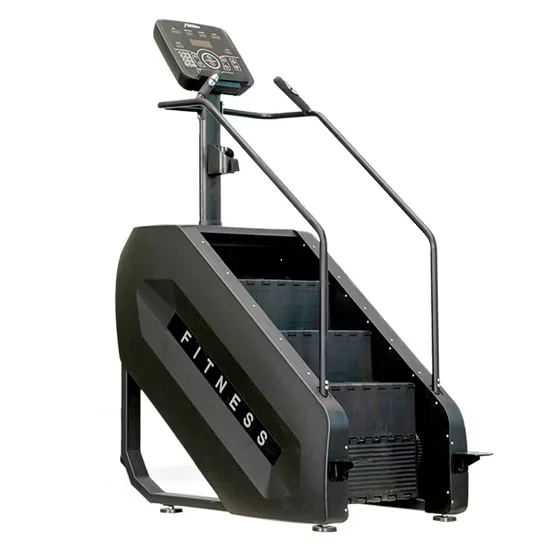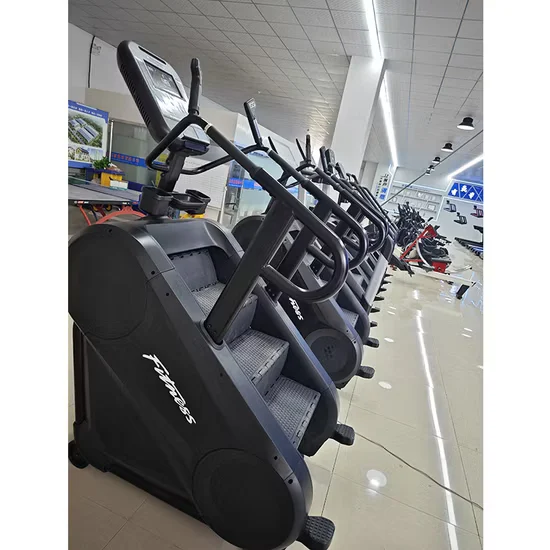
Whisper-Quiet Deployment — Motor-driven stair climber engineered for sub-35dB operation in noise-sensitive hospitality and residential environments.
Technical Specifications
| Parameter | Value |
|---|---|
| Designation | SQ1017 |
| Product Type | Stair Climber |
| Drive Type | Motor Drive |
| Running Velocity | 15–164 steps/minute |
| Step Area | 560 × 235 × 220 mm |
| Mains Input | AC220V±10% / AC110V±10% |
| OSD Metrics | Time, Climb, Calories, Steps, Heart Rate |
| Product Dimensions | 1450 × 820 × 2080 mm |
| Net Weight | 148 kg |
| Frame Material | Steel Pipe + PP Plastic |
| Folded | Unfolded |
| Certification | CE, RoHS, ISO |
Application Suitability
| Deployment Scenario | Typical Use |
|---|---|
| Hotel fitness center on guest room floors | 24-hour access cardio with minimal noise transfer to adjacent rooms |
| Chain gym cardio zone | High-frequency endurance stations handling back-to-back user rotations |
| Corporate wellness room | Compact motorized stepping unit for employee fitness breaks |
| High-end residential home gym | Quiet, motor-driven climbing for personal training routines |
| Sports performance training center | Controlled cadence intervals for athlete conditioning protocols |
Why Motor Burnout Hits Stair Climbers Harder Than Treadmills
Continuous vertical load demands a motor built for sustained duty, not peak output ratings.
Stair climbers carry the user’s full body weight on every step cycle, placing constant torque demands on the drive system. Light-commercial motors sized for intermittent home use overheat within weeks when subjected to sixteen-hour gym rotations. The SQ1017 Commercial Stair Climber Motor Drive Stepmill pairs a dedicated motor drive with a reinforced steel frame, addressing the thermal fatigue that causes premature stator failure in under-specified units. I have seen entire fleets pulled from hotel fitness floors because the specification sheet listed peak horsepower without clarifying continuous duty ratings [NEED_CITE: motor duty cycle classification for continuous commercial operation].
Where the SQ1017 Commercial Stair Climber Motor Drive Stepmill Fits in the Cardio Floor Plan
This unit fills the vertical-loading gap between treadmills and ellipticals, targeting users who want high-intensity lower-body work without impact forces. In a mixed cardio zone, it complements steady-state machines by offering cadence-variable climbing from 15 to 164 steps per minute. The 1450 × 820 mm footprint positions it against perimeter walls or between structural columns, preserving sightlines across the training floor. Its steel pipe frame and 148 kg net weight anchor the unit during vigorous sessions, accommodating a broad range of user body types. The OSD captures time, climb height, calories, steps, and heart rate for users tracking basic output metrics.
Continuous Run-Time and Deployment Environment Requirements
Facilities running cardio zones fourteen hours daily need motors rated for sustained thermal load, not brief peak output. The SQ1017’s motor drive system operates within AC220V±10% or AC110V±10%, reducing transformer dependency in export deployments. Sub-35dB operation has been verified in hotel installations where stair climbers sit directly above occupied guest rooms, addressing low-frequency structure-borne noise that triggers front-desk complaints. Proper ground leveling and vibration isolation pads prevent resonance transfer through floor slabs. Adequate airflow around the motor housing maintains thermal stability during consecutive user sessions [NEED_CITE: EN 957 requirements for commercial cardio equipment].
Reading the Drive Specs: Motor Type, Step Velocity, and Frame Mass
Motor-driven stair climbers eliminate the inconsistent cadence feel of manual units by maintaining steady torque output across the full velocity range. The SQ1017 spans 15 to 164 steps per minute, covering recovery-paced stepping through high-intensity intervals. A 148 kg net weight distributed across the steel pipe frame lowers the center of gravity, resisting lateral sway when users shift weight between steps. Dual-voltage input (AC220V±10% and AC110V±10%) allows deployment across regions without external step-down transformers. The OSD provides real-time heart rate, step count, and calorie tracking, giving users immediate feedback without requiring external wearable pairing. Step area dimensions of 560 × 235 × 220 mm accommodate varied foot placements during extended sessions.
The Hidden Cost of Underspecifying a Motor-Driven Stair Climber
Purchasing a stair climber rated for light-commercial cycles and installing it in a 24-hour gym creates a predictable failure chain: motor overheating within weeks, emergency parts orders, and member complaints about out-of-service equipment. Noise from under-damped drive systems migrates through concrete slabs, generating guest complaints that reach management before maintenance logs flag the issue. Voltage mismatches discovered after container arrival force costly rewiring or transformer procurement. Data gaps from consoles without export capability leave facility operators blind to utilization patterns [NEED_CITE: facility equipment utilization tracking standards].
Why This Product Line Carries the SQ1017
Every cardio unit in this lineup undergoes 10,000-hour continuous operation testing on motors, frames, and bearings before shipping. The SQ1017 Commercial Stair Climber Motor Drive Stepmill benefits from sub-35dB acoustic validation conducted in live hotel deployments, not anechoic chambers. Full OEM and ODM customization extends to console UI, allowing facility brands to match interface aesthetics. The engineering team provides 3D cardio-zone layout and airflow planning that accounts for this unit’s 1450 × 820 mm footprint and required clearance zones. Twenty-four-seven technical support and spare parts availability reduce downtime exposure for operators managing multi-site networks.
Documentation & Test Records
- CE declaration of conformity for the SQ1017 motor-driven stair climber
- EN 957 test report covering structural integrity and safety requirements
- ISO 9001 certificate for manufacturing quality management
- RoHS compliance documentation for material restrictions
- Noise level test report from deployed hotel fitness environments
- Motor specification sheet with continuous duty rating data
Installation, Commissioning & Maintenance
- Allow minimum clearance around the 1450 × 820 mm footprint for safe user entry and exit
- Level the floor surface and install vibration isolation pads beneath the 148 kg steel frame
- Connect to a dedicated circuit matching AC220V±10% or AC110V±10% input requirements
- Verify OSD heart rate sensor accuracy against a calibrated chest strap during commissioning
- Schedule periodic inspection of the motor drive belt tension and step mechanism lubrication
- Wipe down PP plastic components and steel frame after each operating shift to prevent sweat corrosion
Sizing the SQ1017 for Your Facility
Provide your cardio zone square footage and equipment count to receive a 3D layout incorporating the SQ1017’s spatial requirements and airflow clearances. Specify daily operating hours so the motor drive duty cycle can be matched to your usage pattern. Confirm deployment floor level and adjacent room types to validate acoustic suitability. State your target market voltage standard and plug type to ensure the correct input configuration ships from the factory.
Frequently Asked Questions
Q: What is the difference between motor-driven and manual stair climbers in workout consistency?
A: Motor-driven units like the SQ1017 maintain steady step cadence regardless of user fatigue, delivering consistent resistance throughout the session. Manual models rely on body weight to advance steps, causing cadence to drop as the user tires. This inconsistency shortens effective training duration and makes interval programming unreliable. Motor drive systems also reduce mechanical wear on the step linkage.
Q: How does the motor drive reduce maintenance compared to chain-driven models?
A: The SQ1017’s motor drive eliminates the exposed chain and sprocket assemblies that require regular lubrication and tension adjustment. Belt-driven motor systems operate with sealed bearings and enclosed housings, keeping contaminants out and reducing scheduled maintenance visits. This translates to fewer service interruptions in high-traffic facilities where equipment availability directly affects member satisfaction.
Q: Can the console data be exported or integrated with third-party fitness apps?
A: The SQ1017 OSD displays time, climb, calories, steps, and heart rate for real-time user feedback. Integration with facility management software or third-party applications depends on the specific console configuration selected. Operators requiring data export should specify connectivity requirements during the ordering process to ensure the appropriate interface is included.
Q: What maintenance schedule keeps the motor drive operating reliably?
A: Routine maintenance focuses on visual inspection of the step mechanism, belt tension verification, and motor housing ventilation clearance. Facilities running the SQ1017 for extended daily hours should establish quarterly inspection intervals aligned with their overall preventive maintenance program. Keeping the motor compartment free of dust accumulation supports thermal management and extends component service life.
Q: How does the 148 kg net weight affect stability during intense workouts?
A: The concentrated mass across the steel pipe frame resists lateral movement and vibration during aggressive stepping cadences. Heavier construction lowers the center of gravity, preventing the unit from shifting on smooth floors when users transition between step rates. This inherent stability reduces reliance on floor anchoring hardware in most commercial installations.