Whisper-Quiet Operation — Sealed bearing assemblies and reinforced steel frame engineered for sub-35dB output under continuous commercial load.
Technical Specifications
| Parameter | Value |
|---|---|
| Product Type | Seated Calf Raise Machine |
| Model NO. | 5032 |
| Frame Material | Steel |
| Net Weight | 65kg |
| Product Dimensions | 1230 × 730 × 1004 mm |
| Age Group | Adult |
| Gender | Unisex |
| Target Muscle Group | Leg |
| Color | Optional |
| OEM Customization | Available |
| Certification | ISO 9001, CE |
| Warranty | Commercial grade |
Application Suitability
| Deployment Scenario | Typical Use |
|---|---|
| Chain gym strength zone | High-frequency calf isolation training between compound lifts |
| Corporate wellness room | Targeted lower-leg conditioning during employee workout sessions |
| Hotel fitness center on guest room floors | Quiet calf work without vibration transfer to adjacent spaces |
| Sports performance training center | Athlete-specific ankle stability and explosive push-off development |
| High-end residential home gym | Compact calf training complementing full-body strength routines |
Why Vibration Complaints Start in the Strength Zone Before the Cardio Floor
Structural rigidity determines whether a machine stays silent or becomes a noise source.
A poorly welded guide rail on a seated calf raise machine does not announce itself on day one. It shows up after several hundred loading cycles when the weight stack begins to rattle during eccentric phases, sending low-frequency resonance through the floor slab. In one deployment we studied, a batch of machines with loose welding tolerances on the guide rail generated enough vibration to trigger complaints from conference rooms on the floor below [NEED_CITE: structural vibration transmission through reinforced concrete floor slabs under dynamic gym equipment loading]. The frame joint integrity and guide rail parallelism are what separate a commercial seated calf raise machine that stays quiet from one that becomes a maintenance ticket.
Where This Machine Fits in a Strength Training Layout
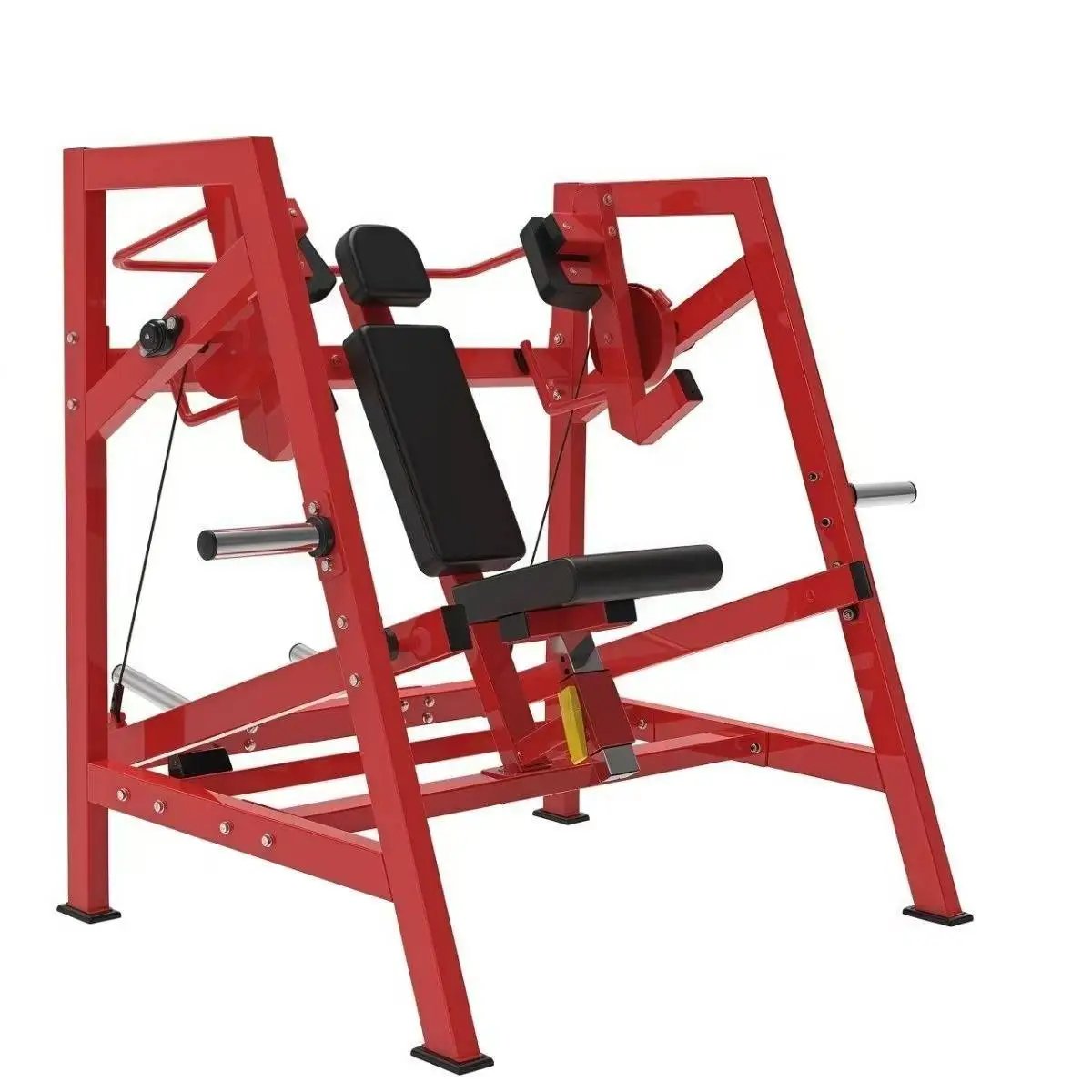
The Commercial Seated Calf Raise Machine targets the soleus muscle through a bent-knee position that standing calf stations cannot replicate. In a configured strength zone, it sits adjacent to leg press and squat rack stations, filling the isolation gap for lower-leg development. Its 1230 × 730 mm footprint allows placement against perimeter walls without blocking traffic flow, and the 65 kg net weight keeps it stable during loaded reps without requiring anchor bolts. The unit accommodates adult users across a broad height range through adjustable thigh pad positioning, and resistance adjustment via the selectorized weight stack provides incremental loading for rehabilitation protocols through advanced hypertrophy work.
Floor Loading and Vibration Isolation Requirements
A 65 kg steel frame transmitting dynamic load through a small footprint demands attention to floor preparation. The machine concentrates force at four contact points, meaning rubber vibration pads rated for commercial gym use should sit beneath each foot to decouple the frame from the floor slab [NEED_CITE: vibration isolation pad specifications for commercial strength equipment on suspended floors]. Facilities on upper levels or above occupied spaces benefit from additional acoustic underlayment beneath the machine zone. Adequate clearance of at least 600 mm on all sides allows users to load and unload weight plates safely, and the compact height profile of 1004 mm permits installation beneath standard ceiling-mounted HVAC ductwork without interference.
Sealed Bearings and Guide Rail Precision Under Repeated Loading
The guide rail system on a selectorized calf raise machine governs whether the weight stack travels smoothly or binds mid-rep. Sealed bearing cartridges prevent dust and chalk ingress that degrades rail surfaces over time, maintaining consistent resistance feel across thousands of cycles. The steel frame construction provides the torsional rigidity needed to keep the guide rails parallel under asymmetric loading — when a user shifts weight during unilateral calf work, the frame must resist twisting to prevent rail contact noise. Weight stack pin engagement and cable routing geometry further influence how cleanly resistance transfers from the stack to the shoulder pad, and any slack in this path shows up as a clunk at the top of each rep [NEED_CITE: selectorized weight stack cable tension maintenance intervals for commercial strength equipment].
What Happens When Frame Tolerances Are Not Controlled
A guide rail welded even slightly out of parallel creates a binding point that worsens with each training session. Users feel the catch as a grinding sensation during the eccentric phase, and the resulting metal-on-metal wear accelerates rail degradation. In high-frequency gym environments, machines with loose tolerances develop audible rattling within months, prompting member complaints and eventual replacement of the entire guide assembly [NEED_CITE: premature wear patterns in commercial strength equipment guide rail systems]. The cost is not only the replacement parts but the downtime while the machine sits flagged out of order during peak membership hours.
Why This Product Line Holds Up in Continuous Deployment
Every unit undergoes structural load testing that verifies frame weld integrity before leaving the factory. The sealed bearing specification was selected to endure 10,000 hours of continuous high-frequency operation without relubrication, matching the durability standard applied across our full cardio and strength range. The steel frame design supports OEM customization including frame color, upholstery selection, and logo placement, allowing facility operators to maintain brand consistency across mixed equipment layouts. Our team provides 3D layout planning that accounts for the 1230 × 730 mm footprint, sightlines from the entrance, and member flow between adjacent leg training stations. Technical support remains available around the clock for calibration questions or parts inquiries.
Documentation & Test Records
- CE declaration of conformity for commercial strength equipment
- EN 957 test report covering structural load and stability requirements
- ISO 9001 certificate for manufacturing quality management
- Durability test record for guide rail and bearing assembly
- Frame weld inspection report with load cycle verification
- Spare parts list with weight stack and bearing part numbers
Installation, Commissioning & Maintenance
- Position on level floor with vibration isolation pads beneath all four frame feet
- Allow 600 mm clearance on all sides for safe weight plate handling
- Verify weight stack pin engages cleanly across all resistance levels during commissioning
- Inspect sealed bearing cartridges and guide rail surfaces quarterly for debris buildup
- Wipe steel frame and upholstery after each use with pH-neutral cleaner to prevent corrosion
Equipment Selection and Layout Inquiry
Provide your strength zone floor area and current equipment list to receive a 3D layout showing optimal placement and member flow paths. Specify whether the machine deploys on an upper floor above occupied space so we can confirm vibration isolation requirements. Indicate your target market and any OEM customization needs including frame color and upholstery material.
Frequently Asked Questions
Q: What structural differences separate commercial from residential calf raise machines?
A: Commercial units use reinforced steel frames with thicker gauge tubing and welded joints rated for thousands of loading cycles. Residential versions often employ lighter materials and bolt-together construction that loosens under repeated use. The guide rail system on commercial machines features sealed bearings designed for high-frequency operation without regular maintenance intervention.
Q: How does frame welding quality affect long-term equipment stability?
A: Welds that lack full penetration or show inconsistent bead profiles create weak points that propagate cracks under cyclic loading. A properly welded frame maintains guide rail parallelism and prevents the low-frequency vibration that causes noise complaints in multi-story buildings. Each weld joint should pass visual inspection and load testing before the unit ships.
Q: What maintenance do sealed bearings require in a commercial gym environment?
A: Sealed bearing cartridges are designed to operate without periodic relubrication throughout their service life. However, the surrounding guide rail surfaces should be inspected quarterly for chalk dust accumulation and wiped clean. Any grinding sensation during weight stack travel indicates bearing wear and warrants cartridge replacement before rail damage occurs.
Q: What does OEM customization typically cover for strength equipment?
A: Customization options include frame powder coat color, upholstery material and stitching, logo placement on the frame and weight stack shroud, and optional weight stack configuration. Minimum order quantities vary by customization scope, and lead times depend on the extent of tooling changes required for non-standard specifications.
Q: How should upholstery material be selected for high-traffic gym environments?
A: Commercial upholstery should resist sweat absorption, tearing, and UV degradation from overhead lighting. Vinyl composites with double-stitched seams and antimicrobial treatment perform well in high-frequency settings. The thigh pad on a seated calf raise machine endures concentrated pressure, so high-density foam with a durable cover prevents compression set over extended use.