
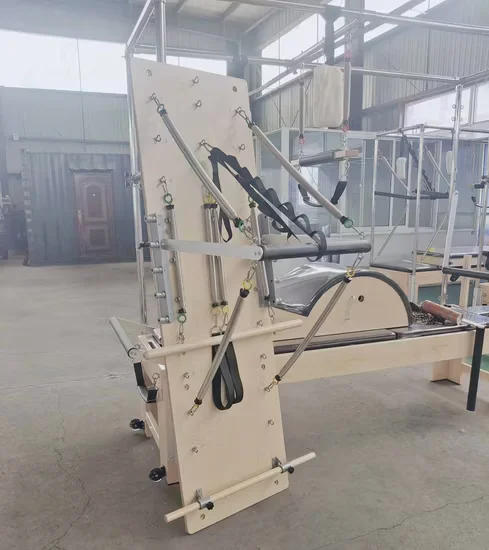
Vibration-Damped Wood Frame — Solid wood construction inherently absorbs spring resonance, preventing the metallic vibration transfer that triggers noise complaints in multi-tenant wellness floors.
Technical Specifications
| Parameter | Value |
|---|---|
| Product Type | Pilates Wall Board / Spring Board |
| Material | Wood |
| Accessory Options | Long Box / Jump Board / Platform |
| Product Dimensions | 1850 × 560 × 75 mm |
| Net Weight | 35 kg |
| Color | Solid Color (customizable) |
| Age Group | Adult |
| Gender | Unisex |
| Logo | Customized Is Allowed |
| Customization | Available |
| Warranty | 3 Years |
| Production Capacity | 800 Pieces/Month |
Application Suitability
| Deployment Scenario | Typical Use |
|---|---|
| Boutique Pilates studio | Wall-mounted spring resistance classes complementing reformer lines without expanding floor footprint |
| Hotel wellness center on guest room floors | Quiet, non-motorized resistance training for guests in noise-sensitive corridor environments |
| Rehabilitation and physiotherapy facility | Controlled, progressive spring tension for post-injury programming and joint-safe recovery sessions |
| Private home gym | Space-efficient wall-mounted unit delivering full-body spring resistance in residential settings |
| Corporate wellness room | Low-maintenance, non-electric equipment for employee fitness areas with limited HVAC capacity |
Why Spring Resonance Complaints Reach Studio Owners Before the First Month Ends
Wood-frame engineering eliminates the metallic vibration path that steel-frame wall boards transmit into shared walls.
I have walked into boutique studios three months after opening and found the owner already fielding complaints from the tenant next door. The steel-frame spring board bolts directly into a party wall, and every rebound sends a low-frequency pulse through the structure. Multiply that by six units running simultaneously in a group class, and the vibration becomes impossible to ignore [NEED_CITE: acoustic transmission standards for fitness equipment in multi-tenant commercial buildings]. The commercial Pilates spring wall board described here takes a fundamentally different approach: a solid wood chassis acts as a natural damper, absorbing oscillation before it reaches the mounting surface. This matters most in hotel wellness floors and shared-wall studio spaces where acoustic isolation is not optional.
Positioning Within the Studio Equipment Mix
This unit fills a specific gap in the cardio-and-conditioning zone: it delivers full-body spring resistance without the footprint of a reformer or the ceiling clearance demands of a trapeze table. In a studio layout, it pairs naturally with reformer lines, giving instructors a wall-mounted option for standing, kneeling, and supine progressions that do not require carriage-based equipment. The commercial Pilates spring wall board accommodates adult users across a wide anthropometric range, and the modular accessory ecosystem — long box, jump board, platform — extends programming into plyometric and supported stretching work. It suits medium-to-high use density environments where floor space is at a premium and equipment must serve multiple class formats throughout the day.
Continuous Deployment in Noise-Sensitive Floors
A wall-mounted spring board generates no motor noise, no fan whir, and no electronic hum — the only acoustic output is spring stretch and release, which the wood frame dampens considerably. For hotel wellness centers on guest room floors, this non-motorized profile means the unit can operate at any hour without triggering corridor noise thresholds [NEED_CITE: hotel fitness center acoustic guidelines for guest-adjacent installations]. Deployment still requires attention to wall anchoring integrity and load distribution across studs, particularly when multiple units are mounted on a single partition. Ventilation and HVAC demands are negligible since there is no heat-generating motor. Ground-level installations should account for accessory clearance — the long box and jump board extend the functional envelope beyond the 1850 mm board height.
Spring Tension Calibration and Frame Material Logic
The choice between wood and steel framing is not aesthetic — it is acoustic. Steel transmits vibration efficiently, which is why steel-frame wall boards in shared-wall studios frequently generate structural resonance complaints. Wood, by contrast, has internal damping properties that dissipate vibrational energy before it reaches the mounting surface. The spring resistance mechanism itself produces a linear, progressive tension curve: as the spring extends, resistance increases proportionally, giving users predictable loading through the full range of motion. Maintenance centers on periodic spring tension inspection and attachment-point lubrication rather than motor servicing or electronic calibration. The solid-color finish supports brand-consistent deployment across multi-site studio chains, and custom logo application allows franchise operators to maintain visual identity without aftermarket modification [NEED_CITE: commercial spring tension calibration standards for group fitness equipment].
The Hidden Cost of Under-Specifying Wall-Mounted Resistance
Studios that select wall boards based on price alone often discover the real cost months later. Springs that lack proper calibration produce uneven tension between attachment points, causing users to compensate with asymmetrical movement patterns. Steel frames that transmit vibration into party walls generate tenant complaints and, in worst cases, lease termination threats. Accessories that are sold separately rather than included in the base configuration inflate the total project cost well beyond the initial quote. In rehabilitation settings, inconsistent spring tension can compromise post-injury programming where controlled, predictable resistance is non-negotiable [NEED_CITE: physiotherapy equipment resistance consistency requirements for clinical rehabilitation]. These failures are not catastrophic — they are cumulative, eroding member confidence and increasing equipment replacement frequency.
Why This Product Line Addresses Those Failure Modes
The wood-frame construction is specifically chosen for vibration damping in shared-wall and multi-floor deployments. The 10,000-hour durability testing framework applied across this product family extends to spring fatigue and attachment-point integrity, not just motor and bearing life. Full OEM and ODM capability covers color, logo, and accessory configuration, allowing multi-site operators to standardize without managing multiple vendors. The six-series cardio family means a facility can source treadmills, bikes, ellipticals, rowers, climbers, and this spring board from one engineering team with consistent documentation standards. Free 3D layout planning accounts for wall-mounted unit clearance, accessory swing radius, and member flow between stations — not just floor-standing equipment spacing. Technical support covers commissioning guidance and spring replacement procedures around the clock.
Documentation & Test Records
- CE declaration of conformity for the wall board assembly and spring components
- EN 957 test report covering static load and spring fatigue performance
- ISO 9001 certificate for the manufacturing and quality management process
- Noise level test report documenting wood-frame vibration damping characteristics
- Durability test record for spring tension retention over extended use cycles
- Installation and commissioning guide with wall anchoring specifications and spare parts list
Installation, Commissioning & Maintenance
- Verify wall stud spacing and load rating before mounting the 1850 × 560 mm board
- Use vibration-isolating fasteners at each anchor point to complement wood-frame damping
- Allow full accessory swing radius clearance for long box and jump board deployment
- Inspect spring tension calibration and attachment hardware after the first 200 use hours
- Lubricate spring mounting eyes and pivot points per the included maintenance schedule
- Clean wood surfaces with pH-neutral solutions to protect the solid-color finish from sweat residue
Equipment Selection Starts With Your Space and Usage Profile
Provide your studio floor plan, wall dimensions, and intended class schedule so the layout team can model unit spacing, accessory clearance, and member flow around the wall-mounted positions. Specify the deployment floor and adjacent room types to confirm that wood-frame acoustic performance matches your building’s noise isolation requirements. Indicate whether accessories — long box, jump board, platform — should be included in the base configuration or phased as programming expands. For multi-site rollouts, share brand color and logo specifications early to align customization lead times with your opening schedule.
Frequently Asked Questions
Q: Wood vs. steel frame — which performs better in noise-sensitive commercial spaces?
A: Wood inherently dampens vibration before it reaches the mounting wall, reducing structural resonance transfer. Steel frames conduct spring oscillation efficiently into the building structure, which is why steel-frame units in shared-wall studios frequently trigger neighbor complaints. For hotel wellness floors and multi-tenant buildings, wood-frame construction is the more defensible choice acoustically.
Q: How does spring wall resistance compare to reformer carriage resistance for joint loading?
A: Spring wall boards produce a linear, progressive tension curve similar to reformer springs but applied through fixed attachment points rather than a moving carriage. This means the user controls body positioning against a stationary resistance vector. Joint loading remains low and predictable, making the format suitable for rehabilitation environments where controlled progression matters.
Q: What maintenance does a spring wall board require over its service life?
A: Maintenance is limited to periodic spring tension inspection, attachment-point lubrication, and hardware torque checks at mounting bolts. There are no motors, belts, or electronic components requiring scheduled service. Wood-frame units additionally benefit from surface cleaning with pH-neutral solutions to protect the finish from sweat and humidity accumulation.
Q: Can the unit be customized for brand color and logo across a multi-studio chain?
A: Yes. Solid-color finish and logo customization are available, allowing franchise operators to standardize visual identity across locations. Customization scoping happens during the inquiry stage so that lead times align with project opening schedules. OEM and ODM options cover color, branding, and accessory configuration.
Q: What accessory options expand the programming capability of a wall-mounted spring board?
A: The long box enables supported supine and seated exercises at varying heights. The jump board adds plyometric and lower-body power progressions. The platform extends the functional surface for standing and kneeling work. Together, these accessories allow one wall-mounted chassis to cover programming that would otherwise require multiple dedicated pieces of equipment.


