
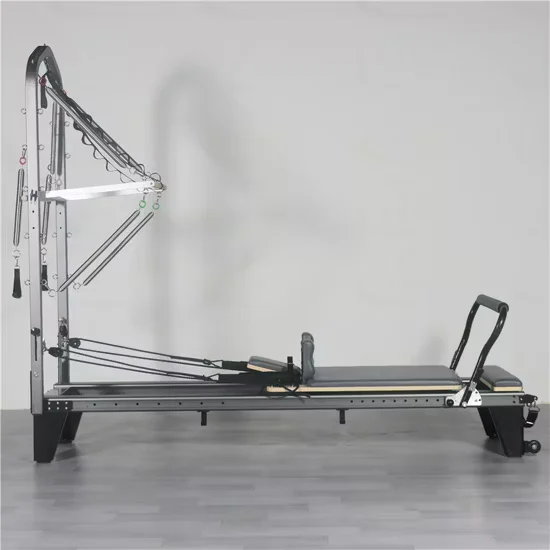
Whisper-quiet glide and structural rigidity — low-friction rails and reinforced steel frames keep the commercial Pilates reformer with tower silent during continuous studio sessions.
Technical Specifications
| Parameter | Value |
|---|---|
| Product Type | Pilates Reformer |
| Model NO. | SRY-11 |
| Resistance Type | Spring-based |
| Spring Stages | Multiple progressive levels |
| Frame Material | Reinforced commercial-grade steel |
| Rail System | Precision bearing with low-friction track |
| Max User Weight | 180 kg |
| Product Dimensions | 2390 × 900 × 1960 mm |
| Net Weight | 120 kg |
| Included Accessories | Long Box, Jump Board, Platform |
| Tower Attachment | Integrated spring-resistance system |
| Color | Black (OEM color options available) |
| Logo | Customized is allowed |
| Warranty | 3 Years |
| Certification | ISO 9001, CE |
| Production Capacity | 80 Pieces / Month |
Application Suitability
| Deployment Scenario | Typical Use |
|---|---|
| Boutique Pilates studio | Group reformer classes with tower-based resistance progressions |
| Five-star hotel fitness center on guest room floors | 24-hour access with minimal noise transfer to adjacent rooms |
| Chain gym Pilates zone | High-frequency member scheduling across multiple daily sessions |
| High-end residential community gym | Shared facility requiring low acoustic footprint and compact footprint |
| Corporate wellness center | Employee movement programs during shift breaks |
Why Vibration Complaints Start Before the First Class Ends
Rigid frames and precision rails eliminate the rattle that cheaply built reformers broadcast through multistory buildings.
Studio operators in mixed-use developments hear it within weeks: spring oscillation traveling through lightweight frames, carriage wheels chattering on worn tracks, tower uprights flexing under load. Members notice the vibration through the footbar before they notice the workout. Those complaints land on the property manager’s desk long before maintenance gets a call [NEED_CITE: vibration transmission through floor-mounted fitness equipment in commercial buildings]. A commercial Pilates reformer with tower must isolate movement internally rather than pass it into the structure around it.
Where This Reformer Fits Inside a Mixed-Modality Studio
This full-size unit supports classical and contemporary Pilates protocols spanning supine footwork through advanced tower-based arm and spinal articulation sequences. In a studio layout, it complements mat zones and cadillac stations by absorbing the bulk of intermediate-to-advanced programming demand. The 2390 mm footprint fits standard studio bays, and the integrated tower eliminates the need for a separate wall-mounted unit. Users across a broad height and weight range work within the same rail travel and spring-tension envelope. The commercial Pilates reformer with tower bridges the gap between mat-only classes and full apparatus sessions without requiring additional floor area.
Continuous Scheduling and the Acoustic Envelope Around the Unit
Studios running back-to-back classes from early morning through late evening demand equipment that does not accumulate noise as bearings heat and rails expand. The sealed bearing carriage maintains consistent glide whether it is the first session or the eighth of the day. Tower springs undergo cyclic loading and release hundreds of times per class; fatigue-tested springs keep tension predictable across weeks of continuous scheduling [NEED_CITE: spring fatigue testing standards for commercial resistance equipment]. Floor-mounted deployment requires level substrate and vibration-isolating pads to prevent structure-borne transfer to occupied rooms below. Voltage considerations do not apply to this mechanically driven apparatus, simplifying international deployment.
Engineering Behind the Rail and Spring Assembly
The carriage travels on precision bearings within a low-friction track profile, reducing lateral play that causes the rattling sound associated with worn reformers. Spring resistance in the tower section operates independently from the carriage springs, allowing instructors to layer limb loading against spinal stabilization. Heavier spring gauges provide the progressive tension curve needed for advanced practitioners, while lighter springs accommodate rehabilitation and introductory sessions. The reinforced steel frame is welded and surface-treated to resist the sweat and humidity typical of enclosed studio environments. Each spring group undergoes fatigue cycling to confirm that resistance decay remains within acceptable limits before replacement intervals.
The Hidden Price of Compromising on Frame and Rail Quality
Reformers built to residential duty cycles develop carriage wobble within months of studio use, forcing operators into unplanned downtime and member rescheduling. Springs that have not been fatigue-rated lose tension unpredictably, creating safety concerns during overhead tower work. Noise from degraded rails and loose fittings drives complaints from neighboring tenants in mixed-use buildings, sometimes triggering lease review clauses [NEED_CITE: acoustic compliance requirements for fitness equipment in commercial tenancy agreements]. Operators who replace an entire fleet after eighteen months spend far more than those who specified commercial-grade construction from the start.
Why Operators Source This Product Line for Studio Buildouts
Sub-35dB acoustic performance verified across cardio deployments translates directly to reformer studios sharing walls or floors with occupied spaces. The 10,000-hour durability protocol applied to motors and bearings in the cardio range informs the same testing discipline applied to rail and spring assemblies here. The complete six-series cardio family allows a facility to source treadmills, bikes, and ellipticals from one supplier alongside Pilates apparatus, consolidating vendor management. OEM customization covers logo, color, and accessory configuration so the reformer matches studio branding. Free 3D studio layout and airflow planning accounts for the 2390 mm length plus required clearance on all sides, ensuring member circulation without bottlenecking between units.
Documentation & Test Records
- CE declaration of conformity covering the complete unit assembly
- EN 957 test report for structural integrity and user safety
- ISO 9001 certificate for manufacturing quality management
- Spring fatigue test record with tension decay data
- Rail noise level measurement at operational load
- Spare parts list with spring replacement intervals
Installation, Commissioning & Maintenance
- Allow minimum 600 mm clearance on all sides of the 2390 × 900 mm footprint for safe carriage travel
- Level substrate and place vibration-isolating pads beneath all four frame contact points
- Inspect carriage bearing glide and rail alignment during first-week commissioning
- Check spring tension consistency monthly and replace per fatigue test schedule
- Wipe down steel frame and vinyl upholstery after each session to prevent sweat corrosion
Planning Your Equipment Inquiry
Share your studio square footage and target unit count to receive a 3D layout with member flow and equipment spacing mapped to your floor plan. Specify whether the reformer will sit on an upper floor with occupied space below so that acoustic isolation recommendations match your building structure. Indicate any OEM requirements including logo placement, frame color, and accessory bundles. Confirm your target market to ensure compliance documentation matches local regulatory requirements.
Frequently Asked Questions
Q: How does the rail system influence noise levels and maintenance frequency?
A: Precision bearings within the low-friction track reduce lateral carriage play that generates rattling during repetitive movements. Sealed bearings resist dust and sweat ingress, extending service intervals compared to open-track designs. Consistent glide performance means fewer mid-class disruptions and reduced need for emergency maintenance calls during peak scheduling windows.
Q: How do the tower springs interact with carriage springs during exercises?
A: The tower spring group operates on an independent resistance circuit, allowing instructors to apply limb loading while the carriage springs handle spinal and pelvic stabilization work. This dual-system arrangement supports advanced protocols that require simultaneous upper and lower body tension without overloading a single spring bank.
Q: What distinguishes commercial-grade from residential reformer construction?
A: Commercial units use reinforced steel frames, fatigue-rated springs, and sealed bearing carriages tested for continuous daily scheduling. Residential reformers typically use lighter frame gauges and non-rated springs that degrade under high-frequency class rotation. The structural margin in commercial equipment prevents the unplanned downtime and fleet replacement cycles that erode studio profitability.
Q: How should studio dimensions inform reformer placement decisions?
A: Each unit requires its 2390 × 900 mm footprint plus surrounding clearance for instructor access and safe movement transitions. A 3D layout service accounts for member circulation paths, tower upright height clearance, and spacing between adjacent units to prevent bottlenecking during group class choreography.
Q: What OEM options are available and how is minimum order quantity handled?
A: Customization covers logo application, frame color selection, and accessory bundle configuration including long box and jump board options. Minimum order quantities remain flexible to accommodate single-studio buildouts as well as multi-location rollout programs. Contact the sales team with your branding specifications for a detailed scope.
![Folding Reformer Bed Wholesale Home Use Balanced Pilates Reformer [WARN] draft identifier mismatch](https://bicksport.com/wp-content/uploads/2026/08/folding-reformer-bed-wholesale-home-use-balanced-pilates-reformer-warn-draft-identifier-mismatch-5e8012.webp)

![Commercial Foldable Aluminum Pilates Reformer Bed for Home Studio [WARN] draft identifier mismatch](https://bicksport.com/wp-content/uploads/2026/08/commercial-foldable-aluminum-pilates-reformer-bed-for-home-studio-warn-draft-identifier-mismatch-a7cd88.webp)
![2025 Wholesale Pilates Wall Unit Wood Sliding Reformer with Full Tracking [WARN] draft identifier mismatch](https://bicksport.com/wp-content/uploads/2026/08/2025-wholesale-pilates-wall-unit-wood-sliding-reformer-with-full-tracking-warn-draft-identifier-mismatch-04e46e.webp)