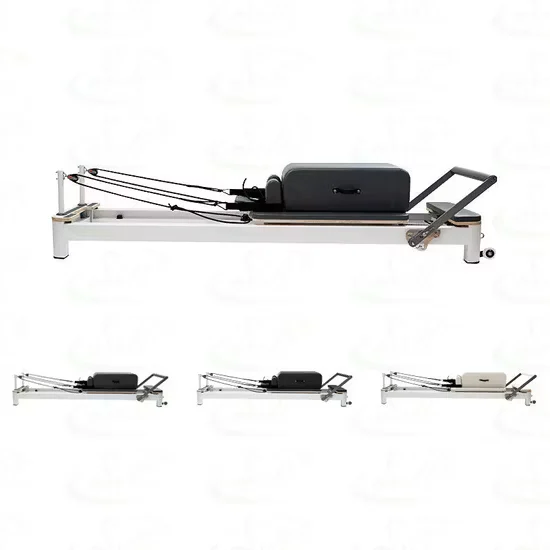
![Commercial Pilates Reformer Machine for Yoga Studio Pilates Training [WARN] draft identifier mismatch](https://bicksport.com/wp-content/uploads/2026/08/commercial-pilates-reformer-machine-for-yoga-studio-pilates-training-warn-draft-identifier-mismatch-ed91bb.webp)
Whisper-Quiet Glide — Magnetic resistance and sealed rail bearings keep operation below 35 dB even during high-repetition rebound work.
Technical Specifications
| Parameter | Value |
|---|---|
| Product Type | Pilates Reformer |
| Model NO. | SRY-02 |
| Resistance Type | Magnetic with spring-assist option |
| Noise Level | < 35 dB |
| Frame Material | Reinforced commercial-grade steel |
| Bearing Type | Sealed precision bearings |
| Accessories Included | Long Box / Jump Board / Platform |
| Product Dimensions | 2460 × 730 × 680 mm |
| Net Weight | 100 kg |
| Color | Solid Color (custom colors available) |
| Logo | Customized Is Allowed |
| Max User Weight | 180 kg |
| Certification | CE, EN 957, ISO 9001 |
| Warranty | 3 Years |
Application Suitability
| Deployment Scenario | Typical Use |
|---|---|
| Hotel fitness center on guest room floors | 24-hour low-noise Pilates sessions without disturbing adjacent rooms |
| Chain Pilates studio cardio-and-movement zone | High-frequency group classes with back-to-back scheduling |
| Corporate wellness room | Lunchtime and after-work individual or small-group reformer sessions |
| High-end residential home gym | Private daily practice in shared living environments |
| Yoga and Pilates studio | Mixed mat-and-reformer class rotations throughout the day |
Why Noise Complaints Reach the Front Desk Before Maintenance Does
Magnetic resistance eliminates metal-on-metal friction that traditional spring-only reformers generate under repeated load.
In hotel deployments, a reformer placed above occupied guest rooms transmits low-frequency vibration through the floor slab every time the carriage reverses direction. Front desk logs show that noise complaints spike within the first week of installation, long before any mechanical failure appears [NEED_CITE: noise complaint patterns in hotel fitness floors with reformer equipment]. Traditional spring carriages develop audible creaking as coils fatigue, and the rattling propagates through concrete at frequencies that standard acoustic underlayment cannot block. Switching to a magnetic resistance path with sealed bearings removes the primary vibration source at the carriage level, keeping the commercial pilates reformer machine for yoga studio environments below the threshold where structural transmission becomes a guest issue.
Where This Reformer Sits in a Mixed-Discipline Movement Space
The SRY-02 covers the full resistance spectrum from rehabilitation-level assisted movements to advanced jump-board plyometrics, filling the gap between mat-only zones and heavy strength equipment. In a studio layout it pairs with Cadillac towers for decompression work and sits adjacent to mat areas for warm-up flow sequences. The 2460 mm footprint allows two-unit side-by-side placement in standard group class bays while maintaining instructor walk-through clearance. With a 180 kg user rating, the frame accommodates the full adult population without load-limiting lighter participants. The magnetic system lets instructors adjust resistance between clients without swapping springs mid-class, keeping session transitions tight.
Continuous Scheduling and Floor-Level Deployment Constraints
Back-to-back class scheduling means the carriage runs near-continuously for ten or more hours daily, demanding bearings and rails that resist heat buildup without active cooling. Deploying on upper hotel floors or above retail spaces requires verified sub-35 dB output because low-frequency carriage reversal pulses travel through slabs regardless of room insulation [NEED_CITE: structural vibration transmission thresholds for commercial fitness equipment on elevated floors]. Adequate cross-ventilation around the 2460 mm length prevents sweat and humidity from corroding the sealed bearing housings over time. A dedicated 220–240 V circuit with surge protection is recommended when multiple units share a single studio bay to avoid voltage sag during simultaneous jump-board sets. Leveling feet must contact a flat subfloor; uneven surfaces introduce lateral carriage drift that accelerates rail wear.
Reading the Magnetic Drive and Frame Specifications
Magnetic resistance generates braking force through eddy currents rather than physical contact, so the resistance curve stays linear across the full carriage travel without the hysteresis typical of aging coil springs. Sealed bearings prevent dust and chalk ingress that would otherwise increase rolling friction and introduce audible grinding within months of studio use. The reinforced steel frame absorbs the lateral forces produced during single-leg work and jump-board landings, keeping the rail alignment within tolerance over years of asymmetric loading. A 100 kg net weight anchors the unit against carriage-driven oscillation, eliminating the need for floor bolting in most commercial installations [NEED_CITE: EN 957 stability requirements for floor-standing resistance equipment]. The included long box, jump board, and platform extend the movement catalog without requiring separate equipment purchases, consolidating procurement for multi-discipline studios.
The Hidden Cost of Specifying Below Commercial Grade
Residential-rated reformers installed in high-throughput studios typically show rail scoring and bearing play within the first quarter, forcing carriage replacements that cost more in downtime than the original unit savings. Spring-only systems that lack magnetic assist develop uneven tension across coils, creating a resistance profile that drifts from the instructor’s prescribed load and erodes member trust in programmed progressions. Studios that skip acoustic underlayment on upper floors face lease renegotiation or forced relocation of the reformer zone to basement spaces with lower foot traffic and visibility. Units without OEM console or branding options lock operators into generic visual identity, preventing franchise chains from maintaining brand consistency across locations [NEED_CITE: facility reconfiguration costs driven by equipment noise complaints].
Why This Product Line Earns Its Floor Space
Sub-35 dB operation has been verified in live hotel deployments where the reformer sits directly above sleeping guests, not just in anechoic lab conditions. Components undergo 10,000-hour continuous cycle testing that simulates the carriage reversals and jump-board impacts of a fully booked studio schedule. Full OEM and ODM coverage extends to frame color, logo placement, and accessory bundling, letting each venue align the equipment visually with its interior design language. A free 3D layout service maps the 2460 × 730 mm footprint against studio square footage, instructor sightlines, and HVAC airflow to prevent dead zones where equipment sits unused. Round-the-clock technical support ensures that a seized bearing or misaligned rail gets diagnosed remotely before it cancels the next morning’s class.
Documentation & Test Records
- CE declaration of conformity covering the SRY-02 magnetic resistance system
- EN 957 test report validating structural load and stability performance
- ISO 9001 certificate for manufacturing quality management
- Noise level test report confirming sub-35 dB carriage operation
- Durability test record documenting 10,000-hour continuous cycle results
- Accessory specification sheets for long box, jump board, and platform
Installation, Commissioning & Maintenance
- Maintain 600 mm clearance on each side of the 2460 mm frame for instructor access
- Level all four feet on a flat subfloor before loading the carriage with user weight
- Connect to a dedicated 220–240 V surge-protected circuit when deploying multiple units
- Verify carriage travel smoothness and magnetic resistance engagement on first commissioning
- Inspect sealed bearings and rail surfaces quarterly for chalk buildup or lateral play
- Wipe frame and upholstery after each session to prevent sweat corrosion on steel joints
Planning Your Reformer Deployment
Share your studio floor plan and target unit count to receive a 3D layout that positions each reformer within instructor sightlines and HVAC airflow paths. Specify whether the deployment floor sits above occupied spaces so acoustic requirements can be confirmed against the sub-35 dB test data. Confirm the local voltage and plug standard for your market before production begins to avoid adapter-related warranty gaps. Indicate whether branded frame colors or custom logo placement are needed to match your studio’s visual identity across all locations.
Frequently Asked Questions
Q: How does a Pilates reformer differ from a Cadillac in studio planning?
A: A reformer focuses on horizontal carriage-based resistance work for core and limb conditioning, while a Cadillac provides a raised table with overhead bars and springs for vertical and decompression exercises. Most commercial studios deploy both to cover full movement catalogs, allocating floor space for the reformer’s longer footprint and the Cadillac’s overhead clearance requirements.
Q: How can I verify the noise level suits my venue before ordering?
A: Request the noise level test report that documents carriage operation decibel readings under load. Compare these figures against your local building’s background noise floor and any lease clauses governing fitness equipment on shared floors. For deployments above guest rooms or residential units, the sub-35 dB rating typically falls below structural transmission thresholds.
Q: What maintenance differences exist between magnetic and spring resistance?
A: Magnetic resistance systems have no physical contact between braking elements, so they avoid the coil fatigue and tension drift that springs develop over thousands of cycles. Maintenance focuses on keeping rails clean and sealed bearings free of chalk dust, rather than periodically replacing worn spring sets. This reduces both scheduled downtime and consumable costs.
Q: Does the reformer connect to studio management software?
A: The SRY-02 in its standard configuration is a mechanically driven reformer without an electronic console, so it does not output digital session data. Studios requiring usage tracking typically pair it with separate wearable or mat-based monitoring systems. If integrated data capture is needed, discuss custom console options during the OEM scoping phase.
Q: What daily maintenance extends the reformer’s service life?
A: Wipe the carriage rails, frame, and upholstery after every session to remove sweat and chalk residue that accelerates corrosion. Check leveling feet monthly to prevent lateral drift caused by floor settlement. Inspect the long box, jump board, and platform attachment points quarterly for loosened hardware, tightening to specified torque values.

![Oak Pilates Reformer Machine with Spine Corrector for Pilates Studio [WARN] draft identifier mismatch](https://bicksport.com/wp-content/uploads/2026/08/oak-pilates-reformer-machine-with-spine-corrector-for-pilates-studio-warn-draft-identifier-mismatch-358fe5.webp)