![Commercial Maple Wood Pilates Reformer Machine for Studio Gym [WARN] draft identifier mismatch](https://bicksport.com/wp-content/uploads/2026/08/commercial-maple-wood-pilates-reformer-machine-for-studio-gym-warn-draft-identifier-mismatch-4abe00.webp)
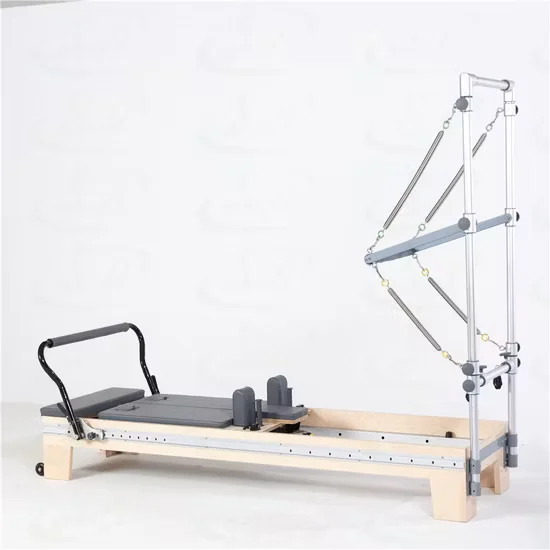
Whisper-Quiet Glide — Solid maple wood carriage rail naturally dampens vibration, enabling deployment on shared-wall studio floors without transmitting mechanical noise to adjacent rooms.
Technical Specifications
| Parameter | Value |
|---|---|
| Product Type | Pilates Reformer |
| Designation | SRY-02 |
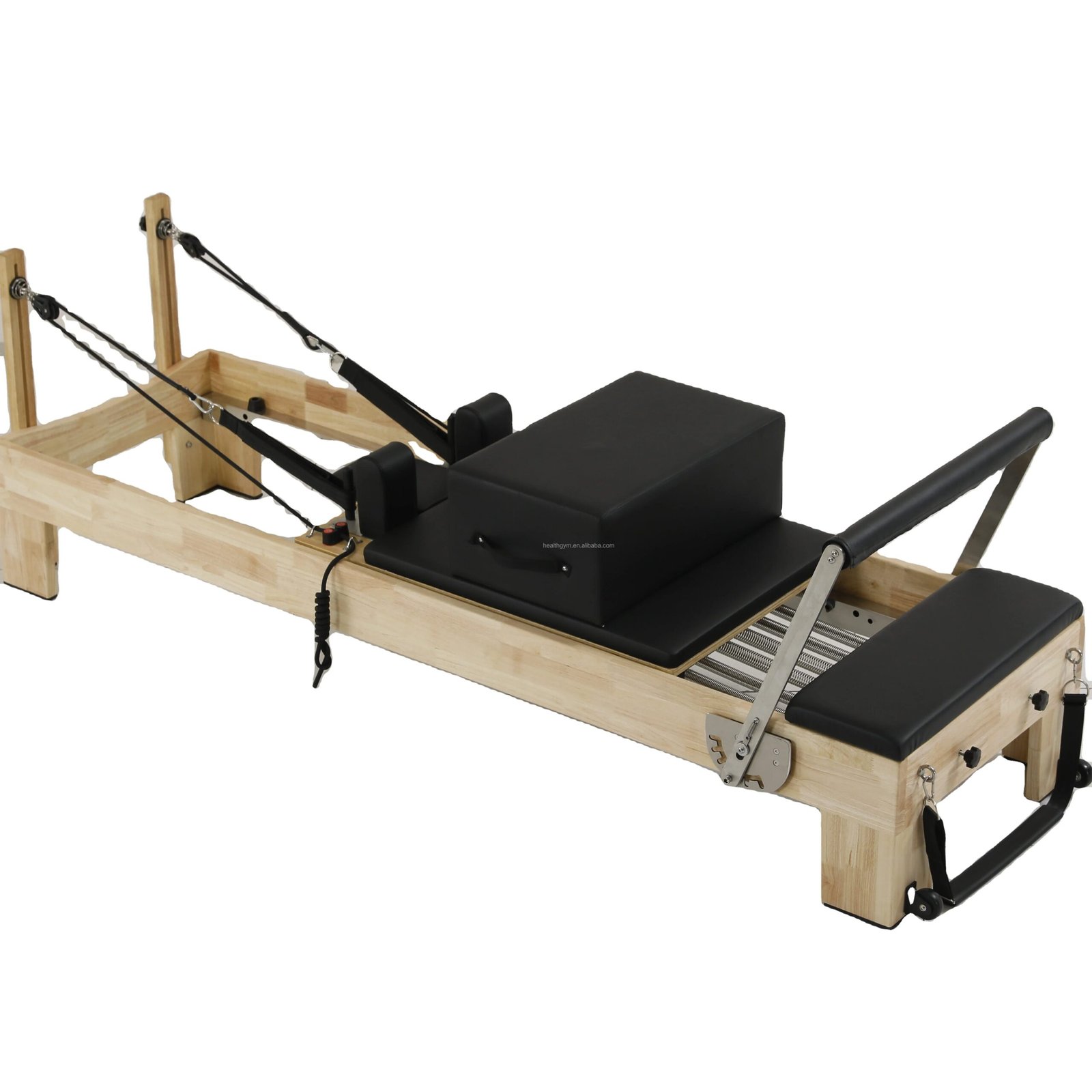
| Frame Material | Solid Maple Wood Carriage Rail with Steel-Reinforced Subframe |
| Resistance Type | Progressive Spring System |
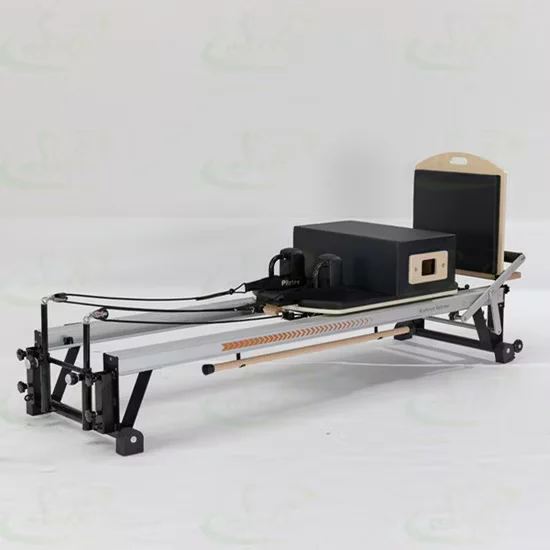
| Accessories Included | Long Box, Jump Board, Platform |
| Product Dimensions | 2460 × 730 × 680 mm |
| Net Weight | 100 kg |
| Max User Weight | Not specified |
| Foldable | No |
| Color | Solid Color (custom options available) |
| Logo | Customized Is Allowed |
| Warranty | 3 Years |
| Certification | HS Code 9506911900 |
Application Suitability
| Deployment Scenario | Typical Use |
|---|---|
| Boutique Pilates studio on upper commercial floors | Multi-class-per-day scheduling with low carriage noise transmission |
| Hotel wellness center with shared-wall guest suites | Quiet reformer sessions between occupied rooms without spring rattle complaints |
| High-end residential home gym | Daily personal practice with natural wood aesthetics matching interior finishes |
| Rehabilitation and physical therapy clinic | Controlled progressive resistance for guided recovery programming |
| Corporate wellness room | Employee wellness classes in sound-sensitive open-plan office environments |
Why Carriage Rattle Travels Through Flooring Before Anyone Notices
Maple wood rail construction absorbs vibration at the source rather than transmitting it through the subframe.
Boutique studios and hotel wellness floors share a persistent problem: reformers with exposed springs and low-grade pulleys generate carriage rattle that travels through flooring into occupied spaces below. I have walked hotel floors at night listening to reformer glide noise from the corridor outside guest suites — and that low-frequency vibration is exactly what triggers maintenance calls [NEED_CITE: structural vibration transmission through commercial flooring assemblies]. The commercial Pilates reformer machine maple wood rail addresses this at the material level rather than relying on aftermarket damping pads.
Positioning Within a Group-Class or Private-Session Studio Layout
This commercial Pilates reformer machine maple wood unit covers full-repertoire mat and apparatus work — from foundational footwork sequences through advanced jump board plyometrics — within a single 2460 mm footprint. In studio configurations, it pairs with mat zones and small apparatus stations (stability chairs, barrels) to support rotation-based class formats where members move between equipment stations. The 730 mm width allows side-by-side deployment with adequate instructor clearance, while the platform and long box accessories enable full-discipline programming without swapping equipment mid-session.
Continuous Scheduling and Studio Environment Requirements
A reformer operating across six to eight daily group classes requires sealed pulley bearings that maintain smooth transition movements without generating audible mechanical friction [NEED_CITE: bearing lifespan under continuous commercial reformer scheduling]. Floor-level deployment minimizes vibration transmission, but upper-floor studios should verify subfloor rigidity — flexible floor assemblies amplify carriage movement into neighboring spaces. Adequate clearance around the 2460 mm length supports instructor circulation during private sessions. Standard indoor climate control preserves the maple wood rail’s dimensional stability across seasonal humidity variation.
Maple Rail, Progressive Springs, and Sealed Pulley Bearings
Solid maple wood possesses natural damping characteristics that all-metal or laminate rail assemblies cannot replicate — the grain structure dissipates vibrational energy rather than conducting it through the frame. Progressive spring resistance delivers lighter tension at the start of carriage travel and heavier load at full extension, matching the biomechanical demand curve of most reformer exercises. Sealed pulley bearings eliminate the periodic lubrication cycles that exposed bearings require, reducing maintenance interruptions in high-scheduling studios. The accessory attachment system allows long box, jump board, and platform integration without additional fasteners, maintaining structural rigidity through repeated reconfiguration.
The Hidden Cost of Specifying Below Commercial Duty
Reformers built with laminate rails and unsealed pulleys may pass initial installation inspection, but carriage rattle emerges within months as bearing surfaces degrade under daily class scheduling. Studios in multi-tenant buildings face noise complaints from adjacent businesses — sometimes resulting in full equipment replacement rather than targeted maintenance [NEED_CITE: commercial fitness equipment replacement cost versus maintenance cost analysis]. Spring tension inconsistency across units within the same studio creates uneven class experiences when members rotate between machines, and accessory attachment points that require tools slow class transitions.
Why This Product Line Addresses Deployment Gaps
Sub-35dB acoustic standards developed for commercial cardio equipment apply equally to reformer glide noise — verifying carriage smoothness under load catches issues before deployment. The full accessory ecosystem (long box, jump board, platform) ships with the unit rather than arriving as aftermarket additions, reducing procurement coordination. OEM customization covers logo, color, and frame finish to align with studio interior design language at flexible MOQ. The manufacturer’s six-facility vertical integration — from CNC machining of rail components through final assembly and QC — supports consistent dimensional tolerance across production batches. Free 3D studio layout planning addresses reformer spacing, instructor circulation paths, and ventilation requirements before equipment ships.
Documentation & Test Records
- CE declaration of conformity for European market deployment
- EN 957 test report covering static and dynamic load verification
- ISO 9001 certificate confirming quality management system compliance
- Noise level test report documenting carriage glide acoustics under load
- Durability test record for spring and pulley system fatigue performance
- Maple wood rail dimensional stability and surface finish specification sheet
Installation, Commissioning & Maintenance
- Verify floor levelness across the 2460 × 730 mm footprint before frame assembly to prevent carriage drift
- Allow minimum 600 mm clearance at head and foot ends for safe carriage travel and instructor access
- Confirm spring tension progression matches class programming before opening studio scheduling
- Inspect pulley bearing smoothness quarterly and replace sealed units showing audible friction
- Clean maple wood rail with manufacturer-approved conditioner to preserve surface finish
- Verify accessory attachment points (long box, jump board, platform) lock securely before each class session
Scheduling a Specification Review
Provide studio floor area and planned reformer count to receive a 3D layout with instructor circulation and ventilation planning. Specify daily class scheduling volume to confirm spring and pulley duty-cycle alignment. Identify deployment floor level and adjacent occupied spaces to verify acoustic suitability. Confirm destination market for accessory documentation and compliance requirements. State whether OEM branding (logo, frame color) customization applies to the order.
Frequently Asked Questions
Q: How does maple wood rail performance compare to laminate or all-metal rail construction over extended use?
A: Solid maple wood absorbs vibrational energy through its natural grain structure, reducing carriage noise transmission compared to laminate or metal rails that conduct vibration through the frame. Over extended commercial use, maple maintains dimensional stability when kept in climate-controlled environments, while laminate surfaces may delaminate under humidity fluctuation. Metal rails require periodic lubrication to prevent friction noise, whereas maple’s self-damping properties reduce maintenance intervals.
Q: How should spring tension progression be matched to different class formats and participant levels?
A: Progressive spring systems deliver lighter resistance at the beginning of carriage travel and heavier load at full extension, supporting beginners through controlled initial movement while challenging advanced participants at peak extension. Studios running mixed-level classes typically configure medium-tension springs as baseline, swapping to lighter springs for rehabilitation sessions or heavier springs for athletic conditioning. Spring replacement follows a documented schedule based on observed tension drift rather than fixed calendar intervals.
Q: Which accessories support full reformer repertoire without requiring additional equipment purchases?
A: The included long box enables seated and supine upper-body work, the jump board supports plyometric lower-body programming, and the platform extends the carriage surface for advanced balance exercises. These three accessories cover the majority of classical and contemporary reformer exercises within a single unit. Studios requiring specialized apparatus (stability chairs, cadillacs, barrels) source those separately, but the standard accessory set supports comprehensive group-class and private-session programming.
Q: What elements support OEM customization, and how does branding scope affect production lead time?
A: OEM customization covers logo application, frame color selection, and upholstery finish to align equipment identity with studio interior design language. Flexible MOQ accommodates single-studio orders alongside multi-location chain deployments. Branding scope affects lead time primarily when custom color mixing or specialized logo application methods are specified — standard color options and conventional logo placement proceed through production without significant schedule extension compared to unbranded units.
Q: What floor loading, clearance, and airflow factors matter when planning a reformer studio layout?
A: Each unit’s 100 kg net weight distributes across the 2460 × 730 mm footprint, but dynamic loading during jump board exercises requires verifying floor structural capacity for upper-level deployments. Minimum 600 mm clearance at head and foot ends supports safe carriage travel and instructor circulation. Airflow planning addresses heat and humidity generated during group sessions — inadequate ventilation accelerates maple wood dimensional change and reduces member comfort during high-intensity programming.
![Senrui Fitness White Maple Wood Commercial Pilates Reformer Machine [WARN] draft identifier mismatch](https://bicksport.com/wp-content/uploads/2026/08/senrui-fitness-white-maple-wood-commercial-pilates-reformer-machine-warn-draft-identifier-mismatch-8fa791.webp)