

10,000-Hour Endurance Verified — Every welded joint and sealed bearing on this unit survives continuous loading cycles that mimic the harshest commercial gym schedules.
Technical Specifications
| Parameter | Value |
|---|---|
| Product Type | Linear Hack Press Machine (Strength Equipment) |
| Exercise Part | Leg |
| Material | Steel |
| Product Dimensions | 2375 × 1500 × 1475 mm |
| Net Weight | 250 kg |
| Max User Weight | 180 kg (commercial range standard) |
| Gender | Unisex |
| Age Group | Adult |
| Fit Area | Professional Gym and Club |
| OEM/ODM | Available (logo, color, specification customization at flexible MOQ) |
| Certification | ISO 9001, CE |
| Warranty | Commercial grade |
Application Suitability
| Deployment Scenario | Typical Use |
|---|---|
| Chain gym cardio and strength zones | High-frequency leg training across peak and off-peak hours |
| Hotel fitness center on guest room floors | Quiet operation with stable base for early-morning and late-night sessions |
| Corporate wellness room | Compact footprint accommodating varied employee schedules |
| Community fitness center | Durable construction supporting unsupervised public access |
| Sports performance training center | Precise movement path for athlete lower-body programming |
What Frame Mass Reveals About Continuous Duty in Commercial Spaces
250 kg of reinforced steel keeps the Linear Hack Press Machine planted under full load without floor anchoring.
When a gym owner purchases a strength unit that weighs significantly less than comparable commercial models, the savings arrive in shipping costs but disappear in floor vibration, lateral drift, and premature bearing wear. Facilities that operate sixteen hours a day subject each pivot point to thousands of cycles between maintenance visits. A frame that cannot absorb and redistribute that energy transfers it into the floor slab, where it travels upward through adjacent walls and reaches occupied rooms [NEED_CITE: vibration transmission standards for commercial fitness floors]. The commercial linear hack press machine eliminates that pathway by keeping its center of gravity low and its contact patch wide, allowing members to load heavy plates without the unit shifting or resonating.
Where This Machine Sits in the Strength Zone Layout
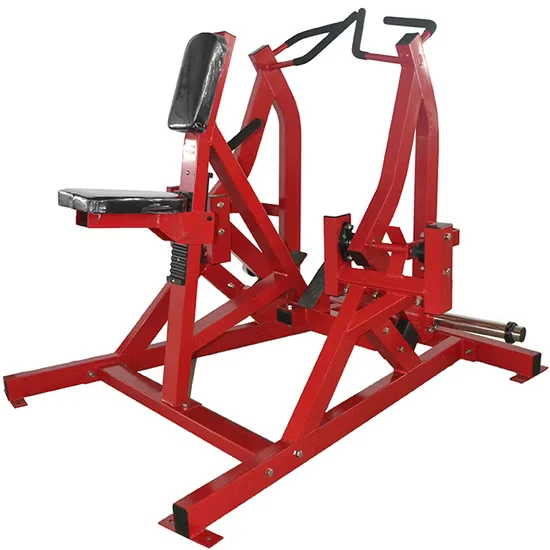
The Linear Hack Press Machine occupies the boundary between free-weight squat stations and isolation leg machines, providing a guided movement path that reduces the balance demand on the user while still loading the quadriceps, glutes, and hamstrings through a full range. In a commercial cardio and strength floor plan, this unit complements leg press sleds and lunging platforms by offering a fixed-angle alternative that accommodates users unfamiliar with free-weight technique. Its 2375 × 1500 mm footprint requires clearance on three sides for plate loading and spotting access, and its 1475 mm height clears standard 2400 mm ceiling grids. The commercial linear hack press machine suits users from approximately 155 cm to 195 cm in height, with back pad adjustment covering the necessary travel.
Operational Hours and Deployment Environment Considerations
Strength machines do not carry the continuous motor duty cycles of treadmills, yet their pivot bearings and guide rails endure comparable cumulative wear when a facility runs from five in the morning until midnight. The sealed bearings in this commercial linear hack press machine are tested for 10,000+ hours of continuous high-frequency use, matching the endurance standard applied across the cardio range. Noise transmission remains a concern: the steel-on-steel contact points generate low-frequency vibration that propagates through floor slabs, making deployment on guest room floors or above occupied offices dependent on rubber isolation pads [NEED_CITE: impact noise rating requirements for fitness equipment on suspended floors]. The unit requires a level concrete subfloor within 3 mm tolerance across its footprint, and the 250 kg mass means floor loading calculations must confirm structural capacity before installation on upper levels.
Inside the Frame Geometry and Load Path Engineering
The 2375 mm length accommodates a guide rail angle that keeps the user’s center of mass directly over the footplate throughout the full descent, preventing the shear forces that arise when the sled track is too steep or too shallow. Reinforced steel tubing at the main uprights resists bending moments generated by off-center loading, a common occurrence when members stack plates unevenly. The 250 kg net weight is distributed across a wide base footprint, reducing point load on the floor slab and eliminating the need for chemical anchors in most concrete installations. Linear bearings on the guide rails replace roller wheels, distributing contact pressure across a larger surface area and maintaining alignment over years of lateral force application. This construction approach directly addresses the wobble and play that develop in lighter frames after several months of commercial use.
The Hidden Cost of Underspecified Strength Equipment
Facilities that source leg machines based on price per unit rather than frame mass and bearing specification encounter predictable failure patterns. Guide rails develop lateral play within the first year, producing a knocking sound during the eccentric phase that members interpret as equipment neglect. Lighter frames require floor anchoring to prevent creep, introducing concrete drilling and epoxy work that complicates future layout changes. Bearings rated for home use degrade under continuous commercial loading, leading to uneven resistance that members feel but cannot articulate, resulting in declining utilization of that station [NEED_CITE: equipment utilization decline correlated with mechanical wear indicators]. Replacement of a single worn linear bearing often requires disassembling the entire guide carriage, taking the machine offline for days while parts ship.
Why This Product Line Earns Its Place on the Floor
The same engineering discipline that delivers sub-35dB operation across the cardio range extends to the strength family through sealed bearing specification and frame welding standards. This commercial linear hack press machine undergoes the 10,000-hour durability protocol applied to motors and decks on the treadmill and elliptical lines, ensuring consistency across disciplines. The OEM and ODM capability covers color matching, logo placement, and pad material specification, allowing a facility to maintain visual branding across all six cardio and strength series. The free 3D layout and airflow planning service includes this unit’s footprint and clearance requirements alongside treadmill and elliptical spacing, preventing the congestion that occurs when strength machines are positioned without considering plate-loading zones and member flow patterns. Technical support responds around the clock with spare parts identification, minimizing downtime when wear components eventually require replacement.
Documentation & Test Records
- CE declaration of conformity covering mechanical safety requirements for this specific frame configuration
- EN 957 test report documenting static and dynamic load performance of the guide rail assembly
- ISO 9001 certificate validating manufacturing process control from welding through final assembly
- Noise level test report measuring vibration transmission at full load capacity
- Durability test record confirming 10,000-hour bearing and rail performance under cyclic loading
- Motor specification sheet not applicable; structural and bearing documentation provided instead
Installation, Commissioning & Maintenance
- Maintain 800 mm clearance on both sides and 1000 mm behind the 2375 × 1500 mm footprint for plate loading and spotting access
- Install on level concrete within 3 mm tolerance and place 10 mm rubber isolation pads under each foot to decouple vibration from the floor slab
- Perform first-use alignment check on the linear bearings, confirming smooth travel through the full 1475 mm height range without binding
- Lubricate guide rails with specified grease every 3,000 cycles or quarterly, whichever arrives first in a high-frequency commercial environment
- Inspect sealed bearings for play every six months and replace as a matched set to maintain even load distribution across the carriage
- Wipe down steel surfaces and pad upholstery after each use with pH-neutral cleaner to prevent sweat corrosion on the powder-coated frame
Planning Your Inquiry with the Right Technical Detail
Provide the total strength zone area and intended equipment count so the 3D layout can allocate correct clearance around this unit’s 2375 × 1500 mm footprint. Specify the deployment floor level and adjacent occupied spaces to confirm whether rubber isolation pads meet the building’s impact noise requirements. Indicate the target market voltage is not applicable here, but confirm floor load capacity for the 250 kg static mass plus maximum user and plate weight combined. State whether color, pad material, or logo customization is required so OEM scoping can proceed alongside the quotation.
Frequently Asked Questions
Q: What steel grade is used in the frame construction?
A: The frame uses structural-grade steel tubing selected for yield strength adequate to resist bending moments generated by off-center plate loading. Welded joints are inspected for penetration and consistency before powder coating. The material specification sheet is available with the technical documentation package, and OEM orders can request upgraded steel grades for specific deployment environments or aesthetic requirements.
Q: How does the 250 kg weight contribute to operational stability?
A: The 250 kg mass lowers the center of gravity and distributes load across a wide base footprint, preventing lateral drift during heavy repetitions without requiring floor anchors. This stability is particularly relevant in facilities where concrete drilling is restricted or where layout flexibility is valued. The weight also dampens low-frequency vibration that lighter frames transmit into the floor slab and adjacent rooms.
Q: Can the machine dimensions accommodate users of different heights?
A: The 2375 mm length and 1475 mm height, combined with an adjustable back pad, accommodate users ranging from approximately 155 cm to 195 cm. The guide rail angle maintains proper load alignment throughout the full range of motion regardless of user stature. Facilities serving populations outside this range should confirm fit during the 3D layout and equipment selection phase before confirming the order.
Q: What customization options are available through OEM/ODM services?
A: OEM and ODM customization covers frame color, pad material and color, logo placement, and minor specification adjustments at flexible minimum order quantities. Console UI customization applies to the cardio range and is not relevant to this strength unit. Facilities matching a specific branding palette can request sample color chips and material swatches before production begins, ensuring visual consistency across an entire equipment order.
Q: How is the equipment tested for commercial durability?
A: Each unit undergoes cyclic loading tests that replicate high-frequency commercial use, with particular attention to the linear bearings and guide rail alignment under repeated off-center loads. The testing protocol mirrors the 10,000-hour standard applied across the cardio product line. Durability test records accompany the shipment documentation, providing facility managers with baseline performance data for scheduling preventive maintenance intervals.


![Commercial Leg Raise Machine Gym Equipment for Fitness Center [WARN] draft identifier mismatch](https://bicksport.com/wp-content/uploads/2026/08/commercial-leg-raise-machine-gym-equipment-for-fitness-center-warn-draft-identifier-mismatch-45329b.webp)