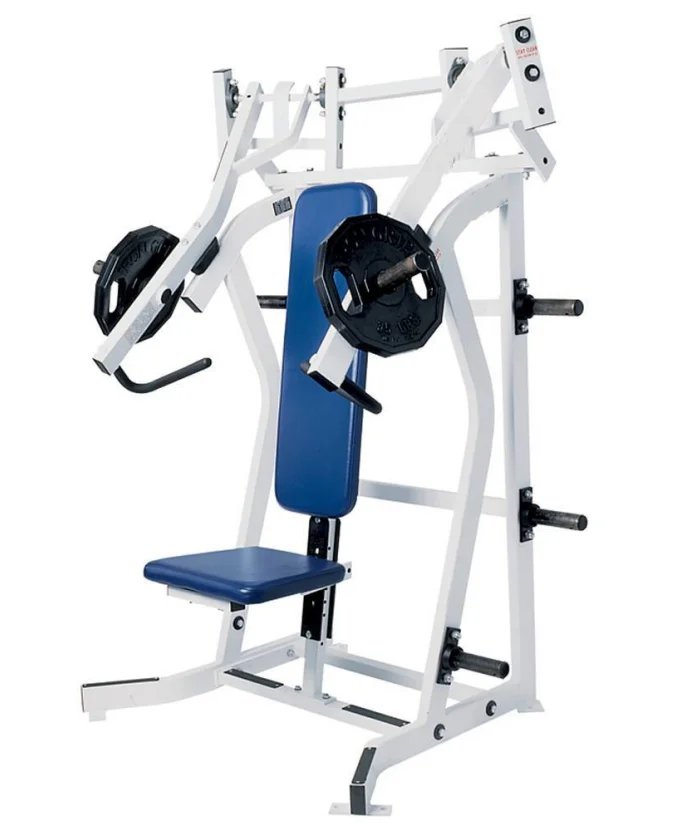
Reinforced Pivot Engineering — Precision-machined bearings and sealed pivot assemblies maintain smooth independent arm articulation through thousands of daily cycles in high-traffic commercial facilities.
Technical Specifications
| Parameter | Value |
|---|---|
| Product Type | ISO-Lateral Low Row Machine |
| Model NO. | 5005 |
| Exercise Part | Back |
| Frame Material | Steel |
| Resistance Type | Selectorized weight stack |
| Movement Pattern | ISO-Lateral independent arm |
| Max User Weight | 180 kg |
| Product Dimensions | 1250 × 1056 × 1700 mm |
| Net Weight | 139 kg |
| Age Group | Adult |
| Gender | Unisex |
| Certification | ISO 9001, CE |
Application Suitability
| Deployment Scenario | Typical Use |
|---|---|
| Chain gym strength training zone | High-frequency back development for general membership |
| Corporate wellness center | Balanced bilateral rowing for employees during short breaks |
| Community fitness facility | Durable back training accommodating varied fitness levels |
| Sports performance training center | Athlete-specific latissimus dorsi and mid-back conditioning |
| Hotel fitness room | Compact footprint back station for 24/7 guest access |
Why Pivot Wear Creates Complaints Before Maintenance Notices
Sealed precision bearings and reinforced pivot points prevent the grinding and stuttering that drive member complaints and premature equipment replacement.
When pivot assemblies use basic bushings instead of sealed bearings, lateral play develops within months under continuous commercial use. Members feel the hitch during the concentric phase, adjust their form to compensate, and start avoiding the station. By the time maintenance logs the issue, the ISO-Lateral Low Row Machine commercial gym equipment has already accumulated negative word-of-mouth across the floor [NEED_CITE: pivot bearing failure patterns in commercial strength equipment].
Positioning This Station Within the Strength Training Floor Plan
The ISO-Lateral Low Row Machine fills a specific gap between cable-based rowing stations and single-arm dumbbell work, delivering guided bilateral movement with independent arm tracking that exposes and corrects strength imbalances. It pairs naturally with high-pulldown and chest-press stations to complete a comprehensive upper-body circuit within a compact footprint. The 1250 × 1056 mm base fits standard commercial spacing grids while leaving adequate clearance for loading and dismounting. Users ranging from lighter recreational members to heavier athletes up to 180 kg can load the weight stack and train without frame deflection concerns.
Continuous Operation Demands on Structural Integrity
Commercial strength equipment endures a different duty profile than cardio machines — fewer moving parts but far higher peak loads per repetition. The reinforced steel frame must absorb repeated eccentric loading cycles without weld fatigue or fastener loosening over years of service. Facilities running 16-hour daily schedules need equipment that maintains structural rigidity without scheduled mid-life frame inspections [NEED_CITE: structural fatigue testing standards for commercial strength equipment]. Floor anchoring requirements depend on the subfloor composition, and vibration transfer through the frame to adjacent stations becomes a consideration in densely packed strength zones. Proper leveling during installation prevents uneven load distribution across the pivot assemblies.
Decoding the Engineering Behind Independent Arm Movement
ISO-Lateral design allows each arm to move independently along its own pivot axis rather than linking both handles to a single crossbar. This means a strength imbalance between left and right sides becomes immediately apparent — the stronger side cannot mask the weaker side as it would on a fixed-bar machine. The sealed pivot bearings reduce friction at the articulation point, which directly affects how smooth the eccentric return feels under load. A 139 kg net weight indicates substantial steel mass in the frame, which correlates with resistance to lateral flex during heavy unilateral loading. Selectorized weight stacks eliminate the plate-loading delays that slow traffic flow in busy commercial environments. The 1700 mm overall height keeps the center of gravity low enough to remain stable without ceiling-mounted anchoring.
What Specification Compromises Cost in Strength Equipment
Machines built with basic bushings instead of sealed bearings develop play within the first year of commercial deployment, creating a grinding sensation that members interpret as equipment failure. Underbuilt frames that flex under heavy eccentric loads accelerate weld fatigue and eventually develop visible cracking at stress concentration points. Selectorized stacks with low-grade guide rods generate scraping noise and uneven resistance that frustrates experienced lifters [NEED_CITE: commercial strength equipment failure modes in high-frequency facilities]. When these issues compound, the equipment gets tagged out-of-service, revenue per square meter drops, and replacement procurement begins — often at a premium for rush delivery.
Why This Product Line Addresses Those Failure Points
Every unit undergoes 10,000-hour durability testing on pivot assemblies and frame welds before leaving the production line, validating continuous operation in high-frequency commercial environments. The sub-35dB operational standard extends to strength equipment bearing surfaces, keeping the training floor acoustically controlled. Full OEM/ODM capability allows facility operators to specify frame color, upholstery, and weight stack increments that match their brand standards. The 3D strength-zone layout service accounts for this machine’s 1250 × 1056 mm footprint alongside adjacent stations, ensuring proper member flow and safe loading clearances. Documentation includes full pivot bearing specifications and maintenance intervals so facility teams can plan preventive service rather than react to failures.
Documentation & Test Records
- CE declaration of conformity covering structural and safety requirements
- EN 957 test report for stationary strength training equipment
- ISO 9001 certificate for manufacturing quality management
- Pivot bearing durability test record with cycle count validation
- Frame weld inspection and fatigue test documentation
- Selectorized weight stack calibration and guide rod specification sheet
Installation, Commissioning & Maintenance
- Maintain minimum 600 mm clearance on all sides for safe loading and dismounting around the 1250 × 1056 mm footprint
- Level the steel frame on solid flooring using adjustable feet before anchoring to prevent pivot misalignment
- Verify weight stack guide rods are lubricated and cables track smoothly during initial commissioning
- Inspect sealed pivot bearings for lateral play quarterly under the ISO-Lateral Low Row Machine commercial gym equipment maintenance schedule
- Wipe down upholstery and steel surfaces daily with pH-neutral cleaner to prevent sweat corrosion on the powder-coated frame
Request a Deployment Assessment
Provide your strength zone floor plan and equipment count to receive a 3D layout incorporating this station’s footprint and member flow requirements. Specify your facility’s daily operating hours so we can confirm the structural duty cycle matches your traffic volume. Indicate your target market and any regional compliance requirements for accurate documentation preparation. Note whether console data integration or facility management system connectivity is required for your operation.
Frequently Asked Questions
Q: How does ISO-Lateral independent arm design differ from fixed-bar rowing machines?
A: Fixed-bar machines link both handles to a single pivot, allowing the dominant side to compensate during the pull. ISO-Lateral independent arms move on separate axes, revealing strength imbalances between left and right sides. This makes the ISO-Lateral Low Row Machine commercial gym equipment particularly valuable for athletes and rehabilitation programs where balanced bilateral development is a priority.
Q: What maintenance interval applies to the sealed pivot bearings?
A: Sealed pivot bearings require no scheduled lubrication under normal commercial operation. Quarterly inspection for lateral play is recommended, with replacement triggered only if measurable wobble develops at the articulation point. This maintenance profile differs significantly from open bushing designs that demand monthly lubrication and generate friction noise as the bushing surface degrades over time.
Q: What spacing standards apply when placing this machine in a commercial strength zone?
A: Maintain a minimum 600 mm clearance on all sides of the 1250 × 1056 mm footprint for safe loading, dismounting, and member passage. Position the station so the seat faces away from high-traffic walkways. The 3D layout service accounts for adjacent equipment sightlines and ensures adequate airflow between stations in densely configured strength training areas.
Q: What is the maximum user weight capacity and structural testing standard?
A: The machine supports users up to 180 kg, validated through static and dynamic load testing per EN 957 requirements for commercial strength equipment. The reinforced steel frame and 139 kg net weight provide a stable platform that resists lateral flex even during heavy unilateral loading on the independent arm assemblies.
![Commercial Pendulum Squat Machine Strength Training Leg Press [WARN] draft identifier mismatch](https://bicksport.com/wp-content/uploads/2026/08/commercial-pendulum-squat-machine-strength-training-leg-press-warn-draft-identifier-mismatch-bd908a.webp)